PlayStation: What Choosing a Disc Really Meant
Before PlayStation reached shops, Sony had to prove its prototype to the people who might make its games. The original console brought together real-time 3D, disc production and a growing software library, with difficult choices for both its creators and its owners.
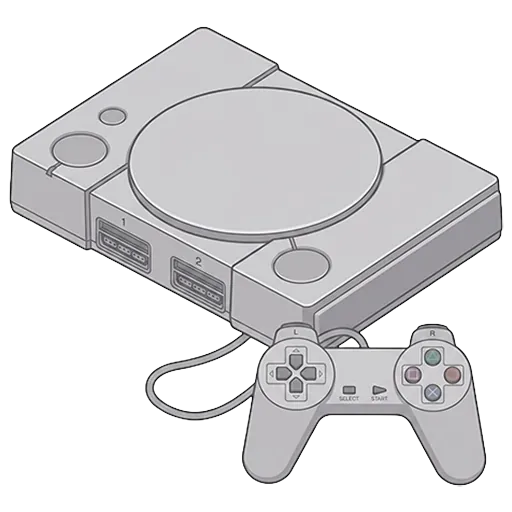
A prototype that needed a witness
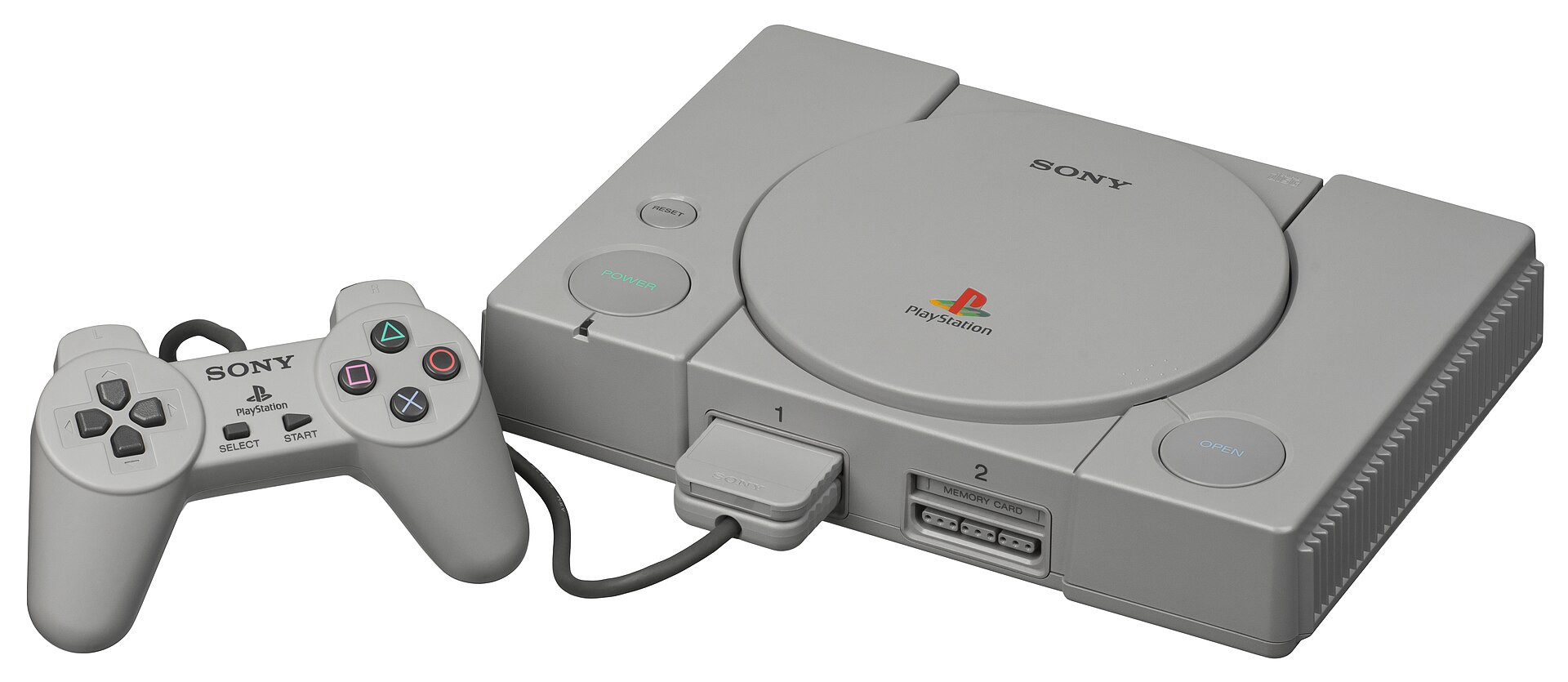
Evan-Amos · Wikimedia Commons · Public domain · Evan-Amos · Public domain

In December 1993, Phil Harrison brought European game developers into Sony's offices to see its new console technology. The early hardware he later described to Edge was a gray metal box about the size of a desktop photocopier. One developer needed proof that the demonstration was running on the prototype rather than on a separate Silicon Graphics workstation. Before Sony could sell a console, it had to convince people who might make its games.
An impressive demonstration can end with the presentation, but a platform has to keep giving people reasons to buy it. The people in that room would need to turn specifications into projects, budgets and release schedules. Sony was asking them to commit work to a machine that consumers had not yet accepted, in a business with established manufacturers and established habits.
The original PlayStation would eventually belong to a hardware family that passed 100 million shipments. Its early history is more interesting at the scale of that meeting: a working machine, a skeptical audience, and a promise that still required software. The familiar gray consumer case followed a much larger effort to convince people the new system was credible.
The partnership left unfinished
The Computer History Museum traces the project to Sony's collaboration with Nintendo on a CD-ROM system related to the Super Nintendo. That effort did not become the console released in 1994. The break concerned the terms under which the proposed business would operate, as well as a technical product. Edge's account identifies contractual and licensing disputes among the reasons the arrangement failed.
Sony's own history says Kutaragi continued to argue for an independent format and pursued 3D graphics. The commercial consequence was substantial: Sony would need games made for its own platform. A broken partnership can explain why an earlier route closed. It cannot, by itself, explain how a different machine acquired useful software or reached shops at a viable price.
Sony Computer Entertainment was established on November 16, 1993, as a joint venture between Sony and Sony Music Entertainment Japan. Hardware engineering and the record business therefore met inside the organization selling the console. The project required more than a circuit design; it needed relationships with creators and a way to manufacture and distribute what they made. That organizational choice mattered alongside Kutaragi's technical work.
A disc on the publisher's balance sheet
A CD could hold a game, but choosing it also meant choosing a manufacturing process. Sony's corporate history describes applying music-disc production and logistics to games, including smaller orders and rapid replenishment. It also describes a distribution structure supplying retailers directly. The disc was part of a route from a finished game to another copy available for sale.
Consider the decision facing a publisher before a new game reaches customers. Ordering heavily commits money to a demand forecast; ordering cautiously risks having nothing to sell if the game catches on. Faster replenishment cannot guarantee a hit, but it changes the consequences of being wrong. Treating manufacture as part of a platform's design, rather than as something that follows creative work, has practical value.
Harrison's later assessment stresses both developers and publishers: the system had to make creative sense to one and business sense to the other. The CD helped connect those needs. It did not make every game cheap to develop, and manufacturing cost was never the whole retail price. It did help turn the format into something companies could consider supporting over successive projects instead of a single experiment.
What the first winter actually contained
The Japanese PlayStation launch was December 3, 1994, at ¥39,800. Ridge Racer was there at the beginning. A racing game offered a direct way to experience a space changing with the player's input: turn into a bend and the road changes across the screen. The console's graphics were now something to control, rather than something to watch in a presentation.
Other games accumulated around that first impression. Namco's own Tekken chronology separates its December 1994 arcade release from the March 1995 PlayStation version. Square Enix dates the original Final Fantasy VII to 1997. Looking backward can flatten these different moments into one shelf of classics, obscuring how much of the platform's identity still had to be built after the hardware shipped.
Shawn Layden's anniversary recollection offers a smaller view of the interval. He remembered continuing to play Ridge Racer in Japan during 1995, then dividing time between Tekken and Battle Arena Toshinden around the North American launch. This is one participant's memory, not a survey of the audience. It nevertheless captures a useful feature of a console's life: the machine remains in place while the reasons to turn it on change.
The second launch season
North America received PlayStation on September 9, 1995; Europe followed on September 29. For these audiences, the starting point was already months into the system's Japanese life. The American price was $299, the figure Steve Race delivered at E3. The announcement gave the new hardware a clear commercial proposition alongside its technical one.
European launch recollections place WipEout next to Ridge Racer. The two offered different ways to move through 3D space. WipEout brought futuristic racing, graphic design and dance music into the same package. For a buyer encountering the system through that game, the console could acquire a different personality from one introduced through Namco's arcade racer. Regional timing affected more than a date printed on a box.
Designer Nick Burcombe recalled that making WipEout in real-time 3D became difficult enough for the team to restart the project. Its arrival at the European launch was an achievement in production as well as design. A machine could make a kind of game possible without making it easy. The work between a convincing concept and a completed disc remained the developer's responsibility.
The scene could not all fit at once

Evan-Amos · Wikimedia Commons · Public domain · Evan-Amos · Public domain

Storage and working memory solve different problems. A disc can contain material that the console is not using at that instant; a playable scene must fit within what the hardware can handle now. Real-time graphics add another constraint, because the machine has to keep drawing in response to input. Disc capacity is therefore a poor shorthand for the complexity of everything visible on screen.
Crash Bandicoot programmer Andy Gavin described fitting the game's world into the PlayStation's 2 MB of main memory. Naughty Dog restricted camera paths and calculated visibility ahead of time. The team also favored shaded polygons over extensive textures on its characters. These were concrete ways to reconcile the desired cartoon appearance with a limited machine.
The reverse-engineered PSX-SPX documentation describes limitations in texture interpolation that help explain the distorted surfaces associated with PlayStation graphics. Seen today, those surfaces can seem inseparable from the period's visual style. For developers, however, they were behaviors to work around. Choosing the camera, arranging scenery and deciding how to model a character were engineering decisions as well as artistic ones. The finished image conceals some of the work that made it possible.
Your hands, then your saved game

Evan-Amos · Wikimedia Commons · Public domain · Evan-Amos · Public domain


Binhow2010 · Wikimedia Commons · CC BY-SA 3.0 · Binhow2010 · CC BY-SA 3.0
.jpg)
The original controller did not have the two analog sticks now strongly associated with PlayStation. Its directional pad, face symbols and shoulder buttons came first; analog and vibration controllers followed within the same hardware generation. A photograph of a gray console with a DualShock may accurately depict an owner's setup while still showing a combination different from the Japanese launch package.
A separate memory card held game progress. Sony's SCPH-5501 instructions devote a section to using the card and managing its contents, including copying and deleting data. The game disc and the player's saved progress occupied different physical objects. The console's front panel made that separation visible: the controller and the card each had a place to connect.
That arrangement imposes a small but important cost: games and saves need to be looked after separately. A player may have a disc ready to use and still need to find the right card or decide what to remove from it. The hardware's appeal was not the absence of such chores. It was the experience available once the necessary pieces were connected and the game had begun.
Useful tools did not finish the game
Sony's history records the provision of programming libraries and sample code for creators entering 3D development. Such assistance gives a team somewhere to begin. It does not decide which movements feel right, which views are readable or how to complete a game within its resources. Those decisions are easier to overlook than a console's specifications because their results are found inside individual games.
Gavin's account of Crash describes substantial custom work rather than a result produced automatically by standard tools. Burcombe's account of WipEout describes a painful change of approach during production. The projects differ, but together they complicate the idea of a universally easy machine. A helpful platform still requires teams to discover what to ask of it, and to give up some possibilities in order to deliver others.
This is also why software support matters beyond the number of names attached to a launch. Each completed game is a particular answer to the machine's constraints. Different answers can appeal to different buyers without a change to the underlying console. An expanding library lets a platform become useful in ways that its earliest demonstrations could only suggest, while failed or difficult projects reveal the limits of the promise.
One generation, more than one object
The compact PS one arrived in 2000, a redesign within the original PlayStation generation. Sony's company timeline explicitly groups PlayStation and PS one when it records the 100 million shipment milestone in May 2004. The company's business data lists more than 102.4 million original PlayStation hardware units sold into distribution as of March 31, 2012. That total describes the platform's hardware, not just the first Japanese model and not a count of unique people.
That distinction changes how we should remember the console: a launch-model photograph fixes one object in time. The commercial history includes revisions, later controllers and a library that grew over years. Someone arriving late could encounter the same generation through a smaller case and a different selection of games. Those experiences belong to the product's history without needing to be projected backward onto December 1994.
These pieces worked together to give PlayStation its lasting achievement. A disc had to reach a store, a developer had to make a scene run, and a player had to find the game worth returning to. The business behind the disc and the calculations behind the image usually disappeared from view once play began. Their results were present in every turn, every new game on the shelf and every decision to keep a save for another day.
Five things to keep in view
Sony's discontinued Nintendo collaboration led to a different platform that needed its own software support.
CD-ROM affected production and replenishment as well as the material a game could contain.
Ridge Racer belonged to the Japanese launch; later classics arrived over the following years.
The launch controller, later DualShock and compact PS one represent different moments within one generation.
The platform's long life joins hardware design to the continuing work of developers, publishers and retailers.
Gizmory editors: Putting in a disc was a small action made possible by a much larger system of people, tools and production choices.
The first PlayStation made real-time 3D compelling at home while giving publishers a disc-based platform to support over successive games. Its constraints remained visible in cameras, textures and the separate memory card. That achievement depended on the hardware and years of production, distribution and software work that kept giving people reasons to use it.
Sources
- Sony Group History: 第2部 第9章 プレイステーション
- PlayStation 1994: PlayStation history timeline
- The History of Sony Interactive Entertainment
- Edge Game Changers: Sony invents the PlayStation
- Retro interview: Phil Harrison 13 years ago, page 2
- Graphics & Games: Timeline of Computer History
- How the Iconic Wipeout Series Was Born
- Making Crash Bandicoot – part 3
- Graphics Processing Unit: PlayStation Specifications
- The Evolution Of The PlayStation Controller
- 15 Years Of PlayStation Memories
- FINAL FANTASY VII
- 카마 엔터테인먼트, 게임사업 강화
- Sony Computer Entertainment Announces Launch Of PlayStation 2 In South Korea
- Sony Interactive Entertainment Business Data & Sales
- Sony PlayStation SCPH-5501 instruction manual: Using a Memory Card
- TITLES: TEKKEN OFFICIAL
- 20 Years Ago Today…
- Sony Interactive Entertainment Expanded Company Timeline