Astell&Kern SP2000 — Two Chips for the Sound
Astell&Kern picked a DAC that sends music out as current, then redrew everything behind it — and then built that back end twice. Inside the A&ultima SP2000.
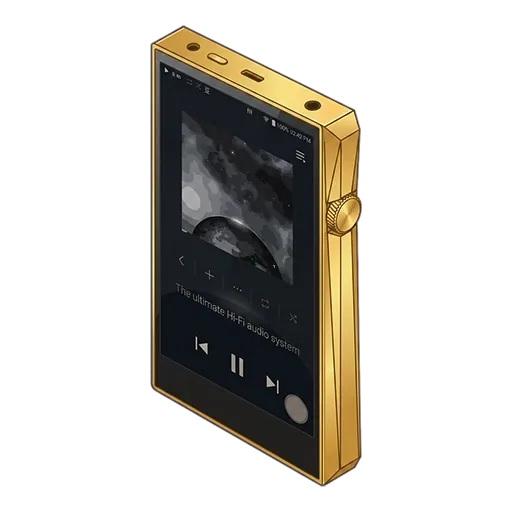
Munich, May 2019. At High End Munich, the annual show for Europe's high-end audio trade, Astell&Kern pulled out a new flagship called the A&ultima SP2000. StereoNET reported it on May 9. It was not the only product unveiled. The company introduced four new products at the show, and the SP2000 was one of them: a slab of machined metal small enough to sit in one hand, with a five-inch screen on its face and no outward sign of the changes inside.
The main changes were inside. On the board, in a spot where one chip would normally be plenty, sat two identical DACs. That adds parts cost and heat, and turns the power supply into a harder problem. Astell&Kern built it that way anyway. The reason reaches back to a company that once dominated its home market for music players, before phones absorbed the category.

Kansai explorer · Wikimedia Commons · CC BY-SA 4.0

A short product teaser panning across the machined metal body
The company that lost its market
iriver did not start out building machines for audiophiles. Founded in 1999 and trading for years under the name ReignCom, it led South Korea's MP3-player market through the first half of the 2000s. The Korea Herald, looking back in 2016, wrote that its cubic-styled players held about 70 percent of that home market and roughly a quarter of the market outside it. For a few years in the middle of the decade, one of the companies shaping what the world carried its music in was Korean.

Andrew Skudder · Wikimedia Commons · CC BY-SA 2.0

It did not last. The Korea Herald described the 2007 arrival of the iPhone, which folded internet, camera and everything else into one device, as the thing that pushed iriver to the brink of collapse. Once phones could play music, a dedicated player needed a stronger reason for people to use it. By 2012 the mass market was gone.

Yarl · Wikimedia Commons · CC BY-SA 3.0

The company chose to move away from price competition with phones and establish a premium sub-brand aimed only at listeners who still cared about fidelity. Park Il-hwan, then iriver's chief executive, put the logic in one line to The Korea Herald years later. “Because the high fidelity sound moves our hearts; smartphones cannot.” He added that a smartphone reproduces only 20 to 30 percent of the sound.
The origin story, with corrections
The brand's start date is still recorded two different ways. English Wikipedia says Astell&Kern was founded in October 2013, and the company's own UK page says its first product launched in 2013. Contemporary reporting points somewhere else. The first product, the AK100, shipped in October 2012, exports to Japan, Italy and Poland began that November, and on December 4, 2012 it went on sale in the United States at $699 through high-end audio dealers, Amazon and Buy.com. The 2013 date refers to the brand's CES debut rather than its founding.
What the AK100 sold was playback of what iriver branded Mastering Quality Sound, up to 24-bit/192kHz. For the American launch the company partnered with the download store HDtracks to supply MQS files. The hardware, as Wikipedia's surviving record has it, was modest: a 500MHz Telechips TCC9201 processor, a 2.4-inch QVGA touchscreen, a Wolfson WM8740 DAC, 32GB onboard with expansion to 96GB, a 2,000mAh battery, 122 grams. Modest by later standards, it was nonetheless the company's first product after it decided to leave the mass market behind.
Even the name has a gap between the story and the etymology. The official brand page explains it as “Astell means 'star' in Greek, and Kern means 'core' in German.” Kern is genuinely German for core. Greek, however, gets its word for star from astēr and astron; Astell is closer to a coinage than to a dictionary entry.
Astell&Kern was never a separate corporation. It was a brand and a business division inside iriver, later Dreamus Company, right to the end, which is why its 2024 sale took the form of a transfer of the device division rather than of a company. Dave Jang, who heads the brand, told an interviewer in 2021 that the DAP work inherited its technical foundations directly from the MP3-player engineering iriver had been doing since 1999.
The American debut was bumpy. The AK100 is recorded as having met a mixed reception when it faced the US press at CES in January 2013, and opinion only improved that August with the AK120, which carried two Wolfson WM8740 DACs instead of one. The habit of doubling the converter, in other words, started right there. The AK120 is said to have been shown for the first time at High End Munich on May 9, 2013, the same show where, six years later, the SP2000 would be unveiled.
New owners, 2014
While the brand was finding its footing, the company changed hands. SK Telecom was named preferred bidder for iriver on June 13, 2014, and on June 24 signed to acquire roughly 10.24 million common shares from the selling funds, with payment due before August 13 and the change of control set for that same date. How much of the company that deal actually bought is reported inconsistently. The transferred stake is given as 34.5 percent in one account and the post-deal holding as something near 39 percent in others. The Korea Herald, in 2016, wrote 49.
The price also reflected the company's changed position. The private equity fund that sold iriver to SK Telecom had bought the whole company back in 2007, and by one Korean account paid roughly twice for it what SK Telecom paid seven years later for a stake. Over those years of smartphone growth, the reported price had halved.
The deal is often explained as SK Telecom buying into Astell&Kern's growth in high-resolution audio. The buyer gave a different reason. In June 2014 SK Telecom's chief executive, Ha Sung-min, framed the acquisition as a way to strengthen the carrier's competitiveness in devices, arguing that a mobile operator serious about the internet of things first has to understand hardware. The stated rationale was accessory-portfolio strength and in-house device planning capability for the IoT era. The audio growth argument came from the other side of the table: in August 2014 Park Il-hwan was the one pointing out that Astell&Kern was building a solid position in portable hi-fi, by which time the brand was selling into roughly 30 countries. By February 2017 the company had taken iF Design Awards four years running, that year for the AK300, AK70 and AK XB10.
Sound that comes out as current
The SP2000 was built around AKM's AK4499EQ, whose unusual feature is the way it outputs the signal. AKM's product brief, dated December 2018, describes the AK4499 as a current-output DAC: the analog signal leaves on pins labeled IOUTxx, which are tied to the common-voltage input pins OPINxx through a 64Ω internal resistance. Something downstream has to convert that current into a voltage before it becomes music.
Swapping a chip and changing an architecture are different jobs. A voltage-output converter can often be dropped into an existing board with modest changes behind it. A current-output converter requires you to build the receiving circuit yourself. Astell&Kern's official product page says that to use the current-output architecture properly, the op-amp and analog amplifier blocks were completely redesigned from scratch. That explains part of the dual-DAC design: using the chip required a redesign of the circuitry behind it.
The converter's published numbers were excessive even for 2018. THD+N of -124dB; dynamic range and SNR of 140dB in mono, 137dB in stereo, 134dB in four-channel mode; 32-bit data at 8kHz to 768kHz; DSD64 through DSD512. All of it in a 128-pin HTQFP package that pairs a delta-sigma modulator with a switched-resistor output stage — the top of the family AKM marketed as Velvet Sound.
The internal channel layout also needs clarification. Dual DAC usually conjures an image of one chip handling the left channel and one handling the right. But a single AK4499 is a four-channel switched-resistor DAC, carrying DACL1, DACR1, DACL2 and DACR2 inside one package. Two of them means eight internal channels, which suggests something more densely paralleled and differential than a simple left-right split — though Astell&Kern has never published the actual channel wiring, so the honest answer is that nobody outside the company can draw it. For contrast: the previous SP1000 and SP1000M used dual AK4497EQ converters, one per channel. Both used two converters, but with different internal architectures. The AK4499 was AKM's first current-output flagship, and the SP2000 was the first Astell&Kern player rebuilt around that architecture.
Two complete paths
The rework did not stop at the converter. The SP2000 is the first Astell&Kern player to give the unbalanced and balanced outputs fully separate, independent audio channels and amplifier circuits. Earlier generations, as the Korean tech outlet Bloter explained in September 2019, switched a single circuit between the two modes. Splitting them means each path can be optimized for the load it actually drives, and it also means more board area, more power draw, and a bill of materials that would not be approved for a mass-market product.
The payoff shows up in the published figures: SNR of 124dB unbalanced and 125dB balanced at 1kHz, THD+N of 0.0005 and 0.0004 percent respectively. The reviewer at headphones.com noted that the output stage had gained 50 percent in strength over the SP1000 — a gain more relevant to driving demanding headphones than to playing louder.
One detail trips up buyers even now. The SP2000's balanced output is 2.5mm, and 4-pole only. The 4.4mm jack that later became the default assumption for portable hi-fi is not on this machine; that belongs to later models such as the SE180 and SE200. The unbalanced 3.5mm jack does double duty as an optical output instead. That difference matters when choosing a cable for this 2019 flagship.
The rest reads the way a flagship of this vintage should: 512GB built in, microSD up to 1TB, PCM from 8kHz to 768kHz at 32-bit, native DSD512, a five-inch 720×1,280 touchscreen. The 3,700mAh battery is rated for up to eight hours, with the fine print that those eight hours assume 16-bit/44.1kHz FLAC played unbalanced at volume 80 with EQ off and the screen off. The body measures 76.3 × 132 × 15.7mm. Those test conditions qualify the battery-life rating.
Steel, copper, and what one reviewer could not hear
The outside has its own official story. The product page describes the design motif as the dispersion of light around the player. The finishes were stainless steel and copper, plus Vegas Gold and Onyx Black. Stainless, Vegas Gold and Onyx Black weigh 410.8 grams, copper 432.4. The difference is 21.6 grams.
Forums have continued to debate one question: does the chassis material change the sound? The folklore says steel is crisper and copper is warmer. The reviewer at headphones.com wrote the opposite. “To date, in level-matched blind comparisons, I've never personally been able to discern any audible difference between A&K's players based on different chassis materials” — and the measurements turned up roughly 1dB of lift in the 26 to 30kHz region, which is to say above where the argument could possibly be settled by ear. The two finishes also sold at the same price, which removes the usual tiebreaker. What is left to choose between them is taste, and 21.6 grams.
An authorized American reseller opens a retail SP2000 box on camera
About the build itself there was far less disagreement. The same headphones.com review is quoted as saying that the level of craftsmanship and quality of materials sat far above any mainstream consumer tech product, the latest iPhone or iPad included. Astell&Kern retained the substantial construction that phones sacrificed to become thinner, selling it as a feature to buyers willing to accept the weight.
What the reviews actually said
Reviews were generally favorable, though their reasons differed. Headfonia refused to call it a dramatic redesign and landed on a single word instead: “You go for a Refinement! And that's exactly what I found while spending the last 2 weeks with SP2000 SS.” The review emphasized greater precision in familiar performance.
The Technovore gave a more restrained assessment of the same improvement. Its June 27, 2019 hands-on called the SP2000 an incremental upgrade over the SP1000, with amplifier output and SNR the substantive changes, and suggested existing SP1000 owners had little reason to trade up. The assessment illustrates the gap between a redesigned back end and the difference a listener can hear over two weeks.
That is not the same as saying nothing changed. The reviewer twister6, after two weeks with the stainless steel model, described a holographic soundstage and layered, resolving sound. headphones.com went further, placing the SP2000 ahead of other excellent units such as the Sony NW-WM1Z, as well as Astell&Kern's own SP1000 line — not a throwaway sentence given which machines occupied the top shelf of portable audio at the time. What Hi-Fi is reported to have reached a similar conclusion, crediting the company's consistency and calling it the best Astell&Kern player it had heard. That review's original URL no longer resolves. Too often, hardware outlasts the press coverage it received.
October 20, 2020
Then, a year after launch, something happened in Japan that exposed how much of the whole design hung on a single supplier. On October 20, 2020, fire broke out at AKM's semiconductor plant in Nobeoka and burned for three days, by the accounts published at the time. The line it took out made audio DAC and ADC chips. AKM's head of public relations, Taro Sekizuka, said in February 2022 that “The fire is believed to have started inside a cleanroom, so we are reinforcing fire prevention measures inside cleanrooms at our other plants.” More than a year on, the statement still left the cause uncertain.
The supply disruption affected companies across the audio industry. Reporting at the time counted at least 18 audio companies caught in the supply disruption, among them RME, JDS Labs, Topping, SMSL, Denon, Marantz, Focusrite, SSL — and Astell&Kern. Enthusiast forums circulated lists of affected parts running from mass-market converters such as the AK4490, AK4493, AK4495 and AK4396 down to the AK4331 and AK4332, alongside industry estimates that normal production was close to twelve months away. Early on there was speculation that the AK4497 and AK4499 were made on a different line and might escape. What came next did not support that hope.
A flagship without AKM
The evidence arrived with the next flagship. Teased in August 2021 and launched that October at a reported $2,499, the SP2000T kept the name and dropped the converters: instead of two AK4499EQs it carried four ESS Sabre ES9068AS chips, wrapped in a triple-amp system that switches between a Korg Nutube 6P1 vacuum-tube mode, an op-amp mode and a hybrid of the two. Five-inch FHD screen, 256GB onboard, 4,200mAh for roughly nine hours, 309 grams in aluminum and 503 in the copper-nickel edition, MQA decoding included. Plenty of reviews and news stories tied the switch directly to the fire, but no official statement from Astell&Kern saying so has been found.
The brand expressed confidence that it could continue without AKM. In a 2021 interview Dave Jang said that “AKM factory burned down is a pity but it doesn't mean that there will be no flagship without AKM DAC,” and added that “DAC is not the only fact[or that] determines sound quality. Power, noise, signal conversion, circuit structure, etc. all affect the sound signature.” The company had promoted its flagship's converters, but now emphasized the other elements of its design. Read one way it is convenient. Read alongside the SP2000's own design history it is perfectly consistent — the company sought credit for the circuit behind the chip rather than the chip itself.
AKM's return took a while. The successor part, the AK4499EX, was not announced until April 20, 2022; AKM said it would debut at the IPS show running alongside High End Munich that May, and confirmed mass production on September 8, 2022 — paired with a second chip, the AK4191. That pairing matters. The AK4499EX splits the delta-sigma modulator out into the AK4191 so that digital and analog live on separate silicon, which makes it a two-chip architecture rather than a drop-in replacement for a single AK4499. Roughly 18 to 19 months passed between the fire and that announcement, and throughout that period the brand's flagship used converters from another supplier.
The return to AKM brought a higher chip count. The SP3000, shown in September 2022, came back with four AK4499EX converters and two AK4191EQ modulators, one each for the unbalanced and balanced paths, under the name HEXA Audio Circuitry. Six chips, three times the SP2000's two. The official page currently lists it at $3,700, or $4,400 for the gold version. Its successor, the SP4000T, is listed with dual AK4499EX converters, two AK4191EQ modulators dedicated to left and right, and four Raytheon JAN6418 tubes wired as a differential quad, at $3,300. The number of chips kept changing as the architecture developed.
Who owns it now
As the players continued to develop, the company underwent several ownership changes. iriver is recorded as having renamed itself Dreamus Company on March 28, 2019, pivoting toward music distribution, six weeks before the SP2000 appeared in Munich. By the same kind of record, SK Telecom spun off an investment holding company called SK Square on November 1, 2021, and Dreamus moved under it. By early 2025, Bloter put SK Square's stake at 38.67 percent, the largest single holding.
Then, on December 30, 2024, Dreamus signed away the iriver and Astell&Kern device division, including the Hong Kong subsidiary and the Chinese subsidiary under it, to Miwang, a real-estate specialist founded in 1966, as a transfer of business operations. Subject to shareholder approval on January 6, 2025, the deal was set to complete on February 28, and the Korean business daily Edaily reported the completion on March 2. The seller framed it as a strategy to sharpen its identity around music and entertainment. Bloter pointed to the parent's broader push to liquidate non-core assets; Edaily's headline simply noted that after eleven years, the company was a music distributor again.
Which makes the sentence still sitting in English Wikipedia, that Astell&Kern is wholly owned by Dreamus, out of date. Since February 2025 the brand belongs to neither Dreamus nor the SK group. Miwang, by one account, has no background in audio or electronics at all, spun the audio operation back out as a subsidiary shortly after taking it over, and is run by management described as audiophiles, which enthusiasts have chosen to read as good news. In November 2025, control of Dreamus itself reportedly passed to a company called bemyfriends. Through every one of those transfers, the flagship kept arriving, one generation after the next.

Astell&Kern web · Wikimedia Commons · Public domain

Astell&Kern's first product, the AK100, shipped in October 2012 — the widely repeated 2013 founding date is the CES debut year in disguise
The AK4499EQ sends its analog signal out as current, so Astell&Kern redesigned the op-amp and analog amplifier blocks from scratch to receive it
The SP2000 was the first player from the brand with fully separate circuits for unbalanced and balanced — and its balanced jack is 2.5mm 4-pole only, with no 4.4mm
Chassis material as a sound signature is not settled fact: headphones.com heard no difference in level-matched blind tests and measured about 1dB between 26 and 30kHz
After the AKM plant fire of October 20, 2020, the flagship line detoured through ESS, and did not return to AKM silicon until the SP3000 in 2022
“Because the high fidelity sound moves our hearts; smartphones cannot.” — Park Il-hwan, then chief executive of iriver, to The Korea Herald
The SP2000's extensive engineering follows from a DAC that outputs current instead of voltage: the circuitry behind it had to be redrawn, once for each output. The measurements backed the decision and the reviews mostly followed, though the words reviewers reached for were refinement and incremental rather than revolution. A year later, a fire in Nobeoka showed how much of that engineering depended on the supply of a single chip.
Sources
- A&ultima SP2000 공식 제품 페이지
- AK4499 Premium Switched Resistor 4ch DAC – Product Brief (Rev.0.0-PB, 2018/12)
- 아스텔앤컨, 음감 끝판왕 '에이앤울티마 SP2000' 출시
- 아이리버 아스텔앤컨 미국 찍고 해외진출 본격화
- [KOREAN LUXURY] Converging digital and analog worlds
- Astell&Kern A&Ultima SP2000 – Flagship Digital Audio Player Review
- Astell&Kern SP2000 Review
- Interview with Astell & Kern (Dave Jang)
- AKM is still puzzled by the fire from 2020
- High End Munich 2019: Astell&Kern Launch New Flagship A&ultima SP2000 DAP
- Astell&Kern launches new high-end audio players... our hands-on
- Astell & Kern A&ultima A&K SP2000 – Twister6 Reviews
- 하성민 SKT 사장 "아이리버 인수로 단말 사업 이해도 높일 것"
- 아스텔앤컨, 아이리버 명성 이어갈까 [창의·혁신 현장을 가다]
- 드림어스컴퍼니, 아이리버 매각 완료...11년만에 음원유통사로
- AKM 공식 뉴스: AK4499EX 발표 (2022-04-20)