Before It Was Called Discman — Sony D-50
The first portable CD player could not play reliably during a jog, needed a bolt-on battery case for use away from home, and lacked the name we remember it by. Sony's D-5 shipped in November 1984 as a compact disc compact player — while a trademark filing in New York was already calling it something else.
Seventy Percent of a Month's Pay
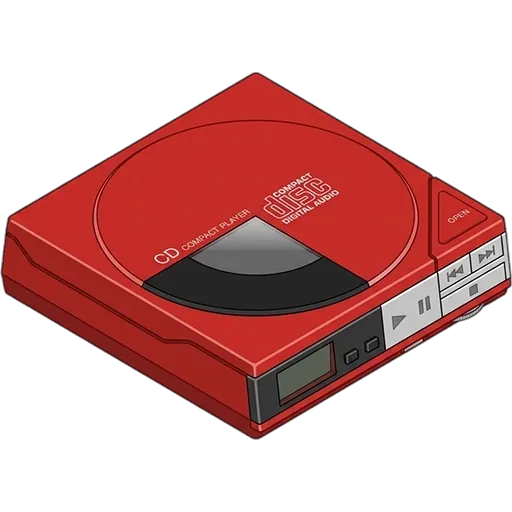
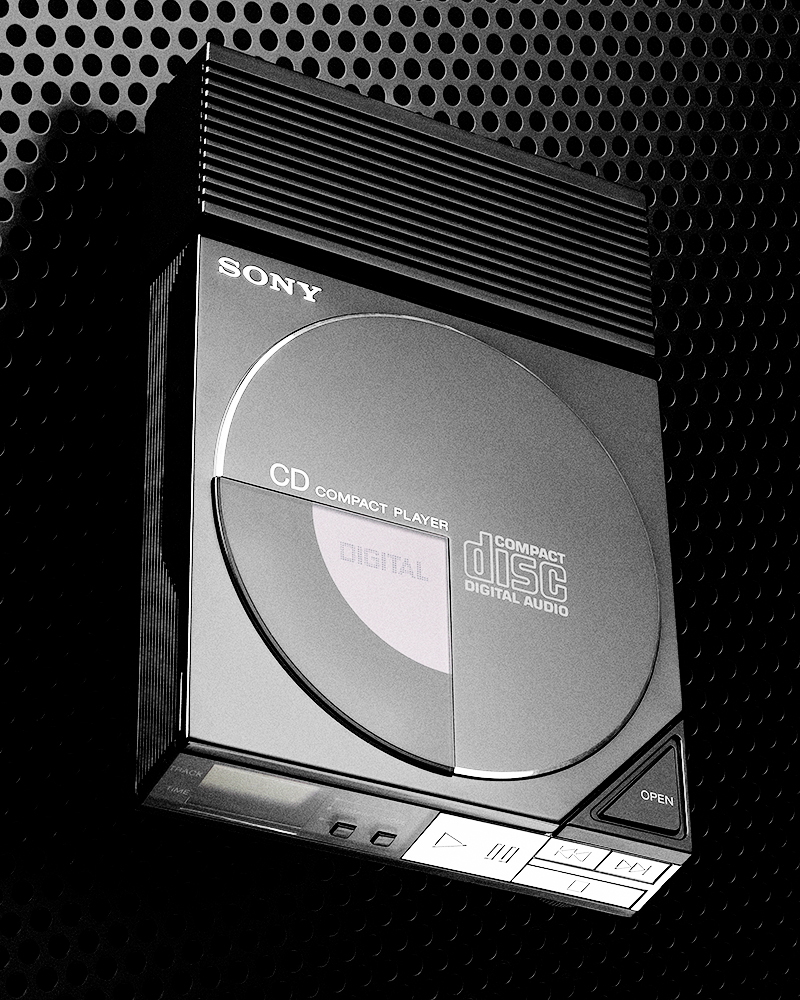
On 28 November 1985, a man named Glenn Benson walked into the Dixons on Regent Street in London and handed over £279.99 for a black square that fit in one hand. That was roughly seventy percent of his monthly salary. He did not own a single compact disc yet. The machine came first and the music could wait until morning, which in 1985 was a perfectly ordinary way to shop.
The next day he went to Harrods and bought his first two discs: Ultravox's Quartet and Holst's The Planets. One synth-pop record and one orchestral showpiece: the pair reflected the new format’s claims to both fine detail and scale. For early adopters of digital audio, choosing the hardware and then the catalog were two expressions of taste.
Thirty years later, in 2015, that exact unit entered the collection of the Victoria and Albert Museum in London, accessioned as W.1-2015 and donated by the same man. The donation included the AC power unit but not the original battery pack. That small gap in the museum record highlights a central limitation: the world's first portable CD player had no internal power source.
Austin Calhoon · Wikimedia Commons · CC BY-SA 3.0

America Already Had the Disc
The compact disc player business began on 1 October 1982 with Sony's CDP-101 at ¥168,000 — about 3.4 times the portable's later price. The same day, CBS/Sony issued the world's first fifty CD titles, led by Billy Joel's 52nd Street, and roughly a hundred were out by the end of the year. Discs and players were available, but relatively few households were willing to buy both.
The American market had opened quietly in March 1983, well before the portable arrived. Sound & Vision, citing Sony spokesman Marc Finer, puts first-year North American player sales at about 35,000 units across every brand selling one; another account of the same period counts some 30,000 players and 800,000 discs sold in the United States in 1983. Both accounts put national demand in the tens of thousands.
Sony's own corporate history records the scale: at the end of 1984, CD production still ran at roughly a tenth of analog records. The format was not dying, but remained a minority hobby despite its appeal. Sound quality was already its selling point; a smaller box and a lower price were the next priorities.
A Block of Wood, 13.4 Centimeters Square
The project began with a piece of timber rather than a written specification. Kozo Ohsone, then head of Sony's General Audio division, put a square wooden mock-up in front of the engineers: 13.4 centimeters on a side, about four centimeters thick, or in the company's own phrase, four CD jewel cases stacked. The photograph of that mock-up in Sony's history carries Ohsone's signature and the year 1983 — more than a year ahead of the finished product.
The accompanying instruction was blunt. Ohsone told the team he did not care whether they put a grasshopper or a cicada inside the thing, as long as it made sound. The joke left the engineers to decide how to fit the parts within dimensions that were not negotiable.
He had a name for the method, too. Do not start from the technology you happen to have, he argued; state the size people will actually be glad to use, and treat that size as an absolute target. The specification, in this case, was a block of wood with a signature and a year written on it.
Get Under Fifty Thousand Yen
Once the size was settled, the founder personally set the price target. Akio Morita's directive was to come in under ¥50,000 and to accept losing money at first, on the conviction that the profit would follow. The launch price landed at ¥49,800. That was less than a third of the price of the CDP-101 from two years earlier, with an equally visible reduction in size.
Sony was not the first manufacturer to cross an important psychological price threshold. In the autumn of 1983, a year before the portable, Yamaha's CD-X1 is said to have broken the ¥100,000 barrier at ¥99,800. The portable arrived at half of that, in a fraction of the space. A Sony retrospective on the line describes the period plainly: the company sold below cost to establish the format, then continued simplifying production to recover the cost.
One frequently repeated number lacks firm support. You will read that the player cost twice its retail price to build and that Sony recovered the gap in about eighteen months. That figure circulates through hobby blogs, aggregation posts, and an English Wikipedia sentence that has carried a citation-needed flag for years. It appears nowhere in Sony's current corporate history, which mentions neither a cost ratio nor a payback period. The documented statement is narrower: Morita expected an initial loss.
What the Shape Cost
The body weighs 590 grams. The V&A's caption calls it "the cheapest CD-player available at the time of its manufacture" and "the world's smallest and most affordable CD-player," which is true — of the body. Those superlatives need qualification: without an external power source, the player could not make a sound.
There was no battery inside. To take it out of the house you bought the optional EBP-9LC battery case, loaded it with six C cells or six Sony KR-C-F-2 nickel-cadmium rechargeables, and clamped it to the underside of the player. For the car you bought the DCC-120 twelve-volt cord as well. Portable use depended on buying accessories.
Indoors, the player ran on an AC adapter that was itself awkward. A Japanese owner who bought one in 1986 later recalled that attaching the adapter to the back made the whole assembly roughly forty percent larger. The smallest-player claim therefore excluded the adapter.

Siren-Com · Wikimedia Commons · CC BY-SA 3.0

The more fundamental limit was mechanical. Writing in Sound & Vision in 2012, Steve Guttenberg put it exactly: "the D-5 didn't have a buffer to prevent skipping, so you could walk with it—gently—but jogging would have been impossible." With no memory buffer, the laser had to track the spiral in real time. A shock that displaced the lens interrupted the music.

Binarysequence · Wikimedia Commons · CC BY-SA 4.0

Spec sheets compiled by collectors and museums list a KSS-110A optical pickup and a CX20133 sixteen-bit DAC. They disagree about the thickness — 36.9 millimeters in one table, 42 in another — so "about four centimeters" remains the honest figure. The V&A records the materials as aluminium and ABS plastic.
A persistent but unconfirmed anecdote claims that the glossy black finish borrowed a lacquering technique from cosmetic compacts, and that the official name followed from it, though Sony's own sources say nothing of the kind. One design critic reads the fine grooves on the flanks as a nod to the 1982 Walkman II. Black was the only color at first; the red known as sporty red came later.
A hands-on walkthrough of the original D-5/D-50 and what it does differently.
November 1984: A Debut Without a Name
It shipped in November 1984, two years to the month after the CDP-101. It lacked the familiar name now used for it. The V&A is categorical on the point: "its official name was the 'compact disc compact player', not Discman." Its name mentioned the compact disc format twice, reflecting the attention the medium still attracted in 1984.
Buyers felt the same absence. A Japanese owner recalling his 1986 purchase described the era as a time when there was not yet any such name as Discman or CD Walkman. The customer’s recollection suggests how quickly the category took shape before its familiar name became established.
The name already existed on paper in New York, however. The United States trademark record for DISCMAN (Registration 1345869, Serial 73510979) shows a filing date of 29 November 1984, with first use and first use in commerce both entered as 5 November 1984. The applicant was Sony Corporation of America at 9 West 57th Street. The goods were listed as PORTABLE COMPACT AUDIO DISC PLAYERS, and registration issued on 2 July 1985.
That date conflicts with two popular accounts of the name’s origin. One says the name began with the D-50 Mk II at the end of 1985; the other says it began with the follow-up D-7. They point at different machines, they contradict each other, and the primary record predates both by roughly a year. One caveat is worth keeping: in trademark practice, first use in commerce includes advertising, catalogs, and packaging, so the November 1984 date does not prove the word was ever stamped on the original chassis. The body said compact disc compact player. The trademark record precedes those accounts of the name on the lid by a year.
Spring Break, Sponsored by Sony
In the United States the machine was the D-5, and accounts of its launch price differ. Sound & Vision reports $300 and notes that this was less than half the cheapest Sony console player of the day; other accounts, including the English-language reference entries, say $350. With the fifty-dollar discrepancy unresolved, the reported range is three hundred to three hundred and fifty dollars.
Sony promoted the D-5 to the spring-break crowd through MTV, jointly with the CBS, RCA, Warner, and Polygram labels. That audience was unlikely to sit still with it, a poor fit for a player sensitive to movement and unable to play reliably during a jog.
The promotion and the player's capabilities were at odds, as Guttenberg's brief verdict made clear: you could walk with it, gently. Some accounts add that the American D-5 came without a remote and without the repeat function, though that detail rests on secondary sources rather than Sony's own literature, which claims only that the portable delivered the functions of the CDP-101.
Still, the timing was better in America than the price suggested. The disc market had been open since March 1983, the catalog was filling, and competing players were bulky components. A three-hundred-dollar object that could sit on a dorm desk, run off an adapter, and then be carried — carefully — somewhere else was a different proposition from a component you bolted into a rack. The D-5’s contribution in the United States was to make CDs more portable, without itself making the format popular.
Sony's own history calls the player an explosive hit but gives no sales figure. It instead traces the growth of the wider format. CD output stood at roughly a tenth of analog records at the end of 1984, overtook them in 1986, passed a hundred million discs around 1988 and three hundred million by 1992. The portable was part of this period of rapid growth, though it did not cause that growth by itself.
Why Seventy-Four Minutes?
A familiar story explains the twelve-centimeter disc this machine reads. Herbert von Karajan wanted Beethoven's Ninth to fit on a single disc, the tale goes, and so the CD holds seventy-four minutes. Add the line attributed to Philips company lore — that the playing time was determined posthumously by Beethoven — and the anecdote appears complete. It still needs scrutiny.
One of the people who actually wrote the format has spent decades contradicting it. Kees Schouhamer Immink joined the Philips side of the joint team with Sony and devised both the EFM channel code and the CIRC error correction that went into the standard. In his account, the fight over diameter was about factories, not music: Philips' subsidiary Polygram had already built a disc plant in Hanover tooled for 115-millimeter discs, and Sony had no equivalent.
If 115 millimeters became the standard, Philips would hold a clear advantage in the music business, and Immink writes that Norio Ohga knew it and refused it. What Sony carried in the end was its own proposal — twelve centimeters, sixteen bits, seventy-four minutes — against the Philips scheme of 11.5 centimeters, fourteen bits, sixty minutes. Ohga, the executive who ran that negotiation, should not be confused with Ohsone, the engineer who later presented the wooden mock-up. Their work concerned different problems, years apart.
The chronology also contradicts the legend. The twelve-centimeter diameter was adopted in December 1979, at the third technical meeting. EFM — the channel code that actually governs how much time fits on a disc — was not settled until June 1980. The playing time could not have driven a decision taken six months before the coding was chosen.
EFM further complicates the story: it raised density by about thirty percent, which meant the same program could have fit on a 115-millimeter disc, even a 100-millimeter one, or the same disc could have run to ninety-seven minutes. Instead the density was dialed back down by thirty percent to protect the twelve-centimeter, seventy-four-minute decision already on the table. The ninety-seven-minute option, Immink notes, was never even considered.
So where does seventy-four come from? The benchmark tabled during the discussions was the longest known performance of the Ninth: Wilhelm Furtwängler's 1951 mono recording from the Bayreuth Festival, which Immink logs at 74 minutes and 33 seconds. Karajan's own Berlin Philharmonic readings run well short of that — the 1977 Deutsche Grammophon recording clocks in at one hour and six minutes. The conductor associated with this story recorded a Ninth that did not need the full playing time he supposedly demanded.

Ehuang · Wikimedia Commons · Public domain

None of which makes the legend a pure invention. Immink concedes that a seventy-four-minute longest-performance requirement was put on the table, and his real complaint is procedural: the decision on diameter and playing time, he writes, was taken outside the group of experts responsible for the format. Snopes still files the whole affair as undetermined, with three explanations in circulation — that seventy-four minutes matched Ohga's favorite recording, or Akio Morita's wife's, or that Karajan demanded it. The article closes with Immink's own description of how corporate history gets written.
The Long Tail
The original's most serious flaw is said to have been fixed within a year. The 1985 successor, the D-50 Mk II, is described as having been redesigned internally to take a BP-200 rechargeable pack that sat flush against the bottom instead of the bolt-on case. That model is also the one most often credited with introducing the Discman name — a year after the trademark office had already recorded it.

JuneAugust · Wikimedia Commons · CC BY-SA 3.0

Over the next decade, Sony pursued both thinner players and more features. The 1986 D-100 came in at less than half the original's thickness; the 1988 D-88 shrank to the footprint of an eight-centimeter mini CD and still played twelve-centimeter discs by moving the lens out to meet them. In 1989 the D-90 inherited the bass-boost circuit from the WM-501 Walkman, and the circuit's name — MEGABASS — remained in use for decades after the machine.
Reliable playback while moving, central to the category's purpose, was the last problem solved. Electronic Shock Protection, which buffers the datastream in memory so a bump does not become a skip, arrived in 1992 on the D-515 — eight years after the machine that could not tolerate jogging. The 1995 D-777 slimmed down around gum-stick batteries while keeping real low end and is remembered as the legendary one; the 1999 D-E01 marked twenty years of the Walkman and fifteen of the CD Walkman with a magnesium shell and a slot-loading mechanism. By the end of fiscal 1998 the CD Walkman line had shipped 46 million units.
The name disappeared from both products and trademark registrations. Between October 1997 and March 1998, Sony began relabeling the Japanese lineup from Discman to CD Walkman, aligning it with the rest of its personal audio; the changeover is understood to have finished across the range in 2000. The paperwork lagged behind the marketing. POCKET DISCMAN was cancelled in September 1995 for failure to file a declaration of continued use, and DISCMAN itself was cancelled on 8 April 2006 for the same reason. The trademark record thus documents the name’s registration and eventual cancellation.
A Sony spot from the years when the Discman name was at full strength.
Two Museums, Thirty Years Late
The Museum of Modern Art collected the player in 2014, followed by the V&A in 2015. The two acquisitions within a year of each other mark a shift in how early digital hardware was viewed: the thirty-year-old plastic player had become a piece of design history rather than simply secondhand goods.
The London unit also has a specific history: bought on Regent Street for seventy percent of a month's pay, carried home with no discs yet to play, and kept for three decades. The battery pack never made it to the museum. Its absence recalls the extra purchase that portable use of the original player required.
Five Takeaways
Sony's first portable CD player shipped in November 1984 at ¥49,800, two years to the month after the CDP-101.
The design started as a 13.4-centimeter wooden block, not a specification document.
In the US it was the D-5, sold at $300 to $350 and marketed to students through an MTV spring break promotion.
With no battery inside and no anti-skip buffer, you could walk with it gently and nothing more.
The DISCMAN trademark records first commercial use on 5 November 1984, a year before the usual origin stories.
“Everyday practice is less romantic than the pen of a public relations guru.” — Kees Schouhamer Immink, on how the CD's seventy-four minutes came to be explained
The 590-gram player needed an external power source and could not play reliably during a jog, yet it overcame the size and price barriers at once and made digital audio available away from the hi-fi rack. A credible starting point, though still an unfinished portable design. ★★★★☆ 8.7/10 · ICONIC 9.4 · DESIGN 8.8 · IMPACT 9.4 · USABILITY 6.5
Sources
- 80年の歴史 第2部第7章「音楽のデジタル化」第5話「音楽鑑賞を身近なものに-ポータブルCDプレーヤー」 (소니 공식 사사)
- USPTO TSDR — DISCMAN, Reg. No. 1345869 (Serial 73510979)
- USPTO TSDR — POCKET DISCMAN, Reg. No. 1527947 (Serial 73732659)
- D-50 compact disc compact player | V&A Explore The Collections
- Shannon, Beethoven, and the Compact Disc (Kees Schouhamer Immink)
- Did Beethoven's 9th Symphony Determine the Length of a CD?
- Sony D-5 Portable CD Player (Sound & Vision)
- わたしの思い出家電 ソニーのCDプレーヤー「D-50」 (Impress Watch)
- 시대 따라 떠오르는 '그때 그 물건' (한국일보, 2016-03-02)
- [WALKMAN의 모든것] 4부. 1990년대 음악과 함께 한 CD워크맨 전성시대 (소니코리아 공식 블로그)
- 소장유물소개 — 아이와(AIWA) CD플레이어 XP-V514 (서울생활사박물관)