Galaxy Fold — The Phone That Opened Like a Book
Review units failed publicly before the phone went on sale. Some reviewers had peeled a layer that looked like a protector; others had left it intact. Screens failed in both groups — and Royole had already shipped a foldable the previous December.
In mid-April 2019, a photograph of a phone that had not yet been sold started circulating: a dead vertical stripe down the middle of the inner screen. The phone was a Galaxy Fold. The units were review samples, still weeks from a store counter, and their failures were becoming public.
Several claims followed the machine afterward: World's first foldable. Reviewers wrecked it by peeling a protector. Delayed indefinitely. Recalled. The record calls for more careful wording in almost every case.
April 2019, a photograph of a dead stripe
The review units were Galaxy Folds, model SM-F900. They were not on sale. Two months earlier the same phone had been applauded on a stage in San Francisco. The screen failed on camera after the announcement but before the first retail sale.
By then a slab phone had nowhere left to go. Bezels had already become very thin. The remaining move was to fold the display itself. Samsung presented it as a major-OEM inward-folding book. It was a significant event for the category. As an unrestricted "world's first commercial foldable," it does not qualify.

KKPCW · Wikimedia Commons · CC BY-SA 4.0 · KKPCW · CC BY-SA 4.0

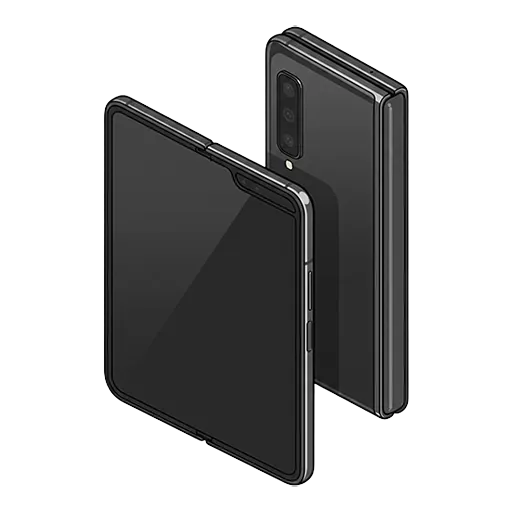
Closed, the 7.3-inch panel disappears. What remains is the 4.6-inch cover, a punch-hole camera, a front so narrow it recalls a phone from a slightly earlier decade. That small face is the price of folding the book inward.
Why fold inward
A screen can fold out or in. Fold it out and the same panel faces the world open or closed. Fold it in and the main display hides against itself, which means you need a second, smaller cover screen for when the book is shut. The Galaxy Fold folded in.
The book metaphor describes how the phone works: opening it reveals the display for reading, while closing it keeps that display inside. Samsung put the 7.3-inch main display on the inside and the 4.6-inch cover on the outside. While shut, the large panel is hidden like the inside of a book. The cost of that form is a tighter curve.
Folding inward requires the panel to take a tighter curve than folding it outward would. Commercial glass in 2019 could not follow that inward curvature. The hinge enabled that curve but also left a seam. The Fold's problems involved both the non-glass surface and the gap beside the hinge.
Film instead of glass
Cover glass had a long engineering life behind it. Bending it like a book was a different problem. Commercial glass of the time could not take an inward fold, so Samsung did not use glass.
The cover was colorless polyimide, CPI, supplied by Sumitomo Chemical — as ETNews and PhoneArena reported in 2018, and as the OLED Association noted. Samsung Display itself wrote that CPI was used on the Fold. Plastic could take the curve glass could not. It was also softer, and it scratched.
Worse, it looked exactly like a tempered-glass screen protector. Lifting a corner with a fingernail and peeling the sheet off caused the display to fail. That vulnerability was not shown at February's presentation.
The gap the hinge left
The film was not the only weak point. Where the hinge met the display, there was a physical gap — room for dust and debris to work in with every fold, and an exposed display edge sitting against moving metal. The seam, rather than the fold count, was often responsible for screen failures.
iFixit's first-edition teardown called the phone "alarmingly fragile." The warning that debris near the hinge could become a "fatal pressure point" appears on both the first edition and the later retail redesign. Repairability: 2 out of 10. The score reflected how difficult the folding phone was to repair.

KKPCW · Wikimedia Commons · CC BY-SA 4.0 · KKPCW · CC BY-SA 4.0

Samsung's official 60-second introduction, showing the inward-folding hinge.
The official introduction shows the inward-folding hinge. In the metal, that motion left a gap. The advertised folding motion left an adjacent gap that could cause failures.
February 20, 2019: Infinity Flex for $1,980
Wind the clock back two months. On February 20, 2019, at San Francisco's Bill Graham Civic Auditorium, Samsung Unpacked put the Galaxy Fold on a stage. Closed: a 4.6-inch HD+ Super AMOLED cover. Open: a 7.3-inch QXGA+ Dynamic AMOLED. The name on the inner panel was Infinity Flex.
The remaining specifications were announced alongside it: 12GB of RAM, 512GB of UFS 3.0, six cameras — three on the rear, two inside, one on the cover. Dual batteries, 4,380mAh typical, 4,275mAh rated. U.S. suggested retail: $1,980. The official chip line was "7nm 64-bit Octa-core." Snapdragon 855 is how contemporaneous PCMag, Android Authority, and iFixit named it.
Samsung's own copy was not "the world's first foldable phone." It was "the world's first 7.3-inch Infinity Flex Display." That narrower claim is easier to substantiate. Royole's FlexPai had already shipped in December 2018 — the actual first foldable to go out the door. The Fold can fairly be described as the major-OEM inward-folding book that drew public attention to the category. The broader claim does not hold without those qualifiers.
The February 2019 Unpacked replay. The presentation that introduced the Fold as a category.

KKPCW · Wikimedia Commons · CC BY-SA 4.0 · KKPCW · CC BY-SA 4.0

The crease sits on the inner panel, not on a closed cover — a distinction previously misrepresented in the use of this photograph. Upper right, a dual-camera cutout. In February the crease seemed characteristic of the folding form. By April, images of a dead stripe drew attention to failures in the same area.
The ones who peeled, and the ones who didn't
In mid-April, with a U.S. launch approaching, review units went out to the press and to YouTubers. Within days, broken screens were public. Coverage often treated the failures as having one cause, although they did not.
Marques Brownlee (MKBHD) and Bloomberg's Mark Gurman mistook the top layer for an ordinary screen protector and peeled it. That layer was the display. Brownlee wrote: "PSA: There's a layer that appears to be a screen protector on the Galaxy Fold's display. It's NOT a screen protector. Do NOT remove it."
Those accounts alone could suggest that people had simply removed something they should have left in place. Dieter Bohn at The Verge left the film on, and his unit still failed at the hinge. Bohn: "I just know that the screen is broken, and there was no obvious proximate cause for the bulge that broke it."
Todd Haselton at CNBC reported a similar experience. "But I never removed the protective film or used the device outside any way a normal user might." His account described normal use with the film intact, yet the unit still failed at the hinge. Removing the film was only one failure mode.
So the tidy narrative — every broken review unit was user error — does not survive the primary accounts. The design used a film that looked peelable, and the hinge left a gap. Some screens died because a reviewer peeled. Some died because nobody did. Both halves have to stay in the sentence.
Coming weeks, then four fixes
On April 22, 2019, Samsung delayed the launch. Contemporaneous reports had the U.S. date as April 26. Samsung's own language was a delay to evaluate the feedback and run further internal tests, with a new date to be announced in the coming weeks. Not indefinite. "Indefinite" was a Verge headline. The company's sentence was shorter, and dated.
On July 24, Samsung outlined four hardware changes in its Newsroom: extend the protective layer under the bezel so it no longer looked like a sheet you could pick off; add caps at the top and bottom of the hinge; put a metal layer under the display; shrink the gap between hinge and body. Each item addressed an April failure involving either the apparently removable film or the seam.

KKPCW · Wikimedia Commons · CC BY-SA 4.0 · KKPCW · CC BY-SA 4.0

The three cameras on the back are the same in February and in July. What Samsung redesigned was the seam, not the lenses. The specifications stayed the same while the gap became tighter. The fix focused on making the announced hardware usable, rather than introducing a new chip.
Embarrassing
On July 1, 2019, The Independent published a Seoul interview with DJ Koh, then head of Samsung's mobile business. He said: "It was embarrassing. I pushed it through before it was ready."
His account concerned a delay before sale, rather than a CPSC recall. Review units had failed publicly, and the product had been held back before customers could buy it. The sequence was the source of the embarrassment: the stage announcement and failed reviews came before customers could buy the product.
Pickup only, September 27
On September 27 the Galaxy Fold went on sale in the United States at Best Buy, AT&T, and Samsung Experience Stores. According to CNET, there was no home delivery; store pickup was the default. T-Mobile was not part of the relaunch. The price stayed $1,980 — the amount announced at Unpacked, unchanged after the spring’s screen failures.
After the device had drawn ridicule throughout the spring, the requirement to collect it in store suggested caution as well as exclusivity. You could not have it mailed. You had to walk into a store and take the folding phone from a person standing in front of you. After April, the personal handover could be read as a form of supervision.

qdjuncheng · Wikimedia Commons · CC BY-SA 4.0 · qdjuncheng · CC BY-SA 4.0

The Qingdao cylinder still says original Galaxy Fold. The spec sheet matches February; the seams match July. The premise — film instead of glass — had not changed. You could finally buy the folding phone. Its screen cover was still film rather than glass.
Later glass and disputed fold counts
The change in screen-cover material came a year later. The 2020 Galaxy Z Fold2 switched the cover to ultra-thin glass. That UTG came from Schott, in Germany, and Dowoo Insys rather than Corning. The more familiar American glass supplier was absent from this generation.
Samsung and Corning announced a UTG collaboration in the second half of 2020, after the Fold2 had already shipped. TheElec's record is that Z Fold3 UTG in 2021 was still 100 percent Schott. Corning's small volume was on the Flip3 only. Attributing the Fold3’s glass to Corning would therefore be incorrect.
The fold-count claim also needs qualification. Samsung's claim is 200,000 folds — 100 a day for five years — relayed by iFixit, CNBC, and PhoneArena. That number is not in the Unpacked Newsroom text. Independent tests disagree: a CNET robot on the order of 120,000, SquareTrade seeing pixel failures around 18,500. Two hundred thousand is Samsung's claim.
iFixit's line on the retail redesign was "still pretty fragile." That sentence belongs to the autumn hardware, not to the April first edition, which the same site had called "alarmingly fragile." The fatal pressure point appears in both. Narrowing the gap had not eliminated the risk beside the fold.
The original Galaxy Fold used film while glass was not yet suitable for that inward fold. It brought public attention to the major-OEM book-style format. On the claim to "first," however, it fails: FlexPai had already shipped. The dead stripe on the review units remains a reminder of those qualifications. This year of film preceded the later foldables that used glass.
Royole's FlexPai had already shipped in December 2018; Samsung's line was the world's first 7.3-inch Infinity Flex Display, not the world's first foldable.
The cover was Sumitomo colorless polyimide, not glass — commercial glass of the time could not follow an inward fold.
April 2019 review units failed two ways: MKBHD and Gurman peeled the film; Bohn and Haselton did not, and still broke at the hinge.
Samsung's April 22 delay said coming weeks, not indefinite, and it was a pre-sale delay, not a recall; on July 24 it listed four fixes: protective layer, hinge caps, metal layer, tighter gap.
Z Fold2 UTG came from Schott and Dowoo Insys; Fold3 was still Schott, not Corning. The 200,000-fold figure is Samsung's claim, and independent tests disagree.
"It was embarrassing. I pushed it through before it was ready." — DJ Koh, then head of Samsung's mobile division, The Independent, Seoul, 1 July 2019
The Galaxy Fold was not the first foldable to ship, and it was not a recall. It was a $1,980 inward-folding book that went to reviewers with a film cover and a hinge gap, and suffered two kinds of failure during public review. Samsung delayed in April, redesigned in July, and sold it pickup-only in September. Ultra-thin glass arrived a year later from Schott, not Corning. The 200,000-fold number was always Samsung's claim.
Sources
- Samsung Unfolds the Future with a Whole New Mobile Category: Introducing Galaxy Fold
- Galaxy Fold Ready for Launch starting from September
- 삼성전자, 새로운 모바일 카테고리를 여는 '갤럭시 폴드 5G' 국내 출시
- A New Era in Mobile Technology: Galaxy Fold On Sale in the U.S. Starting September 27
- Samsung Galaxy Fold Teardown
- Galaxy Fold: Inside Samsung’s struggle to deliver a foldable phone
- My Samsung Galaxy Fold screen broke after just a day
- Samsung's $2,000 folding phone gave me a brief but tantalizing glimpse of the future — before it broke
- Schott supplying all of UTG used in Samsung’s Galaxy Z Fold 3