The Prada Phone — A Face Made of Glass
Months before the iPhone reached a store shelf, a phone you worked with nothing but a fingertip went on sale in Europe. The sensing under its glass came from a Silicon Valley supplier — and neither AT&T nor Verizon ever carried it.
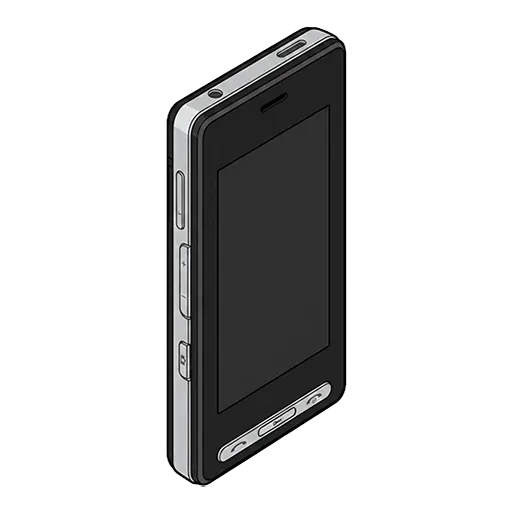
Santa Clara, California, Friday, June 15, 2007. An Associated Press photographer named Paul Sakuma set up a picture at the headquarters of a touch-sensor company called Synaptics. According to the caption filed with the photo, the handset on the table was an LG Prada — a phone AT&T and Verizon never launched, sitting in an American office park, documented by an American wire service.
Five months earlier, on January 25, 2007, Synaptics CEO Francis Lee had said the name out loud on an earnings call: “our ClearPad touch screen technology is being used in the new LG KE850 PRADA mobile phone.” Investors had already heard an answer to the question that would be debated for the next two decades: what was under that glass, and who made it.
These stories concerned the glass touchscreen: the phone’s black front panel, its response to skin rather than fingernails or styluses, and the American component engineering that received little credit.

LG1991 · Wikimedia Commons · CC BY-SA 3.0 · LG1991 · CC BY-SA 3.0

The year of the fingernail
In 2006 a phone screen was something you pressed. Most touch panels were resistive: they read pressure, which meant a fingernail or the bundled plastic stylus did the job better than a fingertip ever could. Touchscreen phones were not new — the IBM Simon of 1992 and Samsung's SCH-X730 in 2000 came long before — but none of those screens had been designed with a bare finger in mind.
LG had a head start it rarely gets credit for. The touch-sensitive control buttons on the LG Chocolate, the company's signature handset at the time, already worked by sensing the electricity in your skin. PhoneArena's review spelled out the lineage: the Prada's screen “is activated by the electricity running on your skin and it does not react when touched with something else (whether a pen, pointer, etc.)” — the Chocolate's trick, scaled up to the size of a display.
The motive was not entirely ergonomic, either. Cha Kang-hee, who ran LG's mobile design lab, told a trade outlet in February 2007 that the effort to get rid of buttons went back to the earliest days of the industry, and that twelve number keys did considerable damage to a phone's looks. PhoneArena read the moment the same way from outside: glossy plastic fashion phones had started to look identical, and designers reached for flat touch panels largely for the sensation of touching one. At least from the outside, the move to fingers looked as much like an aesthetic decision as an ergonomic one.
Prada had been asked before
Lending a name to an electronics product was not a new idea to Prada. London's Mobile Phone Museum records that the house had been approached several times about putting its brand on an existing phone design, and that LG was the first manufacturer to propose designing a new product together. The proposal to design the product together was what brought Prada into the project.
Even then it reportedly took two tries. A case study of the project published in a Korean management journal quotes people involved saying LG first pitched a conventional bar-type handset, that Prada turned it down, and that interest jumped only when LG came back with a full touchscreen. The same paper argues Prada had its own reason to say yes: the house had held to a strictly traditional line since launching Miu Miu in 1993 and felt it was losing ground on novelty.
Chairman and CEO Patrizio Bertelli drew the line himself in LG's press materials: “we are not branding an existing product; rather, Miuccia and I have been working with LG to give this new phone a very strong character and unique style, both in its contents and in its design.” By LG's account the collaboration reached past the shell — the touch interface, the ringtones, the preloaded content, the accessories, and a leather case the company said was inspired by Italian artisan tradition.
The less visible supplier
Synaptics was an American touch-sensor company, headquartered in Santa Clara. On its fiscal second-quarter call on January 25, 2007 — before the Prada phone had reached a single European shop — Francis Lee told analysts that the company's ClearPad touchscreen technology was being used in the new LG KE850 PRADA. It is the earliest confirmation of the supply relationship that names the product.
The confirmations kept coming as the phone shipped. TechCrunch's John Biggs wrote on March 27, 2007 that “Synaptics makes the capacitive sensors in the screen that allow you to move a little fish around the Prada phone's UI.” The fish was not a metaphor: GSMArena's full review noted that switching to the color theme produced a standby screen of butterflies and fish. The sensor-company coverage and the fashion-phone review described the same touchscreen.
Capacitive sensing does not read pressure. As GSMArena explained it, circuitry at the edges of the panel detects the change in frequency your touch causes and calculates coordinates from it — providing durability against dust and liquids and a clearer image, with a limitation every review noticed: the screen does not respond to a stylus, however hard it is pressed. Seventeen years later the supply relationship surfaced in an unlikely venue, a 2024 declaration filed with the U.S. Patent Trial and Appeal Board, in which Bob Mackey, who led touchscreen development at Synaptics, testified that in 2006 the company supplied the touchscreen for what he called the world's first all-touchscreen smartphone, the LG Prada.
The public paperwork leaves some details unresolved. Synaptics' fiscal 2007 Form 10-K lists LG Electronics as a customer and notes that the company uses contract manufacturers for all of its production, but the filing never prints the word Prada; the part number of the controller IC inside the KE850 and the plant that built it are still not established in public documents. Those missing details explain why the line “the panel supplier was never confirmed” survived so long. Lee was happy to talk about the category and not about his other customers: he told the AP in June 2007 that the new interface would hit an entire spectrum of devices like a tsunami, and declined to say whether Apple was among them. The same AP story drew a distinction worth keeping — the iPhone, it noted, was “the only cell phone that can handle more than one finger at once.” First-to-capacitive and first-to-multitouch were never the same claim.

Andrew · Wikimedia Commons · CC BY-SA 2.0 · Andrew · CC BY-SA 2.0

A screen that responded only to skin
The hardware was smaller than Americans tend to picture when they imagine a 2007 touchscreen phone: 99 × 54 × 12 mm and 85 grams, with a 3.0-inch 240 × 400 display taking up most of the face and no physical keypad at all. PhoneArena lined it up beside the iPhone (115 × 61 × 11.6 mm, 135 g), the Samsung F700 and the Motorola RAZR V3 and concluded that “made entirely of plastic, this phone is much lighter than the iPhone, as well as smaller in volume … The Prada phone is so small, it's even smaller than the original RAZR when closed!”
Behind the glass was Macromedia Flash. The interface is often remembered as an icon-free design, but that is not what reviewers described: PhoneArena reported a four-tab main menu built from “big, round, easy-to-press icons.” The design used fewer, larger icons rather than removing them. Document viewers and a Flash-based browser came preloaded, but GSMArena emphasized a distinction — using Flash did not give the phone an operating system, and the Prada was not a smartphone.
Reviewers quickly found drawbacks to the new interface. PhoneArena warned that the panel responded through a light fabric or even through the bundled case, so the phone had to be carried locked or it would dial from your pocket. SlashGear's Chris Davies was harsher: dragging a photo around with a fingertip was not possible, he noted, concluding that “LG's engineers have merely recoded a more traditional phone's OS for onscreen buttons.” The touchscreen hardware was ahead of the software that ran on it.
The camera’s performance was less impressive than its branding. The 2-megapixel Schneider-Kreuznach-certified lens topped out at 1600 × 1200 and took roughly eight seconds per shot, about four of them spent focusing, and the LED was too weak for anything but close range. PhoneArena called the rear module “the only ugly feature of the Prada phone.” The accessories were more generous: a black cube with the contents stacked in layers, a headset with a 3.5 mm adapter, a 256 MB microSD card, a data cable, and a hard leather case cut so the PRADA wordmark stayed visible with the phone inside it. The only LG logo anywhere on the device was on the back.

LG1991 · Wikimedia Commons · CC BY-SA 3.0 · LG1991 · CC BY-SA 3.0

On sale before the iPhone shipped
The phone first surfaced in mid-December 2006. Engadget ran it on December 15 under the headline “The LG KE850: touchable chocolate,” and the copy admitted that “its specs remain a mystery” — what was known amounted to a 400 × 240 touchscreen and a camera on the back. The first joint LG–Prada announcement, dated December 11 or 12, appears to have been little more than a promise to start selling early the following year.
The detailed announcement, with specifications, prices and launch countries, came on January 18, 2007: late February in the UK, France, Germany and Italy from 600 euros, late March in Hong Kong, Taiwan and Singapore. Even that story still listed the screen resolution as unknown. European retail landed at 599 to 600 euros; Phone Scoop, covering 3GSM, told American readers an import would run just under $800. In New Zealand the recommended price was NZ$1,299 — for a phone with no 3G and no Wi-Fi.
The wait between the announcement and the arrival of hardware drew suspicion. TechCrunch, covering an unboxing video on March 15, 2007, wrote that until then the phone had been surrounded by rumors of vaporware and vanity puffery. Engadget's Sean Cooper finally handled one at CeBIT that month and described the contrast in its construction: the build quality looked top-shelf and felt like inexpensive plastic. By spring it was selling — roughly 100,000 units in two months, topping the weekly charts at Britain's largest phone chain from April. The iPhone went on sale in the United States on June 29.
A brief dispute with Apple followed. On February 12, 2007, Woo-Young Kwak, who headed LG's mobile handset R&D center, was quoted via a trade wire: “We consider that Apple copycat Prada phone after the design was unveiled when it was presented in the iF Design Award and won the prize in September 2006.” A month earlier MacDailyNews had reported that LG was undecided about suing at all. Years later GSMArena dismissed the claim based on the timeline — Apple could not have designed a new phone between September and January — and noted that the company which actually took Apple to court over the iPhone name was Cisco. LG never sued Apple.
A hands-on clip of the KE850 preserved on a personal YouTube channel.
What the reviews actually said
The reviews generally praised the design while questioning how well the phone worked. GSMArena praised the ergonomics — “the handset fits great in your hand and the weight and form factor add for a really nice user experience” — then noted in the same review that fingers were the only input and the ringer was on the quiet side. Tech Digest found fingerprints all over the piano-black finish, paint wearing off around the rear buttons, and typos piling up during long sessions on the touch T9 keypad. London's Mobile Phone Museum sums the machine up as having relatively basic specifications, a restrained assessment of the same limitations.
The design juries were more generous. The award is formally the iF product design award 2007, and the iF listing is filed under “PRADA phone by LG GUI (KE 850)” — the GUI in that title suggests what was honored was the interface rather than the phone. A red dot “best of the best” is recorded for the same year. The design awards sat alongside reviewers’ criticism that the touchscreen could not drag a photo.
Sold without a single TV spot
The marketing was as unusual as the hardware. There was no launch event, only a shipping window; no television advertising, only print and in-store placement; and no discounts. An LG executive later explained the constraint plainly — luxury brands do not run TV commercials, so the Prada phone had to advertise in magazines and at retail instead. The campaigns leaned on fashion-world faces rather than mainstream entertainers: Sasha Pivovarova in 2007, Linda Evangelista in 2008, and Daria Werbowy with the actor Edward Norton in 2012.
Retail displays followed detailed rules too. Per contemporaneous reporting, stores were issued a display manual: the product could be called only “The Prada Phone by LG,” backgrounds had to be black, white or a gray mixed from 60 to 70 percent black, and the price card could not exceed one tenth the size of the phone. The approach was effective enough. On September 24, 2008, eighteen months after the European launch, LG announced the phone had passed a million units, and an executive noted that developing it had produced 49 patent filings. At 3GSM in Barcelona and again in London that May, Britain's Prince Andrew handled one and pronounced it excellent; LG sent him one with his name engraved on it.
A Prada phone ad preserved by an archive channel; where it originally ran is not documented.
The phone America never got — and what that means
The KE850 was a tri-band GSM/EDGE device: 900, 1800 and 1900 MHz, with no 850 MHz, the band American networks leaned on. Mobile Gazette called it on announcement day — unlikely to make it to the US in its present form — and it never did. Neither AT&T nor Verizon put it on a shelf. Most of what circulated here came in as a gray-market import.
The missing band did not make it unusable. The Cingular-era LG C2000 manual that AT&T still hosts lists the American GSM bands as 850 and 1900 MHz, and PhoneArena's review told readers the KE850 would work here wherever 1900 MHz service reached. Coverage was unavailable in places that depended on 850. There was also an error in the coverage: SlashGear explained the absence as a “lack of 800MHz band support,” and the low American band is 850, not 800. That explanation of the phone's American absence used the wrong band number.
There is an unusual exception to the blanket claim that no US carrier ever offered it. Covering the collapse of Voce Communications — an ultra-premium concierge MVNO charging $118 to $200 a month with an activation fee of up to $500 — RCR Wireless reported in February 2008 that its handset lineup had included “the Prada by LG Electronics Co.” alongside the Nokia N95 and the Sony Ericsson W880i.
The better-known Verizon story rests on limited sourcing. In May 2007 a run of reports had Verizon preparing the Prada phone as its answer to the iPhone, but those were not independent — they traced back through several outlets to a single TheStreet item. A European GSM handset could not simply join a CDMA network, so a Verizon Prada meant building a separate model, and that model never appeared. Verizon shipped the LG Voyager instead, and AT&T followed in May 2008 with the LG Vu, which Phone Scoop called every bit as sleek as the Prada phone, perhaps more so.
One account of why it did not reach the major carriers says AT&T insisted on television advertising that Prada's contract forbade, and that Verizon wanted its own logo on the front of a handset whose agreement allowed no logo but Prada's. The entire basis for that account is a single anonymous interview in that Korean academic case study. American trade coverage and carrier records from 2006 through 2008 contain nothing confirming a negotiation or a collapse; what they contain is the rumor running the other way. There is no documented certification refusal, band review or other paper trail explaining the outcome.
Two sequels and the end of a name
LG developed further models. The Prada II (KF900) is recorded as announced in October 2008 and released at the end of that year, and it added nearly every feature missing from the first model: a 5-megapixel Schneider-Kreuznach-certified camera, a slide-out full QWERTY keyboard, 3G/HSDPA, Wi-Fi, a front camera. It is recorded as shipping alongside the Prada Link, a Bluetooth wristband that showed incoming calls and messages — a distant ancestor of the smartwatch, sold years before anyone had that word for it. The timing was the problem: the first Prada phone had one rival, and the second arrived into the year of the iPhone 3G and the first Android handsets, when, as retro outlets note, it received little attention among those competitors.
The third and, as far as anyone can tell, final one was the Prada 3.0 (P940) in December 2011: a 4.3-inch 800 × 480 display, a 1 GHz dual-core chip, Android 2.3 with Prada's monochrome interface. Engadget's Mat Smith summed it up as “last year's flagship specs, dressed up in a Prada suit,” and Pocket-lint concluded the Prada theme was only skin deep. Prices subsequently fell: reports put it between £430 and £500 at launch in early 2012, and IntoMobile reported that by September 12 that year Asda was selling it for £149. Writing in 2017, the retro site Retromobe put collector prices for the original KE850 anywhere from 50 to 600 euros, typically around 200. The name never came back to an LG phone.

LG Electronics · Wikimedia Commons · CC BY 2.0 · LG Electronics · CC BY 2.0
.jpg)
What being first meant
The defensible claim is specific: the KE850 was the first phone to ship with a capacitive touchscreen. Nearly every broader version of that claim fails scrutiny. It was not the first touchscreen phone — Mobile Gazette said so on announcement day, with the Simon and the SCH-X730 already on the record. It was not a multitouch device; the AP made that distinction in print in June 2007. Its screen was 240 × 400, though even GSMArena's own 2021 retrospective printed 320 × 480, which is the iPhone's number, in the Prada's column.
The supplier received even less recognition. A phone's place in history usually goes to whoever assembled it, and the sensing that made this one historic was designed by an American company, sold into a handset that never had a US carrier launch. The evidence was spread across an earnings call transcript, a wire story, a 10-K that never named the product, and finally a patent-office declaration filed seventeen years later. The record of who supplied the component proved harder to keep in view than the phone’s claim to being first.
The capacitive panel in the LG Prada KE850 was Synaptics ClearPad, named on the record by the company's CEO on January 25, 2007.
The claim that holds up is narrow: the first phone to ship with a capacitive touchscreen, not the first touchscreen phone and not a multitouch one.
The screen was 3.0 inches at 240 × 400, the interface was drawn in Macromedia Flash, and the main menu was four tabs of big round icons.
It never launched with a US carrier, but it worked where 1900 MHz service reached, and the ultra-premium MVNO Voce is reported to have offered it.
European retail was 599 to 600 euros, an import ran just under $800, and the line ended with the Prada 3.0 in 2011.
“This new user interface will be like a tsunami, hitting an entire spectrum of devices.” — Francis Lee, CEO of Synaptics, to the Associated Press, June 2007
The KE850 succeeded with its glass touchscreen but struggled to turn that early lead into lasting recognition. The American company that supplied the touchscreen received even less credit than the phone itself.
Sources
- LG KE850 Prada goes official
- LG KE850 Prada review
- Synaptics Inc (SYNA) Q2 FY2007 Earnings Call Transcript
- Synaptics, the Prada, and the Scrawla
- Touch me, please touch me
- 밥 매키 진술서 — PTAB IPR2023-00708 제출 문서
- Mobile Innovation Meets Avant-Garde Design
- LG PRADA KE850 Phone Review
- Voce flames out: another MVNO casualty
- LG전자, 한국형 프라다폰 출시
- 한국형 프라다폰, 15일부터 판매
- 이투데이 2021-04-06 프라다폰 회고 기사