The Chocolate Phone — A Face With No Buttons
LG removed the visible keypad from the front of a phone and redesigned the interior around touch sensing. On Verizon shelves in 2006, it partly reversed that decision with a physical D-pad.
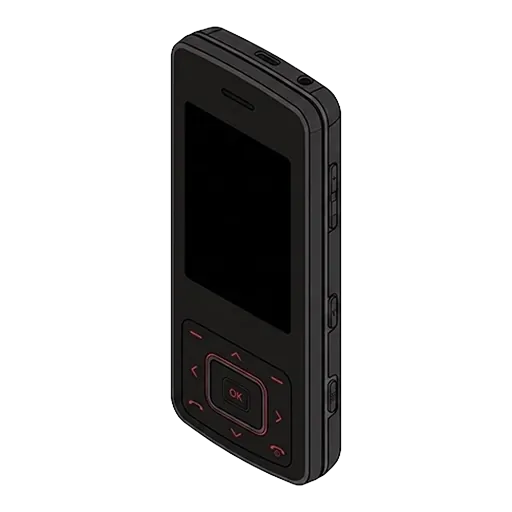
The Slab on the Verizon Counter
The demo unit feels unfamiliar under the thumb. Below the screen is a physical D-pad, Verizon’s concession to conventional controls. The soft keys and the send and end keys, however, are printed into the surface, lit from underneath and responding to a brush rather than a push. Sliding it open reveals twelve ordinary number keys. On a Verizon counter in the summer of 2006, the mix of controls could be disorienting.
In 2006, users expected buttons to move when pressed. Carrier displays were full of flips and sliders, camera megapixel counts dominated spec sheets, and an audible click gave the clearest indication that the phone had registered an input. LG deliberately challenged that expectation with a keypad that responded to proximity rather than pressure.
LG presented that difference as a selling point. Speaking to NBC News in July 2006, executive vice president Jae Bae called it “a breakthrough product for us,” and the phone's designer, Cha Kang-hee, described the intent more precisely: “This is designed to give users emotional satisfaction with a surprise.” The interior was designed to support that intended surprise.

Headwes ( talk ) ( Uploads ) · Wikimedia Commons · CC BY 2.5

LG’s Move Toward Premium Design
By 2005 LG had decided its phone business could not win on specifications, and went after the premium segment with a separate brand instead. The Chocolate was model number one in the new Black Label brand. It was a deliberate attempt to make a handset people would want to be seen holding, rather than a flagship defined by specifications.
The designer assigned to it had never designed a phone. Cha Kang-hee had spent his career on portable cassette players, audio gear and camcorders, and he proposed an unusual concept: a phone with neither a visible screen nor visible buttons, unlike a conventional handset. To put it into production, he had to persuade engineers and executives that removing familiar controls could be an advantage.
Outside observers were more enthusiastic than LG’s own staff. Peter Zec, who founded the Red Dot design awards, told NBC News the phone was “very charming. I can imagine teenagers really liking it.” That praise came at the height of interest in 2006, though a securities analyst in the same article was skeptical. Later accounts of the Chocolate often leave out that contemporary skepticism.
American coverage began before the phone reached stores. On November 4, 2005, Gizmodo ran a short item headlined “LG KV5900 Cyon Slider,” drawn from Slashphone, in which the writer admitted “that's unfortunately all I know about this slim slider.” Nine months later the same handset would be sitting in Verizon stores under a completely different name.
Erasing the Keypad
Removing a keypad requires more than a styling decision. A key that cannot move still has to register an input. Capacitive sensing does that electronically: a fingertip approaching a copper pad changes the capacitance around it by a tiny amount, and a controller reads the change and decides whether it counts. The system detects proximity in place of pressure, but fabric, moisture and static electricity can also affect it.
A Cypress Semiconductor PSoC handled that detection. An Embedded.com teardown of the Verizon VX8500 identifies it exactly — a CY8C21434-24LFXI, a single 32-pin package driving nine copper sensing pads. The same piece reports that Cypress first approached LG in May 2005, that development began around that August, and that the two companies co-wrote part of the handset's firmware. The companies took the system from their first meeting to a finished product in a matter of months, an ambitious schedule for a new design.
The teardown also lists what the touch system had to solve beyond simple detection: arbitrating priority when two keys register at once, distinguishing an electrostatic discharge from a legitimate fingertip, and moving the design from rigid FR4 board to flex circuitry. These requirements were part of the original design for a blank front face, rather than fixes added after complaints.
The technology also appeared in other markets. LG's own English service manual for the GSM Chocolate, dated April 2006, shows the same silicon in the navigation-key circuit: component U1000, a CY8C21434. The same chip family supported the touch controls across different radios, carriers and model numbers.
How Do You Lock a Button That Doesn't Move?
Touch sensing also raised the problem of accidental input in pockets. Mechanical keys resist contact with denim, whereas capacitive pads do not. LG documented its safeguard before complaints arose. The GSM Chocolate's official user guide describes a Touch Protection feature — the touch keys lock automatically when the slide is closed or a call is in progress, and unlocking from the closed state requires pressing the volume key twice. The same guide warns that conductive material such as metal touching the keys can cause errors.
The requirement to press “twice” was central to the safeguard. One press could happen by accident in a pocket; two presumably could not. The cost was that it also took two presses for the person deliberately reaching for their phone. In September 2006, firmware update T85VZV04 added speakerphone to the VX8500 and, alongside it, an option to unlock with a single press. Often described as a malfunction fix, the change partially relaxed a safeguard whose deliberate inconvenience had frustrated users.
The marketing name for all of this was Magic Touch. Behind the name were specific controls: input arbitration, ESD discrimination, automatic locking, double-press unlock. Keeping the front face clear required these additional rules.

The Random Editor · Wikimedia Commons · Public domain

The Front America Got
In the original design, the navigation key remained hidden in the blank front face until it lit up. The American version partly reversed that approach. On the Verizon VX8500 it came back as a physical D-pad — and that D-pad doubled as media transport controls. In the market LG most wanted to win, its phone built around removing visible front-face buttons arrived with some of them restored.

The Random Editor · Wikimedia Commons · Public domain

Other American revisions reinforced the visible controls and finish: a QVGA external display, a circular button cluster that emphasized the directional key, glossy metal trim, and roughly 100 grams on the scale, according to the surviving spec listings — a little heavier than the version sold in Europe. The touch wheel that remained looked, to more than one reviewer, like a shrunken iPod click wheel. Mobile Tech Review put it plainly: “The touch-wheel controls look much like a smaller version of the iPod click-wheel, but they're much more sensitive than those found on iPod.”

Petar Milošević · Wikimedia Commons · CC BY 4.0

No contemporary document explains why the American version partly reversed the phone’s defining design.
Verizon, Summer 2006
The VX8500 is reported to have gone on sale through Verizon's website in the last days of July 2006, reaching retail shelves in the first week of August. It listed at $199.99 on a two-year agreement with a $50 mail-in rebate, which put the real price around $149 — a price that could encourage impulse purchases of a phone sold on looks.
Verizon introduced colors absent from the original Chocolate. Alongside the default black Dark Chocolate, the lineup is said to have included Mint, White, Strawberry and Cherry Chocolate. The American range included pink and pale green alongside the unbroken black that had defined the handset.
The 2006 Verizon television spot for the LG Chocolate.
The extensive campaign also drew jokes from reviewers. Reviewing the phone that September, Mobile Tech Review's Tong Zhang wrote: “With the enormous marketing effort pushing the LG Chocolate phone, you wonder if everyone walking down the red carpet at movie premiers will have one in their Channel [sic] bags.” The luxury-brand reference reflected how heavily the phone was promoted as an accessory, and the reviewer’s fatigue with that promotion.
What the Reviewers Found
PCMag’s Sascha Segan gave it four stars out of five, with a verdict that remains apt: “This phone is an acquired taste, but it is a sweet one.” His camera assessment was more prosaic: “The flashless, 1.3-megapixel camera is about average in its field.” Its flashless 1.3-megapixel camera was ordinary for the time. Mobile Tech Review measured it against a rival on the same store wall, judging that the Chocolate's camera “can't compete with the Samsung SCH-a990's 3.2 megapixel quality, but it leads the 1.3 megapixel camera phone pack.”
CNET's Kent German scored it 7.0 out of 10 and wrote that “Though the LG Chocolate is beautifully designed and offers a respectable mix of features and performance, it doesn't quite live up to the hype.” Phone Scoop’s Eric Lin was harsher about call quality. Calls were choppy on a strong signal and dropped consistently on a weak one, he reported. The same review complained that you couldn't check the time without opening the slide — a gripe readers promptly argued with in the comments.
Reviewers disagreed sharply about the touch keys. Engadget's August 2006 mini-review reported that “Erroneous entries were frequent, including the occasional accidental phone call.” It also acknowledged that “The phone's pretty hot looking, no question.” A European review of the same generation praised those very keys for having “no moving details and thus almost no malfunctions and soiling, such common for standard buttons.” Both were written in 2006, illustrating how sharply the experience varied with the unit, firmware and conditions of use.
The often-repeated claim that the VX8500 was recalled for defective batteries is not supported by the record: the only Verizon–LG cell phone battery recall the U.S. Consumer Product Safety Commission documents is from June 24, 2004, covering roughly 50,000 counterfeit LG TM-510 batteries under recall number 04-559. That involved a different model and year. The documented battery shortfall was more modest: CNET's own testing returned 2.5 hours of talk time against a rated 3.5. That hour-long shortfall does not substantiate the battery-recall rumor.
Ten Million, and the Year People Get Wrong
On April 27, 2007, Engadget reported that LG had announced ten million Chocolates shipped — eleven months after the phone went global. Later retrospectives often place that milestone a full year earlier, in the spring of 2006. The contemporary reporting does not support it, and neither does the sales curve leading up to it.
The reported sales growth was already substantial. Mobile Mentalism estimated in November 2006 that about six million Chocolates had sold worldwide that year, three million of them in the preceding two and a half months, and noted that the model at one point accounted for around 18 percent of LG's total handset sales. By 2009, GSMArena and FoneArena were both putting cumulative Chocolate-family sales above 20 million.
English-language accounts often credit this one phone with turning LG’s handset business around single-handedly. Mobile Mentalism reported that LG posted a $33 million loss in the first quarter of 2006 and was profitable by year's end on the Chocolate's momentum. The reported recovery coincided with the Chocolate’s success, but the evidence does not establish that the phone achieved it “single-handedly”.
What Came After
The sequel changed suppliers as well as shape. The 2007 VX8550 paired a rotating navigation wheel with a touch keypad, and on August 27 that year Synaptics announced that its OneTouch capacitive solution had been designed into the second-generation model's four-button interface — replacing the Cypress silicon that defined the original. TechCrunch read the whole navigation redesign as LG answering complaints about the first Chocolate's touch keys.
Accounts generally list the American models that followed by name: the VX8550 Chocolate Spin, the VX8560 Chocolate 3, and finally the VX8575 Chocolate Touch, which put a capacitive touchscreen where the capacitive buttons used to be. Touch sensing had moved from the keypad to the entire front face, extending the original idea while replacing its form.
The line’s last substantial design was the BL40 of 2009, the fourth Black Label model, which GSMArena and FoneArena both reported was built by the same team that designed the original Chocolate. It carried a four-inch 800×345 display — a 21:9 shape almost nobody was making in 2009 — and a five-megapixel camera, and FoneArena flatly called it an iPhone killer. Its official launch event was held in Hong Kong on November 4, 2009. Western coverage and photo captions sometimes call it the Chocolate 2; whether LG ever used that name officially is not established.

LGEPR · Wikimedia Commons · CC BY 2.0

LG reportedly crossed 100 million handsets in 2008, passing Motorola to become the world's third-largest maker. Thirteen years later, on April 5, 2021, the company's board formally shut the phone business down. The keypad design helped LG approach the top of the industry, though its eventual decline lasted much longer than that rise.
Sixteen Years Later
The Chocolate retains a modest presence on YouTube, where people charge one up and read out what remains stored on it. A 2022 video titled “What's on my LG Chocolate...16 years later” shows a phone once bought for its looks being revisited for what it contains.
A 2022 retrospective: what's still stored on an LG Chocolate sixteen years on.
By current standards, its screen is tiny; the choppy calls and occasional accidental dialing would remain drawbacks. The underlying engineering remains notable: nine copper pads, one sensing chip, a flex circuit and a stack of lock-out rules, all needed to give the front face its blank appearance. Yet the D-pad returned in the market that mattered most, without a documented contemporary explanation.
The Chocolate's front keys were capacitive pads read by a single Cypress PSoC — a CY8C21434-24LFXI driving nine copper sensing pads.
ESD discrimination, two-key priority handling and the move from rigid FR4 to flex circuitry were designed in from the start, not patched in after launch.
Verizon sold the VX8500 from late July 2006 at $199.99 on contract with a $50 mail-in rebate, and reportedly reached five chocolate-themed colors.
American reviewers differed sharply: PCMag gave it four stars, CNET 7.0 out of 10, and Engadget reported frequent erroneous entries — while a European review praised the same keys for having no moving parts to fail.
LG announced ten million Chocolates shipped in April 2007, not 2006 as later retrospectives often claim; the battery-recall story is a confusion with a 2004 counterfeit-battery recall.
“I don't think LG is out of the woods yet.” — Greg Roh, securities analyst, speaking to NBC News in July 2006
The Chocolate’s seemingly buttonless face required a dedicated sensing chip, a flex circuit and four layers of lock-out rules. For the market LG most wanted to win, the company restored a physical D-pad.
Sources
- Tear down handsets: Touch sensor permits more functions in less space
- LG-KG800 사용설명서(터치 보호 기능 안내)
- Cypress Semiconductor 2005 Annual Report
- LG VX8500 Chocolate gets speakerphone
- LG has shipped ten million Chocolates
- LG KG800 (Chocolate) review
- LG Chocolate review
- LG VX8500 Chocolate by LG
- LG Chocolate VX8500 for Verizon
- CPSC, Verizon Wireless Announce Recall of Counterfeit Cell Phone Batteries
- NBC News, 2006년 7월 21일 LG 초콜릿폰 보도
- 2006년 LG전자 최고 뉴스, '초콜릿폰 히트'
- 한국경제, 2006년 2월 안승권 단말연구소장 인터뷰
- 파이낸셜뉴스, 2007년 12월 초콜릿폰 누적 판매 결산
- [응답하라, 그때 그 휴대폰] LG 초콜릿폰