The Color Flip Phone America Never Got
It reached American counters in August 2002 as a Sprint handset; Europe had received the same design that spring as the SGH-T100. Many later claims about it do not hold up against the dates.
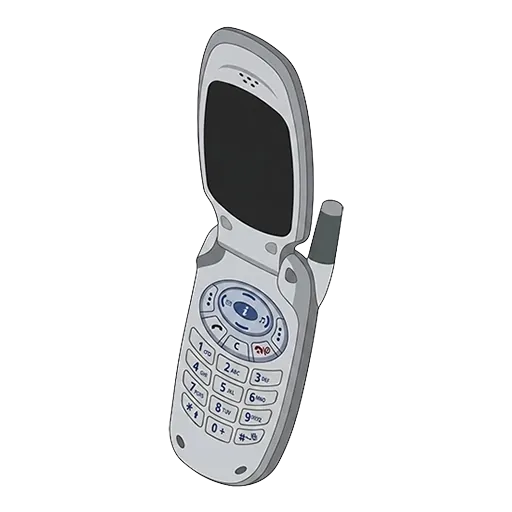
In August 2002, Sprint stores began carrying a small folding phone with rounded sides and a color screen behind the lid. Sprint’s paperwork used the carrier branding typical of the era: "the PCS Phone by Samsung A500." The smooth closed shell concealed a color screen, still an unusual feature on a phone that year.
In Europe, a similar design had a different name and radio. It was the SGH-T100, a GSM phone that had opened CeBIT in Hannover that March and would pass ten million units the following year. The two are routinely described as one machine, although they were distinct models. The distinction matters, as do the dates that contradict so many later claims about this phone.
Third Place, Before the Phone
The market standings are a useful place to start checking those claims. Gartner's tally for 2001 put Siemens third in the world at 29,753,000 handsets and 7.4 percent of the market. Samsung was fourth, at 28,234,000 and 7.1 percent, with Ericsson fifth at 26,956,000. The top two sold far more handsets: in the second quarter of 2002, Nokia moved roughly 35.1 million units for 35.6 percent of the market and Motorola about 15.5 million for 15.7 percent. Samsung was chasing a company only slightly ahead of it.
Samsung then overtook Siemens. Writing up Gartner's first-quarter 2002 numbers, Telecompaper listed the field plainly: "Motorola, Samsung and Siemens came up second, third and fourth." The figures behind that sentence are 9,030,000 units for Samsung against 8,229,000 for Siemens. By the second quarter, RCR Wireless was calling Samsung "now the No. 3 vendor," and The Register put the same quarter at roughly 9.3 million units for Samsung and 8.2 million for Siemens. For the full year, Gartner's end-user tally had Samsung at 41,684,400 units and 9.8 percent, up from 7.1 percent the year before.
The first quarter of 2002 ended in March; the T100 did not go on sale until April. The familiar story — that this phone lifted Samsung into third place — puts the effect a month before the supposed cause. Sources cannot even agree on when the title was won; a wire report from early 2003 dates it to the third quarter of 2002. But no version of the timeline waits for the phone, and placing the launch and the ranking in adjacent paragraphs can suggest a causal link that the dates do not support.
Opening Day in Hannover
The T100 was shown on the opening day of CeBIT in Hannover in March 2002 — the German trade press wrote it up on the 13th — and went on sale that April at €599. That was a substantial price for a phone without a camera, GPRS or Bluetooth. Its attraction was the folding design and color TFT behind the lid. Samsung was not new to European GSM — the SGH-600 had been in that market since 1998, on its way to ten million units of its own. In 2002, the company put the screen and shape first, pricing the phone on their appeal.

AnVuong1222004 · Wikimedia Commons · CC BY-SA 4.0 · AnVuong1222004 · CC BY-SA 4.0
.png)
With its short feature list, the phone sold on the appeal of the object itself: how it looked and felt when picked up in a shop. Those first ten seconds in the hand underlie its later reputation.
The Pebble and Its Color Screen
At 88 by 50 by 22 millimeters and 94 grams, its dimensions were unremarkable, but its shape stood out. Samsung's designers rounded the corners and curved the sides outward, so the closed phone sat in a palm without an edge touching anything, prompting repeated comparisons to a pebble. Samsung adopted that description in its own retrospectives. Its designer is less often named: Hyun Sang-min, a senior designer at Samsung Electronics. He received the company’s internal design honor for this shape in 2002. The award category had been created in 1997, following the company’s declaration of a corporate design revolution the year before.

AnVuong1222004 · Wikimedia Commons · CC BY-SA 4.0 · AnVuong1222004 · CC BY-SA 4.0
.png)
The main display was a 128×160 TFT in 4,096 colors, showing twelve lines of text at a time, with a three-line monochrome window outside the lid. Its 720mAh removable lithium-ion pack was rated for 60 hours of standby and 80 minutes of talk, and the phonebook held five hundred entries. No camera, no GPRS, no EDGE, no Bluetooth, no Wi-Fi. In 2002 the extravagance was putting two screens on one phone; everything missing was the price of that.
A 2002 television spot for the T100, preserved from a VHS recording.
In 2002, the choice of color display still came down to cost. The cheap route ran through STN-derived panels, and Samsung announced one of its own that same spring: UFB-LCD, which matched TFT's 65,000 colors at 30 to 40 percent lower production cost but topped out dimmer — 170 candela against TFT's 200. Later accounts routinely attribute the cheaper panel to the T100, contrary to the company’s own press release: the first two phones to carry UFB were different models entirely. The T100 used TFT, accounting for its higher cost.
Not a Rebadge
The A500 is usually described as the T100 with different lettering, but the documentation distinguishes them. The phone sold in Europe was dual-band GSM: the cover of Samsung's own English-language manual calls it a "DUAL BAND GSM TELEPHONE," and the Hungarian edition's certification table lists GSM 900 and DCS 1800, and nothing else. The A500 was a CDMA phone. Its FCC ID is A3LSPHA500, and the 2002 test report filed under it records PCS CDMA testing alongside a "Tri-Mode Dual-Band" classification. The phones shared a generation and folding color design but used different radios. That distinction is also the likely source of the stray claim that the T100 was a tri-band phone. That specification belongs to its American sibling.

Samsung · Wikimedia Commons · Public domain · Samsung · Public domain

The models also differed in their camera options. Sprint's September 2002 announcement of its PCS Vision service notes that "The PCS Vision Camera is compatible with the PCS Phone by Samsung A500 and the PCS Phone by Samsung N400" — the camera is named there as a separate product the phone works with, not as a feature inside it. For the GSM original, the record is clear: GSMArena's spec sheet for the SGH-T100 lists no camera. Yet two decades later, retrospectives would credit this phone with a built-in camera absent from its spec sheet.
August, and Half a Million
American sales started in August 2002. By October the A500 had sold 500,000 units. Samsung's own market-by-market tally that November reads: 2.05 million in Europe, 550,000 in Southeast Asia, 500,000 in China under the name SGH-T108, and "500,000 in the US (model name in the US: SPH-A500)" — 4.5 million worldwide in roughly six months. A Taiwanese trade report that December expected six million by the end of the year.
Half a million is a respectable number for a phone most American buyers could not have named, and it is the reason two opposite claims about this device are both wrong. Samsung's corporate retrospective states that the phone went on sale in the United States in August 2002 — which reads like an error to anyone who has combed American GSM carrier archives for an SGH-T100 and come up empty. The retrospective omits the change in model number for the American market.
One Carrier, One Name
American buyers chose the phone from a carrier’s catalog. The name on it was Sprint's format rather than Samsung's — "the PCS Phone by Samsung A500" — and Samsung's own manual for the model walks the owner through signing up with Sprint and activating the handset on Sprint's network. The handset was tied to that operator and its branding.
The timing put it at the front of Sprint's data push. In September 2002, a month into the phone's American life, the carrier announced PCS Vision, and the A500 was one of the two phones the service's new camera was said to work with. In America, the phone arrived as part of a carrier service, under the network’s branding, with its color screen visible from three feet away when the lid opened.
The evidence supports a narrower account: a CDMA sibling of the T100 sold here, through one carrier, in real volume. What has never surfaced is evidence of a phone called the SGH-T100 being sold under that name by an American GSM operator. The documented American sales were through Sprint under its own model name.
Ten Million, but Not the First
The T100 crossed ten million units in 2003, roughly a year and five months after launch. Samsung treats it as the start of a successful series: the E700 that followed in the second half of 2003, the Blue Black phones that together managed sixteen million, the E250 in December 2006, the J700 in 2008. Samsung continued to develop the design approach it had established.
The corporate account omits the earlier phone to reach that total. Four years earlier, the SGH-600 — a GSM handset built for Europe — had already sold ten million units, a fact recorded without drama in the Korean daily press of 2002 while the T100 was still climbing. Contemporary coverage distinguished the speed of sales in 2002 — 4.5 million units in six months — from the total reached. Somewhere between those reports and later anniversary pieces, that qualification disappeared, turning a sales-speed record into a claim to being first.
Another later claim concerns the phone’s nickname. In Korea the device is the chairman's phone, after Lee Kun-hee, who ran Samsung for decades. The nickname is older than most people assume. A trade paper used it in April 2007, describing it as a customer pet name rather than a manufacturer’s marketing term. Its use peaked in October 2020, when Lee died; it did not originate then. The record shows that he took an active interest in design, followed the product from the development stage and carried one himself. That interest was evident well before 2002: a 1995 bonfire of defective handsets at the company’s Gumi plant and a 1996 new-year address declaring a design revolution preceded it by six and seven years. The more common claim that he drew the phone has no primary source in either the corporate history or designers’ accounts. The design award for this phone went to Hyun Sang-min in 2002. The nickname instead credited Lee.

Republic of Korea · Wikimedia Commons · CC BY-SA 2.0 · Republic of Korea · CC BY-SA 2.0

What the Reviews Actually Said
For a phone that sold ten million units, few substantial contemporary reviews survive. Two survive from 2002 with any depth — a German news item out of CeBIT in March and a long mobile-review.com writeup in October. The user comments on the phone’s GSMArena page offer no contemporary record: all were posted in 2025 and 2026. Online accounts rely almost entirely on later recollections, which helps explain the errors that recur in them.
A 2002 video review of the SGH-T100, from a collector's archive channel.
The October review balances admiration with practical reservations. On the screen: "T100 is a first series model, which has a color screen and a successful realization." On the gaps: no infrared, no GPRS, no MMS, no EMS. On the money: roughly $450 to $500 at European retail that autumn. Its verdict was that this was a fashion phone with simple functions and an excellent example of the breed — a combination of praise and reservation that closely fits the record.
Other praise appeared in November 2002 press reports, which said that an Italian fashion magazine called the design ergonomically excellent and reminiscent of a UFO, and that the phone reached the final round of Germany's iF design award. These were secondhand reports about how the phone looked and felt. They did not discuss data rates, because the phone had none.
What It Left Behind
On November 7, 2002, Samsung installed an oversized sculpture of the phone at the entrance road to Charles de Gaulle airport in Paris. The company gave a practical explanation: conventional advertising was restricted along that stretch, and a sculpture is not conventional advertising. Another went up in downtown São Paulo. The television campaign was reshot market by market — localized versions from Poland, Spain, Russia and the Czech Republic are still online, some of them preserved by people who taped them off the air two decades ago.
Samsung continued the same commercial approach, making slim folding handsets with better screens, and the E250 that arrived in late 2006 is credited with fifty million units. It outsold this one five to one, yet the earlier phone retained the more celebrated story.
Five-Line Recap
Shown on CeBIT's opening day in March 2002 and sold from April at €599, the SGH-T100 was an 88×50×22mm, 94-gram clamshell built around its shape rather than its spec sheet.
The main display was a 128×160 TFT in 4,096 colors with a three-line monochrome window outside; there was no camera, no GPRS and no Bluetooth, and the panel was not the cheaper UFB-LCD it is often credited with.
America bought it as the Sprint SPH-A500, a CDMA sibling with its own FCC filing — not a rebadge of the GSM original, which was a dual-band 900/1800 phone.
It passed ten million units in 2003, but it was not the first Samsung to manage that: the SGH-600 had done it four years earlier, and the new record was the speed, about a year and five months.
Samsung already sat third worldwide in Gartner's first-quarter 2002 tally, a month before this phone went on sale, so the ranking it gets credited with creating was there before it arrived.
"The total impression after using SGH-T100 is very positive, but you should remember that it is a fashion phone with rather simple functions" — mobile-review.com, October 2002
The T100 earned its place with a color TFT and an appealing shape when neither was ordinary. Later claims that it was Samsung’s first ten-million seller or that it pushed the company into third place do not hold up against the dates.
Sources
- 다섯 번째 텐밀리언셀러폰 탄생
- 삼성전자, 新개념 UFB-LCD 채용 컬러 휴대폰 본격 출시
- SGH-T100 User Manual (English, for Europe)
- FCC ID A3LSPHA500 Test Report (Samsung SPH-A500)
- Samsung Phone a Global Hit
- Sprint Touts PCS Vision
- Worldwide mobile phone sales declined 4% in Q1 2002
- Samsung T100 - Full phone specifications
- Samsung SGH-T100 Review
- [人터view] 현상민 삼성전자 수석디자이너 (상)