ThinkPad 701C — The Keyboard That Unfolded
The often-quoted $1,499 price for the ThinkPad 701C came from a 1996 cut, not IBM's launch list. Hardware Announcement 195-063 priced the Type 2630 from $3,799 to $5,649. TrackWrite put an 11.5-inch keyboard on a 9.7-inch chassis. IDC called it 1995's top-selling notebook.
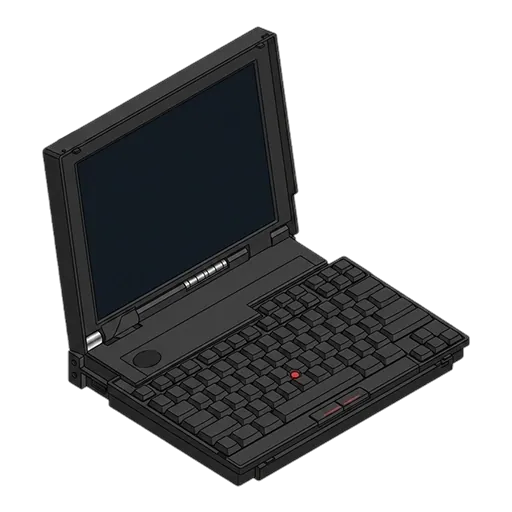
The price most often remembered is $1,499. IBM's Hardware Announcement 195-063, dated March 7, 1995, put the single-unit list for ThinkPad 701C and 701CS Type 2630 at $3,799 to $5,649. The familiar price reflects a later reduction.
Open the lid and an 11.5-inch TrackWrite keyboard hangs off a 9.7-inch chassis. The machine weighs 4.5 pounds — 2,050 grams — not 2.25 kilograms. Retrospectives often treat its short life as evidence of a flop. IDC, quoted in BusinessWeek in February 1996, put 1995 sales at 215,000 and called it the year's top-selling notebook PC.
The 10.4-Inch Problem

nakashi · Wikimedia Commons · CC BY-SA 2.0 · nakashi · CC BY-SA 2.0

Early-1990s subnotebooks became easier to carry as they shrank, but harder to type on. Wrap a chassis around a 10.4-inch LCD and an adult-sized keyboard no longer fits. Enlarge the glass and the whole computer grows. IBM's remaining move was to let the keyboard grow only when it was needed.
The announcement lists dimensions of 9.7 by 7.9 by 1.7 inches and a weight of 4.5 pounds, 2,050 grams, including the nickel-cadmium battery and the modem. That differs from the often-quoted 2.25 kilograms or 4.96 pounds.
Not a Yamato-Only ThinkPad
The Butterfly is often associated with IBM's Yamato lab, which defined the ThinkPad line, but the mechanism originated elsewhere. John Karidis, a mechanical engineer at IBM Research in the United States, invented the split keyboard. IBM's own history page credits him with the invention, rather than Yamato.
The product was a collaboration. MoMA credits the keyboard to Sam Lucente, with Karidis and Robert P. Tennant, and the overall design language to Richard Sapper in Milan. Manufacturing was based in Raleigh and Research Triangle Park, with Yamato also involved in development. The compact computer drew on work across those locations.
A later account from Lenovo executive Dilip Bhatia has Karidis watching his three-year-old daughter fit wooden blocks into shapes. It is secondhand, not a contemporary note from Karidis. It still describes the idea: a broad surface can hide inside a smaller outline if it stops being one rigid slab.
An 85-Key Keyboard the Lid Opens

Raymangold22 · Wikimedia Commons · CC0 · Raymangold22 · CC0

TrackWrite is an 85-key keyboard, split on a diagonal through the 4, T, H, and M keys. It is not a tray the user folds. Raising the lid drives a cam: the halves lift, travel outward, and hang past the chassis. Closing reverses the sequence. One half moves beneath the other, allowing them to overlap inside the narrower body.
MoMA measures the open keyboard at about 11.5 inches — 29.2 centimeters — wide. IBM's announcement said almost an inch of overhang per side. Folding reduced the space it occupied in transit, though the open keyboard still needed desk space.
On the Lenovo Think channel — the successor brand's period demo, not an IBM original.
The fifty-five-second clip shows the same linkage. The lid, rather than the user's fingers, unfolds the keyboard.
701C Is TFT. 701CS Is DSTN

Mikebabb · Wikimedia Commons · CC BY-SA 3.0 · Mikebabb · CC BY-SA 3.0

The 701C uses a 10.4-inch active-matrix TFT. The 701CS uses a dual-scan DSTN of the same size. The panel type distinguishes the two models. The CPU is an Intel 486 DX2-50 or DX4-75. The type is 2630. There is no Pentium SKU.

MKFI · Wikimedia Commons · Public domain · MKFI · Public domain

The photographed label shows this is not a 701C: it has the same butterfly keyboard but a different panel. The red external floppy in the case reflects another consequence of the small chassis: the drive had to sit outside it.
4.5 Pounds, Not 2.25 Kilograms

Thomas Cloer · Wikimedia Commons · CC BY-SA 2.0 · Thomas Cloer · CC BY-SA 2.0
.jpg)
Wikipedia gives a weight of about 2.25 kilograms, 4.96 pounds. IBM's announcement gives 2,050 grams, 4.5 pounds, including the system unit, the nickel-cadmium pack, and the modem. That figure excludes the AC adapter and the external floppy.
Widening the keyboard pushed other parts out. The 3.5-inch 1.44MB floppy is external. A MultiPort II replicator carries some of the connectors. The PCMCIA space accommodates one Type III card or two Type II cards. The keyboard lifts so you can reach the battery.
Launch memory was 4MB standard and 20MB maximum on DX2 machines, 8MB and 24MB on DX4. Hard disks were 360MB or 540MB; 720MB arrived in September 1995. The catalog's 4–40MB range comes from a later PSREF entry rather than the March list.
March 7, $3,799 to $5,649
Hardware Announcement 195-063 is dated March 7, 1995. DX2 models were scheduled to be available that day; DX4 on March 31. Plenty of later write-ups use March 6. The New York Times of March 7 said IBM had spoken "yesterday," so the press day was the 6th. The letter's date is the 7th.
Do not print $1,499 as the launch price. IBM's single-unit list ran from $3,799 — SKU 2630-US2 — to $5,649 — 2630-5TU. The Times the same week rounded to $3,800–$5,600. The $1,499 figure is the "latest cuts" floor in BusinessWeek of February 19, 1996, later copied onto PSREF sheets. Pentium notebooks were already in use in America while this machine still shipped with a 486.
A fan upload of a period TV spot. Not an official IBM channel.
The fifteen-second spot compares a hand with a subnotebook. Demand also put pressure on the factory. The Times reported that advance orders already exceeded manufacturing, with catch-up likely well into the second quarter.
215,000 Units
The reported sales do not support calling it a flop. BusinessWeek of February 19, 1996, quoting International Data, put the total at 215,000 and called the 701 the top-selling notebook PC of 1995. The figure comes from IDC, rather than an audited IBM 10-K. It still contradicts the account that poor sales ended its run.
The same story counted 27 design awards. Japan's Good Design gold for the 701C in 1995 is independently listed. This page will not enumerate all 27.
PC Magazine's Brian Nadel wrote that the $5,000 ThinkPad 701C had successfully taken the sub out of subnotebook. The opening motion worked as both a sales demonstration and a practical way to create a typing surface.
Taking the Sub Out of Subnotebook
The strength is that cause and effect are visible. A small notebook needs a wide keyboard; opening the lid creates one. Eighty-five keys travel past the chassis, and TrackPoint III in the center keeps the result a ThinkPad. The motion makes the mechanism understandable even before reading the manual.
Its weaknesses reflected its generation of hardware. On announcement day the Times noted the older Intel 486 rather than the faster Pentium. IBM's typical battery figure, from industry tests on the DX2-50 nickel-cadmium pack, was 2.5 to 7.0 hours; contemporary reviews still called the endurance iffy. The forward-looking keyboard sat above hardware caught between chip generations, at a substantial price.
Windows 95 Did Not Kill It
The record does not identify Windows 95 as a reason for the Butterfly's discontinuation. The launch operating system was PC DOS 6.3 and Windows 3.11; DX4 models dual-booted OS/2 Warp 3.0. Windows 95 itself arrived on August 24, 1995. A later Japanese 2630-7TW bundled it. The primary record does not identify that bundle as a reason for discontinuation.
The record points to two reasons. Development slipped from a 1993 concept and a late-1994 target into March 1995, so a 486 machine landed among Pentium notebooks. Larger LCD panels also became available. David Hill told Computerworld in 2011 that once IBM cracked a larger piece of glass, the expanding keyboard became much less necessary. IBM's history page says the same: production delays, and screens already large enough for a full-size keyboard. The Computer History Museum caption agrees.
On November 21, 1995, announcement 995-123 withdrew DX2 701C and 701CS models from IBM marketing effective December 21 — SKUs 2630-UT2, UT5, US2, and US5 only. After that date, leftover units were still available through remarketers and IBM PC Direct. DX4 models took a price cut on February 9, 1996; PSREF marks withdrawal by mid-1996. The withdrawal therefore did not cover the whole family on December 21.
MoMA 112.1996
The Museum of Modern Art holds ThinkPad 701 Portable Computer, 1995, object 112.1996, a gift of the manufacturer. Closed: 9 11/16 by 7 7/8 inches. Opened: 11 1/2 inches wide. The card names Lucente, Karidis, Tennant, Sapper, and IBM.
The Computer History Museum holds object 102707367, a gift of Gregory Joseph Badros. Domus writes that the machine also sits at Die Neue Sammlung in Munich. No object number there was found during this review; the available exhibition photograph does not establish an accession record.
On film the 701 is a prop, not a gadget. In GoldenEye (1995), Bond fidgets with one during Q's briefing — a brief bit, not a product-placement set piece. Starring the Computer logged the shot. Mission: Impossible (1996) and Blood Diamond (2006) use one too. These appearances place a black computer in the frame without making it one of Q's gadgets.
The 701C did not establish a line of modern laptop successors to TrackWrite; later notebooks generally avoided its complexity. Its more limited design lesson concerns a changeable shape: when two physical requirements cannot fit within one rectangle, the object can take different shapes in use and in storage. Such a solution will not always justify the tooling cost. In 1995, for one ThinkPad priced like a serious business machine, it did.
IBM's launch list was $3,799 to $5,649. The $1,499 figure is a 1996 cut, not the Hardware Announcement price.
TrackWrite is an 85-key lid-driven keyboard: 11.5 inches open, on a 9.7-inch, 4.5-pound, 2,050-gram chassis.
701C is 10.4-inch TFT; 701CS is DSTN. John Karidis at IBM Research invented it; Raleigh, Yamato, and Sapper built the product.
IDC via BusinessWeek: 215,000 units, 1995's top-selling notebook. Its short life reflected delays to a 486 machine and larger LCD glass, rather than Windows 95.
MoMA object 112.1996 is confirmed. Die Neue Sammlung is cited by Domus, but no accession number was found in this review.
“We cracked the code on making a larger piece of glass, so the need for having this expanding keyboard became much less.” — David Hill, Computerworld, 2011
The ThinkPad 701C did not launch at $1,499. IBM's March 7, 1995 list ran from $3,799 to $5,649, and the machine weighed 4.5 pounds — 2,050 grams — not 2.25 kilograms. John Karidis at IBM Research in the United States invented the 85-key TrackWrite; Raleigh, Yamato, and Richard Sapper turned it into a product. IDC, via BusinessWeek, put 1995 sales at 215,000 and called it the year's top-selling notebook. Larger LCD glass, not Windows 95, made the mechanism unnecessary. MoMA holds it as object 112.1996.
Sources
- IBM Hardware Announcement 195-063 — ThinkPad 701C and 701CS
- Hardware Withdrawal 995-123 — selected ThinkPad systems
- I.B.M. Fails to Meet Demand on Thinkpad — Laurie Flynn, NYT 1995-03-07
- ThinkPad 701 Portable Computer. 1995 | MoMA
- ThinkPad | IBM
- IBM ThinkPad 701 — withdrawn (PSREF sheet)
- IBM's Butterfly On A Pin — BusinessWeek 1996-02-19
- ThinkPad 701 with butterfly keyboard — CHM Revolution
- Flashback: What killed IBM’s Bufferfly — David Hill, 2011
- How a toy inspired the butterfly keyboard — Dilip Bhatia, 2021
- IBM Thinkpad 701C, the 1995 “butterfly” laptop — Domus
- Starring the Computer — IBM Thinkpad 701
- Thinking Laterally ThinkPad 701c (1995) — Lenovo Think