Atari 2600 — The Living-Room Cartridge Box
Fall 1977, about $199, two sticks, paddles, and Combat. 128 bytes and a cartridge slot turned a living-room box into a software business. The cartridge business brought Space Invaders and Activision, followed by a glut, a $180 million quarterly loss, and a landfill in New Mexico. ATARI 2600 first appeared on the fascia of the black four-switch model late in 1982.
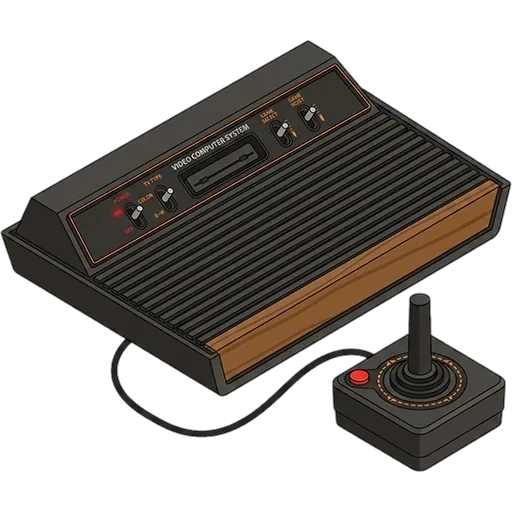
Fall 1977, an American living room. The box under the television had a woodgrain finish to match the furniture. You pushed in a cartridge and the next game arrived. Inside were 128 bytes of RAM and no framebuffer. The fascia read VIDEO COMPUTER SYSTEM rather than 2600.
It was not the first cartridge console. Fairchild’s Channel F commercialized interchangeable ROM cartridges in 1976. The VCS turned the cartridge into a mass software market, with hit games followed by a glut, a crash, and a landfill in New Mexico. Checking the numbers gives a better account than attributing the industry's collapse to one game.
After Pong, the living room
In the mid-1970s a home video game was a box with games baked into its circuitry. Pong machines offered a handful of variations and then ran out of novelty. If a household wanted something new, the manufacturer’s most dependable answer was another box. The business sold hardware to solve a shortage of software.
Fairchild got there first with Channel F in 1976. IEEE Spectrum’s March 1983 design history noted that many companies had tried programmable machines and that most of them — including Fairchild — had sold poorly. By 1983 the consoles in demand were the VCS, Intellivision, Odyssey 2, and ColecoVision. The first cartridge console was not the one that won the cartridge market.

Evan-Amos · Wikimedia Commons · Public domain · Evan-Amos · Public domain

The woodgrain helped a computer look at home beside the family television. Six switches, still lettered video computer system. The photograph is a Light Sixer from about 1978, not the heavy 1977 launch box.
A bicycle named Stella
The Computer History Museum’s prototype X725.86 is Steve Mayer and Ron Milner’s machine: a stock Jolt 6502 card, software assembled on a PDP-11. The first program that ran on it was a forerunner of Combat, the cartridge that would ship in the box.
The chip project was called Stella, after Joe Decuir’s bicycle. The Television Interface Adapter took the same name and had no framebuffer. Software had to build the picture as the electron beam traced each scanline of an American television.
A living-room toy needed a smaller parts budget than a general-purpose computer. Warner Communications bought Atari for $28 million in 1976. IEEE’s 1983 case history says the purchase leaned heavily on expectations for the VCS. The lab project now had a media conglomerate’s backing.
Racing the beam with 128 bytes
The finished CX2600 is built around a MOS 6507 running at 1.19 MHz. That is a cost-reduced 6502 in a 28-pin package, not a 40-pin 6502 dropped into a game. The 128 bytes of RAM live inside the RIOT chip, not on a separate memory board.
The TIA holds no finished frame. A program has to retune registers as the beam moves, and the kernel has to finish a frame in 15.24 milliseconds. Racing the beam describes the work literally: a VCS programmer had to time the game code to the television picture.

Evan-Amos · Wikimedia Commons · Public domain · Evan-Amos · Public domain

The launch bundle included two joysticks and paddles. The stick in the photograph is the CX40: one hexagonal shaft, one red fire button. The Science Museum catalogs a standard CX40 with the CX-2600, dated 1978. An earlier CX10 exists in collector literature. This picture is the CX40.
A $199 bundle
The United States launch was fall 1977. The Science Museum’s package is about $199, two joysticks, and Combat. Paddles came with it. Wikipedia’s $189.95 and the museum’s $199 disagree; this piece prints about $199. There is no clean nationwide store-open day in the record.
Production started in July 1977. IEEE says Atari was late delivering to retailers for Christmas. Joe Decuir later put that year’s production at 250,000 units. That was a modest start compared with the later totals.
A period launch-window spot dated December 17, 1977 in its title — the cartridge and more-games pitch, not the 1982 jingle. Fan reupload, not an official Atari channel.
The commercial emphasizes the next game buyers could play. That was already the business model in the winter the machine arrived late for Christmas.
Space Invaders, the killer cart
The turn is March 1980, when the VCS edition of Space Invaders hit shelves — the Washington Post and the Chicago Tribune both place it that month. In IEEE’s 1983 history Larry Kaplan said the VCS had looked as if it were dying, and then Space Invaders arrived, and bam. One cartridge made established hardware newly desirable.
Atari Archive, working from internal figures, puts lifetime sales around 6.2 million: 1.3 million in 1980, 2.9 million in 1981, 1.3 million in 1982, 435,353 in 1983, and 161,000 from 1986 to 1990. It is recorded as the first home cartridge to pass a million copies in a year. Pac-Man later outsold it. Calling Space Invaders the all-time best seller is wrong.

Kevin Savetz · Wikimedia Commons · CC BY 2.0 · Kevin Savetz · CC BY 2.0
.jpg)
The cartridges on the carpet show what the software business sold. The sharp label in front is Fox Video Games’ Attack of the Killer Tomatoes, 1983. The pile brings together first-party hits and the third-party glut.
Activision, after Atari said no
Successful cartridges did not carry designer credits. Atari refused credits and royalties. In May 1979 David Crane and his colleagues met with Ray Kassar. On October 1, 1979, Crane, Larry Kaplan, Alan Miller, Robert Whitehead, and Jim Levy incorporated Activision.
Atari sued them for selling VCS games without permission. This was not a platform designed as an open licensed system. The case settled in December 1981, with Activision paying royalties. An independent console publisher became a viable business. Atari could not simply control who made cartridges for the slot.
The black box that finally said 2600
The familiar Atari 2600 name dates from after 1977. Atari rebranded the VCS in November 1982, when the 5200 launched. The catalog’s 1982-11 is that window, not a ceremony.

Evan-Amos · Wikimedia Commons · Public domain · Evan-Amos · Public domain

The 1980–82 wood four-switch simplified the fascia by moving the difficulty switches off the front. The plate still reads VIDEO COMPUTER SYSTEM. There is no 2600 on the face.
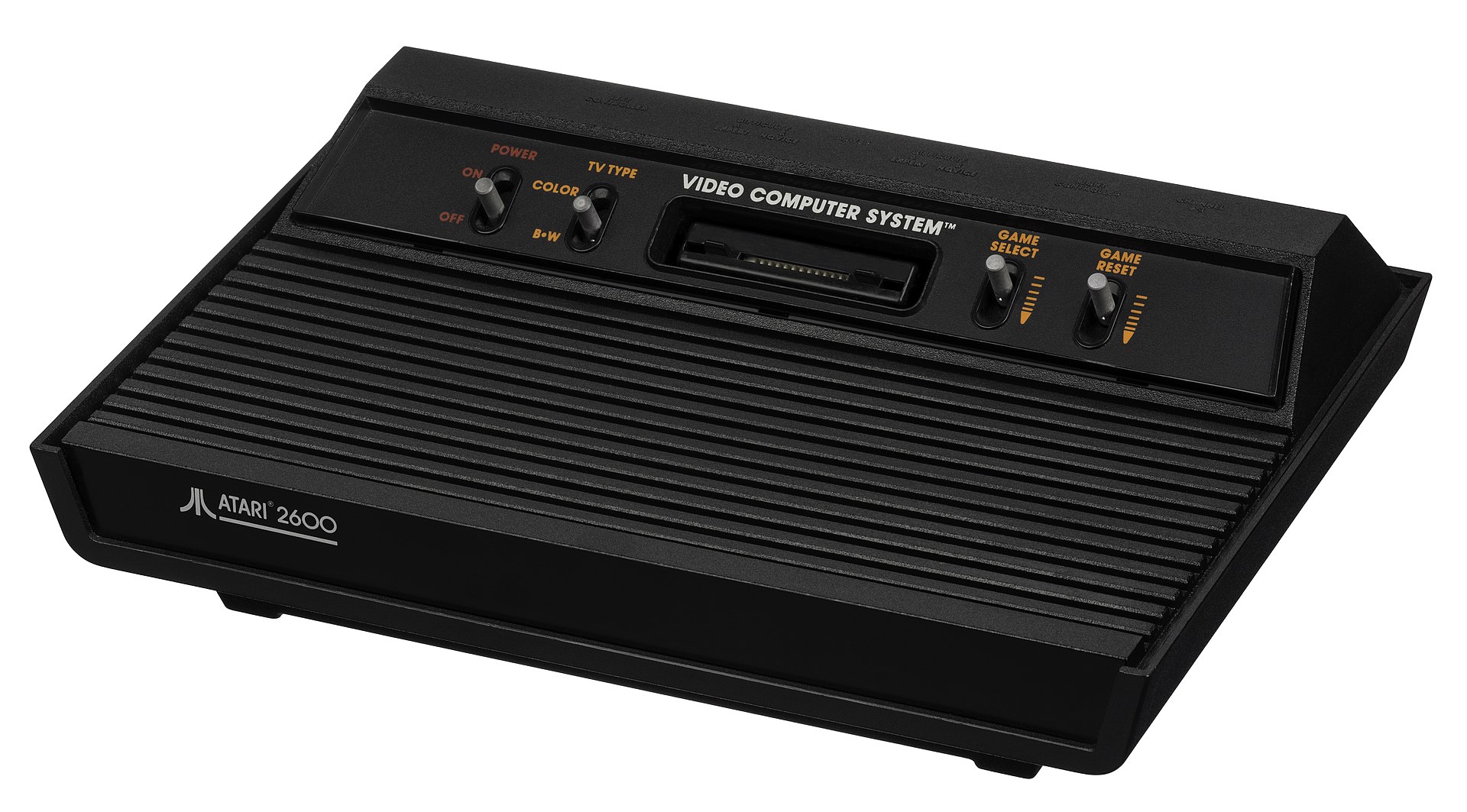
Evan-Amos · Wikimedia Commons · Public domain · Evan-Amos · Public domain

The all-black four-switch, nicknamed the Vader, is the first retail fascia to read ATARI 2600. The switch plate still says VIDEO COMPUTER SYSTEM. The photograph shows the change of name. Do not read this black box back onto the 1977 launch.
The 1982 “Have you played Atari today?” jingle — a household-name spot from the year the machine was renamed 2600, not a substitute for the 1977 launch ad. Fan reupload.
By then the machine was a familiar part of the living room. The jingle asks whether you have played it today, without needing to introduce it.
Strengths and limitations of the same design
The great strength was that software could keep renewing the hardware, with its cheap chips, one stick and one button, and paddles. The CX40 became shorthand because the controls were that austere, and because the library behind them kept changing.
The same design imposed limits: 128 bytes, no framebuffer, and 15.24 milliseconds. Those limits rewarded expert programming and made ordinary production schedules difficult.
The business carried the same split. Activision proved an independent publisher could exist. Atari had sued first; after the settlement, the cartridge market grew rapidly. Good games sold the console. Not every firm attracted by that market produced good games.
$180 million, and a landfill
The 1983 crash involved overproduction, a third-party glut, home computers, and bad forecasts, as well as E.T. The New York Times of October 17 and the Washington Post of October 15 independently put Warner’s Atari loss at $180 million for the third quarter. The Times added that Atari had lost $536 million that year, and set Mattel’s electronics business beside it at $201 million. The headline on the Times piece was that the video-game industry had come down to earth.
The Smithsonian treats E.T. as one contributing factor. Atari needed four million cartridges to break even on the license; more than a million sold, nowhere near four. Those figures do not support blaming that one cartridge for the collapse of the business.
The Alamogordo landfill was real. In September 1983 Atari moved surplus inventory from an El Paso warehouse into a New Mexico dump. The myth describes millions of E.T. cartridges alone, buried under concrete, as evidence that the game destroyed the industry. Former manager James Heller put the burial at about 728,000 cartridges of various games. The concrete-poured-over version was a deterrent story.
The dig on April 26, 2014 proved the mix. Fuel Entertainment later gave the Smithsonian’s National Museum of American History a landfill E.T. carrying a City of Alamogordo serial. It entered the collection as physical evidence of forecasts that left unsold cartridges, rather than proof that one game destroyed the industry.
About thirty million
About thirty million is a useful approximation, but the counts differ. Guinness records 27.64 million from October 1977 to January 1, 1992, and calls it the best-selling second-generation console. The Science Museum and Decuir say over thirty million. IEEE already had twelve million down by 1983. The record contains both the rounded total and the audited count, and they differ.
The lasting model links a console maker to many studios that expand its library with cartridges. A killer game sells hardware, while creators demand credit; here, the platform responded with a lawsuit before offering a license. Losing control of supply or quality erodes trust in the whole platform. Modern consoles still follow that model, with tighter controls on access.
The VCS was not the first cartridge console. Channel F was, in 1976. The VCS turned the cartridge into a mass software market.
The U.S. fall 1977 package was about $199, two joysticks, paddles, and Combat. Production began in July; Christmas deliveries ran late.
Hardware: MOS 6507 at 1.19 MHz, 128 bytes in the RIOT, a TIA with no framebuffer. The kernel had 15.24 milliseconds.
Space Invaders, March 1980, was the killer cart — first VCS million-seller, about 6.2 million lifetime. Pac-Man later outsold it.
Activision incorporated October 1, 1979; Atari sued; settlement December 1981. The crash was not E.T. alone. Alamogordo was a real mixed dump; the 2014 dig, and a Smithsonian cartridge, proved it.
“The VCS was not doing that well—there were only a few million in the field, and it looked like it was dying—then Space Invaders came out, and bam! it exploded.” — Larry Kaplan, IEEE Spectrum, March 1983
The Atari VCS was not the first cartridge console — Channel F was, in 1976. It turned cartridges into a mass software market that supported invention and later suffered a glut. Total sales were about thirty million, with differing counts: Guinness 27.64 million, the Science Museum and Decuir over thirty. Its appeal endures, though the claim that E.T. alone killed the business does not hold up.
Sources
- Inventing the Atari 2600 (Design case history, Mar 1983)
- Design case history: the Atari Video Computer System
- Atari 2600 Video Computer System
- Best-selling second-generation videogame console
- Atari 2600 prototype X725.86
- VIDEO GAMES INDUSTRY COMES DOWN TO EARTH
- Atari Sends Warner Loss to $122 Million
- From landfill to Smithsonian collections: E.T. the Extra-Terrestrial Atari 2600 game
- Space Invaders – March 1980
- Activisionaries: How Four Programmers Changed The Game Industry
- Activision, Inc., was incorporated on October 1, 1979 (MIT Press chapter PDF)