The Apple II, a Computer You Could Take Home
It appeared at the first West Coast Computer Faire on April 16–17, 1977, in San Francisco. The 4KB assembled machine shipped on June 10 at $1,298 — paddles and cassette demos included, monitor and disk drive not. Steve Wozniak designed the board and Jerry Manock the case. The color was an NTSC artifact, not a palette you picked from a menu.
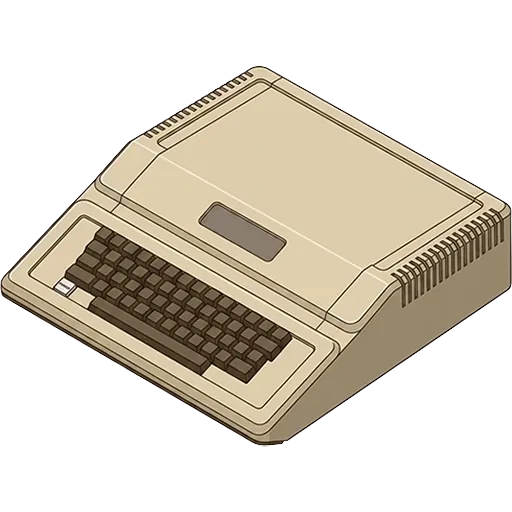
On April 16 and 17, 1977, a beige box sat on the floor of the first West Coast Computer Faire in San Francisco. It had a keyboard and a power cord. Hook it to a television and characters appeared. Most accounts of the Apple II rightly begin that weekend, though shipments came later.
Customers started receiving boxes on June 10. The assembled 4KB machine cost $1,298. Paddles and cassette demos came with it, but a monitor and disk drive did not. Calling this arrangement finished needs some qualification.
When buying meant soldering

The wub · Wikimedia Commons · CC BY-SA 4.0 · The wub · CC BY-SA 4.0

Until then, buying a personal computer often meant assembling it at home. You found a board, found a case, found a power supply, and ran the wires before you had anything that belonged on a desk. In a 1992 interview Steve Wozniak put the older machines in a single sentence: you had to solder them together, bolt parts in place, run wires in. Hobbyists valued that freedom, but the assembly work could be a barrier for a household.
The Computer History Museum describes the Apple II as the machine that reduced the assembly work: electronics, keyboard, power supply, and BASIC in ROM in one enclosure, with an ordinary television as the display. That set it apart from kits, although the box still lacked a monitor and a disk drive.
April at the Faire, June at the dock
The Faire dates are April 16 and 17, 1977, in San Francisco — the dates on the session tape the Computer History Museum still catalogs. The public debut that weekend and the June shipment were separate events; treating them as one creates the apparent disagreement over the launch date.
The original model that shipped on June 10 cost $1,298 with 4KB of RAM. The museum's This Day in History entry gives it sound and color graphics, and memory that could be taken to 48KB. The $1,298 on that same page is the 4KB assembled machine. Paddles and cassette demos were included; the monitor and the drive were separate.
A 32-second period store ad: "Introducing Apple 2… hook it up to your TV." Not an Apple channel upload — a fan copy of a High Technology computer-store commercial.
The commercial opens with the missing piece: buyers still needed a television. Its 32 seconds show both the assembled computer and the display it required.
Wozniak's board, Manock's case
The board design is clearly attributed. Steve Wozniak put the 6502, the color, the slots, Integer BASIC, cassette storage, and keyboard control on one board. Steve Jobs pushed that board into a consumer plastic product. The museum distinguishes the roles: Jobs on promotion and a distinct Apple identity, Wozniak as the designer.
Jobs did not design the case. Jerry Manock designed the injection-molded shell. Rod Holt designed the switching power supply. Jobs insisted on plastic instead of sheet metal; the case design itself was Manock's work.
What Wozniak stressed in 1992 was that plastic box. The Apple II was completely built; in a sense it was the first computer with a plastic case; you could take it out of a box, plug it into a wall, and open a manual. Then the sentence that matters: you have to attach it to your TV set. It takes a few minutes.
Color you did not pick
Color on the original Apple II did not come from a freely selectable palette. The machine outputs a digital luminance bitstream timed to the colorburst; a color television decodes repeating bit patterns as chroma. This produces NTSC artifact color. Hi-res has 280×192 one-bit pixels. Read as color, the effective resolution is closer to 140×192.
The Apple II had color, but without the freely controlled framebuffer familiar from later machines. Users could not simply choose a color and paint with it. What turned heads at the Faire was a compromise: a circuit that used the television's existing color decoding.
The CPU is a MOS 6502 at about 1 MHz — about 1.023 MHz if you derive it from the NTSC colorburst. Base RAM was 4KB, expandable onboard to 48KB, with forty-column text and Integer BASIC in ROM. Cassette was the storage medium at launch. Integer BASIC was available as soon as you switched it on.
Eight empty slots in a finished box

Steve Jurvetson · Wikimedia Commons · CC BY 2.0 · Steve Jurvetson · CC BY 2.0
.jpg)
Along the top of the motherboard sit eight 50-pin expansion slots. Steve Jurvetson's photograph makes the slots and the 6502 legible. This is the original II / II Plus interior, not an IIe or an IIgs. The assembled computer still had room for expansion. Do not generalize that count to the slotless IIc.
The assembled computer still relied on cassette storage. Slow loading and saving limited its out-of-the-box convenience for a year. The advertised $1,298 bought the 4KB machine, with further purchases needed for a fuller computing setup.
Integers, not 37.04
Wozniak said it plainly in 1992: the computer handled integers; it did not handle numbers like 37.04. Mike Markkula wanted floating-point BASIC. Cassette load times blocked the path as well. The language that arrived to do that work was Microsoft's 6502 BASIC — Applesoft.
The 1977 ROM belongs to Integer BASIC. Applesoft becomes the ROM standard on the Apple II Plus in 1979. The original BASIC could not handle dollars and cents as floating-point values; that required the later language.

Akbkuku · Wikimedia Commons · CC BY 4.0 · Akbkuku · CC BY 4.0

The open lid in that photograph is a Plus, not the original. Eight slots, a Disk II card, a Holt-style switching supply. Its interior shows how the later model addressed the first machine's limitations.
Disk II arrived the following June
Disk II and Apple DOS reached customers in June 1978. Wozniak designed the low-chip-count floppy controller. Paul Laughton, a contractor for Shepardson Microsystems, wrote DOS in about seven weeks. The Computer History Museum posted that record in 2013 with Apple's permission. That month, disk storage began to ease the cassette bottleneck.

Rama & Musée Bolo · Wikimedia Commons · CC BY-SA 2.0 fr · Rama & Musée Bolo · CC BY-SA 2.0 fr

The stack in that photograph is not what shipped in 1977. Two Disk II drives sit on the lid, with a Monitor II above them. The machine most people remember is the machine after the disk arrived. Convenience had a price. Apple's 1980 filing put typical systems with memory and peripherals at $1,850 to $5,000 or more.
The program that sold the machine
In 1979 Dan Bricklin and Bob Frankston's VisiCalc arrived first on the Apple II. It automated the recalculation of spreadsheets. The museum's line is that the program turned the personal computer into a business machine and boosted Apple II sales. Spreadsheet work gave buyers a reason to purchase the computer.
Color and games were not the only reasons it reached a small-business desk. A disk went into an empty slot, a worksheet went on that disk, and the machine's job changed. A program that recalculated figures, rather than a faster chip, made the hobby computer useful as an office tool.
Leaving year-by-year unit counts aside, the total is simpler to state. As of October 31, 1980, Apple had sold about 131,000 Apple II mainframes. Fiscal revenues ran about $0.77 million in 1977, $7.9 million in 1978, $47.9 million in 1979, and $117.9 million in 1980.
Internet Archive's official channel. Laine Nooney's July 13, 2023 lecture The Apple II Age — a later talk, not a 1977 commercial, and the thumbnail is a talk-show card, not a period body shot.
The promise, and the invoice
The machine combined several strengths: keyboard, electronics, and power supply were in one shell. Integer BASIC was waiting when you switched on. Color and sound were in the original specification. Eight slots meant the machine could still change after you paid for it. Wozniak's board, Manock's case, and Holt's supply needed one another. Jobs sold that combination as a consumer product.
The same package had limitations. A display and the first storage were external, and cassette was slow. A useful system cost far more than the headline. Four kilobytes was modest, and color was not the unconstrained palette later users would picture. The Apple II did not remove every barrier around computing. It lowered enough of them that the remaining trouble looked like a fair trade.
For an American buyer in 1977 that trade was specific. $1,298 bought a 4KB assembled computer you could carry out of a shop, plug into a wall, and hook to a TV. It did not buy the disk that arrived the next June, or the spreadsheet that arrived in 1979, or the $1,850-to-$5,000 systems Apple would later list as typical. The assembled product left buyers to pay separately for those additions.
Assembled, not complete
Beyond claims about being first, the Apple II's lasting significance lies in the expansion space it deliberately left. The plastic case spared ordinary users direct work on the board, while eight slots gave peripheral makers access to it. Integer BASIC shortened the path to a first program. Disk II and VisiCalc gave people a reason to keep going. Its color did not come from a freely selectable palette, and $1,298 did not buy a complete system.
Wozniak's own description captured that tension. Take it out of a box, plug it into a wall, open a manual. Attach it to a television. A few minutes. The room for additions mattered as much as the plastic case. The assembled computer lasted because other people could keep extending it.
The Faire was April 16–17, 1977; shipments began June 10. The 4KB assembled machine was $1,298 without a monitor or a disk.
Wozniak designed the board, Jerry Manock the injection-molded case, Rod Holt the switching supply. Jobs pushed a plastic product identity.
Color is NTSC artifact color, not a free palette. 1977 ROM is Integer BASIC; Applesoft becomes standard in ROM on the II Plus in 1979.
Disk II and DOS reached customers in June 1978; VisiCalc arrived in 1979 and turned the machine into a small-business purchase.
About 131,000 Apple II mainframes had been sold by October 31, 1980; typical configured systems listed at $1,850 to $5,000 or more.
"The Apple II was completely built, in a sense it was the first computer with a plastic case, you could just take it out of a box, plug it in a wall and open a manual, you have to attach it to your TV set, takes, you know, a few minutes." — Steve Wozniak, 1992
The Apple II proved there was a market for an assembled computer, even when the box did not contain a complete system. The 4KB machine shipped without a monitor or a disk, showed color as an NTSC accident, and left eight slots empty on purpose. Disk II and VisiCalc made the system more complete. Jerry Manock designed the case, while Steve Jobs sold the idea of a plastic product. Their work depended on the board Steve Wozniak designed.
Sources
- June 10: Apple II Shipped Today
- The Apple II — CHM Revolution
- The Computer History Museum Makes Historic Apple II DOS Source Code Available to the Public
- Software & Languages — VisiCalc
- West Coast Computer Faire 1977 session tape
- The Machine That Changed The World; Interview with Steve Wozniak, 1992
- A look back in IPO: Apple
- Vernacular Technical Practices Beyond the Imitative/Innovative Boundary: Apple II Cloning in Early-1980s South Korea
- 조동원 — 청계천 전자상가, 복제의 기술문화, 디지털문화의 형성 (IDI 도시연구 11, 2017)