The Walkman, When Music Left the House
Sony's first personal stereo reached America under a different name, at $199.95, as 1979 turned into 1980 — and almost everything repeated about it since, from the sales figures to the orange button, is off by a season or a decimal place.
A Booth in Las Vegas
In January 1980, at the Sony exhibit on the floor of the Consumer Electronics Show in Las Vegas, a listening demonstration was under way. Billboard printed the photograph in its January 19 issue — Sony's Jon Strom at the left of the frame, a visitor with the headphones on. There was no speaker to gather a crowd around. Each visitor experienced the demonstration through the headphones.
The product had a name Americans have mostly forgotten. Sony sold it here as the Soundabout, list price $199.95, and it had reached the country weeks earlier — Billboard's front page on December 8, 1979 reported the American launch as happening "this month," and by February 9, 1980 the trade paper described the machine as recently introduced to the market.

Yoshikazu TAKADA from Tokyo, Japan · Wikimedia Commons · CC BY 2.0
.jpg)
That matters more than it sounds, because much of what gets repeated about the Walkman is off by a season, a year, or an order of magnitude. The first-month sales figure, the person who named it, the date the orange button disappeared — all of it circulates in a version the primary sources contradict. Even the founding academic paper on the Walkman got the release date wrong in its opening paragraph. This article follows both the machine's impact and the errors that accumulated in accounts of it.
In Japan, it went on sale July 1, 1979 as the TPS-L2, a hand-sized aluminum box, 390 grams, eight hours on two AA cells. It had no recorder or speaker; sound came only through its two headphone jacks. Through the 1970s listening meant staying near a speaker, and the portable alternative Sony itself sold — the 1978 TC-D5 stereo cassette recorder — weighed, according to Sony's official corporate history, 1.7 kilograms. It was portable, but cumbersome to carry.
Modifying a Pressman
The man who carried that 1.7 kilograms most often was Masaru Ibuka, Sony's co-founder, whose complaint, as Sony's own history records it, was simply that the thing was too heavy to use. Before a business trip to the United States he asked Norio Ohga for something simpler: take the Pressman, the mono cassette recorder Sony built for journalists, and put a playback-only stereo circuit in it. Ohga passed the request to Kozo Ohsone, head of the tape recorder division, whose engineers stripped the recording function out and wired stereo playback into the space it left. The modification worked by removing a function from an existing machine.
Ibuka liked what he heard and said so — a machine that small should not sound that good, and if you wanted the sound whole, headphones were how to get it. He took the modified unit abroad, brought it back, and showed Morita, who replied that it had a quality different from listening through speakers, that you could carry it and listen alone, and that this was interesting. Sony's official history preserves both reactions in close to those words.
In February 1979, Morita gathered the young staff from electrical and mechanical design, planning, advertising and industrial design, held up the modified Pressman, and told them the recording function was unnecessary: sell it as a playback-only machine with headphones in the box and it would move. He also set the constraints. Aim it at young people. Ship before summer vacation. Keep the price under ¥40,000, roughly where the Pressman sat. Four months remained.
The four-month deadline shaped the engineering decisions. Shizuo Takashino led the design team for the first unit, and he and Ohsone made the conservative call: no new transport mechanism. If the machine testing a brand-new concept breaks often, Ohsone reasoned, what gets rejected is not the machine but the concept — so they reused the mechanism from a Pressman with half a million units of production behind it. The sources disagree about which Pressman supplied the mechanism: the 100.80.60 exhibition at Ginza Sony Park labels it TCM-100B, the collector archive walkman-archive.com captions its lineage photo TCM-600, and Sony's corporate history gives no model number at all.
Fifty Grams
Headphones were essential to making the Walkman practical. Industry-standard headphones then weighed 300 to 400 grams and used drivers over 50 millimeters across. Clamp 400 grams of that onto a 390-gram player and the load doubles, and the weight undermines the premise of easily portable music.
Another group at Sony had already developed lighter headphones. The research labs were developing an open-air prototype weighing 50 grams with a 23-millimeter driver: a sixth to an eighth of the standard weight, less than half the diameter, later to become the H·AIR line. Neither team knew the other existed. Ibuka and Morita instructed them to work together, and they began doing so in March 1979.
Those ultralight headphones shipped in the TPS-L2's box. The 50 grams of headphones was the addition to a machine otherwise simplified by removing functions, and that lineage outlived the cassette by decades: the world's first in-ear headphones with 16-millimeter drivers in 1982, the first consumer noise-cancelling model in 1992, fully wireless models by 2017. While the tape mechanism became a museum piece, the headphone line continued.
Two Jacks and an Orange Button

Dave Jones from Australia · Wikimedia Commons · CC BY 2.0
.jpg)
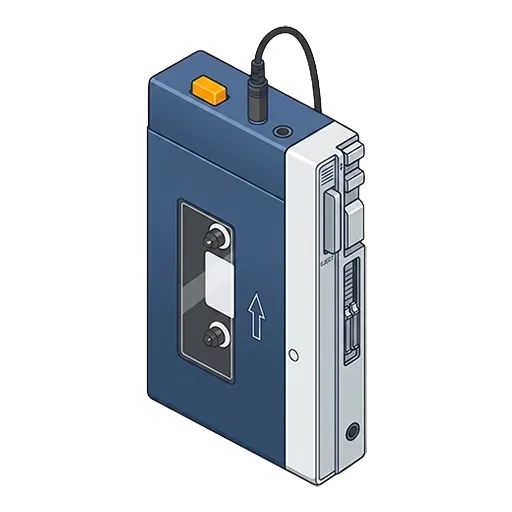
The TPS-L2 had two headphone jacks, labelled A and B, and an orange button beside them called Hot Line, which let two people in headphones talk without stopping the music. These two features allowed people to share a device designed for personal listening. The New York Times, writing on the twentieth anniversary in 1999, called the orange control a "panic button" and reported that Akio Morita later wrote that Sony had hesitated to release a product that might be seen as selfish — a striking admission from the company that turned personal audio into a mass market.
These controls are the subject of a persistent error in the Walkman's history. The standard telling is that the orange button and the second jack both vanished around 1980, when the American name switched from Soundabout to Walkman — linking a marketing decision to an engineering change, as the 1999 Times piece did. But collector-held advertising material from the period shows the TPS-L2 sold in America in 1980, under either name, kept both features, and a 1980 advertisement credited to Sony Corporation of America sold them as selling points: "an extra jack for a second set of headphones. And an exclusive Hot-Line button."
The orange button actually left the chassis with the successor, the Walkman II (WM-2), which went on sale in February 1981 — though the talk function remained. The talk control moved to an orange mute button on the MDR-4L1S headphone cord, at the point where the cable splits, while the body kept both the A and B jacks. The feature continued in a different location.

Birmingham Museums Trust · Wikimedia Commons · CC BY-SA 4.0
.jpg)
The talk function itself lasted longer still. The WM-3, sold in 1981, had a silver talk button and a built-in microphone; the 1982 WM-R2 used a sliding Hot Line switch. Both had two headphone jacks. The model numbers do not follow release order — the WM-1, despite the name, was the third personal stereo cassette player Sony shipped, a 1981 model with no Hot Line microphone and, again, two jacks. Two jacks without a Hot Line carried through to the WM-4, among Sony's fall 1982 introductions in the United States. The account linking the loss of both features to a name change is simpler, but inaccurate.
Soundabout, Stowaway, Freestyle
The name caused more internal trouble than the engineering did. According to Sony's official history, "Walkman" was coined not by an engineer but by a young employee in the advertising department, who combined the base model's name, Pressman, with the Superman films then in theaters. Some English-language accounts credit Ohsone with the idea instead; Sony's own primary record does not, and leaves Morita only the job of approving it over internal objections.
Those objections were grammatical — Walkman is not English, staff argued, and it sounds wrong. Morita's reply, as the history records it, was that young people were the ones who would use it, and if they were fine with it, that settled it. The price was decided with similar economy: the company's history relates that ¥33,000 was chosen on the spot because 1979 was Sony's thirty-third year. (That figure is sometimes converted to $125. At 1979's average rate of roughly 219 yen to the dollar it lands nearer $150, which is what most accounts printed.)
Sales staff were blunter about the product than about the name. The line preserved in Sony's history is that nobody had ever heard of a tape player and that without recording it would absolutely not sell. The often-repeated scene in which Morita vows to resign if the initial run does not clear appears nowhere in that record. What the record contains is the objection, and a sentence saying Morita trusted his instinct — an account that leaves instinct as his stated basis for proceeding.
Overseas sales initially complicated the naming further. Sony's history says overseas distributors refused "Walkman" outright when sales began abroad half a year after the Japanese launch, so the same machine went out as Soundabout in the United States, Stowaway in Britain, and Freestyle in Australia. (English-language sources frequently place Freestyle in Sweden; neither edition of Sony's history says so.) Morita ended the confusion himself, announcing worldwide standardization at a sales convention held in the United States in April 1980. Sony nonetheless maintained its American trademark on "Soundabout" until 2002 — twenty-two years of maintenance on a name it had publicly abandoned.
A Revolution in the Streets
Sony Corporation of America's 1980 campaign line was "There's a revolution in the streets." The print execution showed six people in headphones — a roller skater, a cyclist, a man carrying a briefcase among them — under that sentence and a 1980 Sony Corporation of America copyright line. The radio spots took a less conventional approach: no music at all, just finger snaps, footfalls and humming behind a voice reading "There's a revolution going on in the street." The ads promoted the listening experience without playing music themselves.
Street prices moved around far more than the list price suggests. A Texas Tech student newspaper ad from October 9, 1980 offered the "SONY TPS-L2" at $199.95; the same store's ad on November 13 listed a "HAND-HELD STEREO CASSETTE PLAYER … Complete with headphones" at $149.95. Record World, writing on December 27, 1980, still quoted $199.95 and noted that a still-life product advertisement had run in The New York Times Magazine.

The Chronicle · Wikimedia Commons · Public domain

College papers carried early advertisements for the machine. On January 17, 1980, page 14 of Duke University's Chronicle carried an ad from a Durham audio dealer offering the Sony "TPS-L2 Stereo Cassette Player" — Japanese model number and all — at $249 with a protective pouch, an AC adapter and a rechargeable battery pack. That ad is sometimes read as evidence of grey-market units arriving ahead of an official launch. Given that Billboard had already reported the American introduction a month earlier, the simpler reading is one retailer's bundle price.
TIME, looking back at the thirtieth anniversary in 2009, described the machine as a 14-ounce blue-and-silver case and noted, with some wonder, that "It even had a second earphone jack so that two people could listen in at once." By then Sony had sold 200 million Walkmans across all formats. That article also supplies a sales claim examined later in this piece.
The Walkman Effect
The Walkman's success also drew scholarly attention. In 1984 the Japanese cultural scholar Shuhei Hosokawa published "The Walkman Effect" in volume 4 of Popular Music, the Cambridge University Press journal, pages 165 to 180. It is among the first scholarly treatments of what the device did to listening, and the phrase itself comes from that paper.
Hosokawa treated the Walkman as a relation rather than an object, and defined his central term precisely: "I define musica mobilis as music whose source voluntarily or involuntarily moves from one point to another, coordinated by the corporal transportation of the source owner(s)." The source travels on a body. Street musicians and portable radios belong to the same lineage; the Walkman is one stage of it. Its often-quoted conclusion reads: "The walkman is neither cause nor effect of that autonomy, neither evokes nor realises it. It is the autonomy, or rather autonomy-of-the-walking-self."
That is a substantial claim for a 390-gram playback-only deck, but forty years on it still seems proportionate to the device's impact. The paper also contains a date error. The opening of that same paper states the Walkman was originally invented and marketed in Japan in the spring of 1980. The actual date is July 1, 1979. The founding text of an entire field of listening studies has been cited for four decades with the release date wrong by the better part of a year. The error survived peer review and decades of citation.
The market, meanwhile, turned over quietly. In the United States, cassette sales passed vinyl for the first time in 1983. Whether the Walkman revived the cassette or cassette demand drove the Walkman's success is difficult to establish, but the order of events is not in dispute: the machine came first, the format flip followed.
The Man Who Patented It First
The patent history introduces a figure outside Sony. Andreas Pavel, a German-born inventor, filed his patent in Europe in 1977 for a personal stereo he called the Stereobelt — headphones, a belt, a cassette player, an amplifier — two years ahead of the Walkman. The German patent, DE 2813000 C2, was filed on March 21, 1978 and granted on April 8, 1982. Once it issued, Sony moved to settle; The Independent, reporting in 1996 and citing German press accounts, wrote that the dispute dragged on three more years before Sony paid 150,000 marks, about £40,000 at the time. That covered one country.
The same report says Pavel filed eighteen writs in Britain against major infringers in November 1988, and that the action against Sony reached the English patent court in 1993; had he won, the paper estimated, he stood to collect £100 million in royalties against the £3 billion the Walkman was reckoned to have earned. How it ended depends on which reference you open — German-language Wikipedia records a 1989 filing, a 1996 dismissal and roughly $3 million in costs that left Pavel financially ruined, while the English entry says the British court invalidated the patent around 1993.
The Independent describes how, at the March 1996 appeal, Sony produced a chart showing how tape recorders had shrunk over twenty-five years, Pavel argued the photographs looked smaller while the actual dimensions were growing, and Lord Justice Aldous found for Sony. Pavel's own account at the time was that he had never expected it to take two decades — someone had told him a year — and that he had not set out like Don Quixote to conquer Japanese industry.

Binarysequence · Wikimedia Commons · CC BY-SA 4.0

The geography of the dispute may be surprising to an American reader. The machine being argued over was the one Sony Corporation of America was already selling here — as the Soundabout, then as the Walkman, at $199.95, under a campaign about a revolution in the streets — and those 1980 advertisements ran a full two years before Pavel's German patent was granted. The courtrooms, though, were all on the other side of the Atlantic: a German settlement, eighteen writs in Britain, an English patent court, an English appeal in 1996. The story reached American readers late, in a New York Times profile published in 2005, a year after the case had ended.
In 2003 Pavel signalled further infringement suits in the jurisdictions still open to him, and Sony turned back toward settlement; in 2004 the two sides reached an agreement including a confidentiality clause, and a Sony spokesman confirmed a settlement existed. The amount has never been published, although estimates have circulated. The widely circulated claim that The New York Times put the settlement above $10 million is not supported by the article's wording: the 2005 piece says "a cash settlement for damages in the low eight figures" plus some royalties on Walkman sales, and attributes even that to European press accounts — no currency, no figure, no named outlet. Brazil's ISTOÉ estimated at least $10 million; Folha, citing AFP, said the sum was undisclosed and probably in the millions; outlets citing Der Spiegel wrote several million euros.
Pavel himself, interviewed in Brazil in 2014, said his contract barred him from naming a figure, then added that he had read in some newspapers that it was more than $10 million. His reflection to The New York Times in 2005 was bleaker: he filed that first patent completely naive, assuming it would be a simple matter of twelve months to establish ownership and start production, and never imagined it would keep him from the real interests of his life for as long as it did.
From 200 Million to 400 Million
The cumulative number first. Sony's official history states that by 2019, the fortieth year after the first unit, Walkman sales across cassette, CD, MiniDisc and memory formats had passed 400 million. The figure is frequently cited as a March 2010 total; the baseline is simply different. TIME's count at the thirty-year mark in 2009 was 200 million, meaning the last decade of that run added as much as the first three.
The brand moved through new formats but struggled with the transition to digital music. The first CD Walkman, the D-50, arrived in 1983; MiniDisc and MP3 models followed. But Sony held onto its proprietary ATRAC codec and lost the market to the iPod — retaining a proprietary format despite its earlier success with a simpler product. The last playback-only cassette Walkman released in the United States was the WM-FX290, in 2002.
Sony's own retrospective, made when the cassette Walkman was discontinued
Over time, the TPS-L2 became a museum artifact as well as a piece of equipment. The Smithsonian's National Museum of American History holds one, accession number 1987.0127.01, donated in 1987 by Sony Corporation of America. It is regularly described online as a screen-used prop from Guardians of the Galaxy; the donation predates the film by twenty-seven years. On the film: Peter Quill's player in the 2014 movie is indeed a blue-and-silver Sony TPS-L2, and James Gunn told an interviewer that year, "I decided that the cassette tape would be his only connection to his mother and Earth, and it became important to honour that."
The claim that the movie revived the cassette needs qualification. The frequently quoted 74 percent jump in American cassette album sales describes, as TechSpot reported it, a rise from 74,000 units in 2015 to 129,000 in 2016, and the same report credits other artists' cassette releases that year as well; it cannot be converted into a 2014 box-office effect. The documented figures are more specific: the Awesome Mix Vol. 1 cassette sold roughly 4,000 copies in each of 2015 and 2016, topping American cassette sales both years, Disney's own store sells the physical tape and pitches it on listening the way Star-Lord does, and collector demand for original TPS-L2 units revived. Sony also marketed its history — the NW-A100TPS of 2019 was a fortieth-anniversary product with a case and packaging modelled on the TPS-L2, an anniversary logo and an on-screen animation of a cassette turning. It was an anniversary product, not the movie tie-in it is often described as.
A walkthrough of the NW-A100TPS, Sony's 40th-anniversary tribute to the TPS-L2
How the Story Hardened
Taken together, these errors suggest a pattern of largely unintentional repetition. Memorable stories circulate, then become sources for later accounts even when their details are inaccurate.
The most repeated is the sales figure: that Sony expected 5,000 units a month and sold more than 50,000 in the first two months. Sony's own corporate history says the initial production run was 30,000 units — double the 15,000 a month that counted as a good result for a tape recorder then — that roughly 3,000 had sold by the end of July, and that the run finally cleared at the end of August, after magazine photographs of pop idols wearing one turned the market around. Several rounds of increased production later, stores were still running out six months on. The simpler version leaves out the slow initial sales.
Promotional accounts contain similar errors. A 1980 roller-skating stunt at Rockefeller Center is regularly filed under Sony Walkman marketing. Record World's December 27, 1980 account describes it as Panasonic's, run with Macy's — and, confusingly, refers to Panasonic's own product as a "Soundabout." That use of the name Sony gave up in 1980 adds to the confusion in later accounts.
Later accounts also confuse the player with its film appearances. The Smithsonian's Walkman is a 1987 corporate donation, not a film prop. The 74 percent cassette figure belongs to 2015–2016, not to 2014. A 1979 machine appearing in the film's 1988 scenes is not an anachronism; it is a nine-year-old gadget still in use, which in the 1980s was ordinary. Eight hours on two AA cells made the player practical for continued use.
Launched in Japan on July 1, 1979 at ¥33,000 — playback only, no recorder, no speaker
Sony's own history records about 3,000 units sold by late July, with the 30,000-unit run clearing only at the end of August
Sold in the US as the Soundabout at $199.95, reported as launching in December 1979 and demonstrated at CES in January 1980
The orange Hot Line button moved to the headphone cord on the 1981 WM-2; the talk function survived to the 1982 WM-R2
More than 400 million Walkmans sold across all formats by 2019; Andreas Pavel, who patented a personal stereo in 1977, settled with Sony in 2004
The most quoted machine in consumer electronics is also the most misquoted. What it actually did is the one part nobody gets wrong: it taught music how to walk.
Built by removing the recorder and speaker, the TPS-L2 sold about 3,000 units in its first month before its entire run cleared in August, according to Sony's own corporate history. Nearly everything told about it since got retold slightly wrong: the sales figures, the naming, the date the orange Hot Line button left the chassis, the year it reached America. Read in sequence, the primary sources correct those familiar stories without diminishing the machine's role in making music portable.
Sources
- ソニー80周年グループヒストリー 第2部第3章 ウォークマンによる新しい市場の創造
- Sony: Tiny Stereo Player (Billboard, 1979-12-08, 1면·52면)
- Compact Cassette Players Are This Year's Hot Xmas Item (Record World, 1980-12-27, 64면)
- Humming Off Key for Two Decades (The New York Times, 1999)
- An Unlikely Trendsetter Made Earphones a Way of Life (The New York Times, 2005-12-17)
- See you in court (The Independent, 1996-05-18)
- Shuhei Hosokawa, The Walkman Effect, Popular Music vol.4 (1984), pp.165-180
- Sony TPS-L2 "Walkman" Cassette Player (1987.0127.01)
- 밥솥에서 명품까지…세관 압수품 보면 시대 보인다 (2014-09-05)
- Audio cassette sales climbed 74 percent in 2016