The Red Box and the Gray Box
When The New York Times put video games back on its front page in September 1986, the number under the headline was two million consoles for the year, a quarter of the 1982 peak. The machine driving that recovery had been designed in Kyoto three years earlier to meet a price target, and it reached American shelves one city at a time, with a robot in the box.
The Morning the Times Said Games Were Back
On September 27, 1986, the front page of The New York Times carried Andrew Pollack's story under the headline VIDEO GAMES, ONCE ZAPPED, IN COMEBACK. It announced a revival, backed by a sales forecast. Manufacturers expected to sell about two million game consoles in the United States that year. At the 1982 peak, the figure had been more than eight million.
The forecast showed how limited the recovery remained in 1986: a quarter of the former market, led by a machine developed outside America. In the same story, Ronald Judy, a marketing vice president at Nintendo of America, noted that the children who had not been around for the first craze were now old enough. A new generation of customers had grown up since the first craze.
A 1984 local television special report on the Atari crash.
The machine they were growing into had been built three years earlier in Kyoto, and its path to that front page involved a string of collapses months apart, a recall, a redesign, and a new name. It starts with a price.
The Price Came First
Nintendo president Hiroshi Yamauchi's brief to engineer Masayuki Uemura is remembered as a single sentence: build something that lets people play arcade games on the television at home. He provided a cost target without a spec sheet or performance target.
What that cost was depends on who is telling it. Eurogamer's account of Uemura's recollection puts it at buying the parts for under 5,000 yen; the Japanese Wikipedia entry says Yamauchi's order was to hold the console itself under 10,000 yen. Both accounts describe the same approach. The price was fixed first, and the hardware had to fit inside it.
The trouble was finding anyone willing to build a custom graphics chip at that price. Of the companies Nintendo approached to manufacture the PPU, only Ricoh agreed.
The chip negotiations produced a widely repeated anecdote. Yamauchi, the story goes, guaranteed to buy three million chips within two years and used that promise to force the unit cost down. The familiar story remains unsettled. The source usually cited for it is a footnote on page 65 of a book about Pokemon rather than any hardware history, while the counter-record, in which Yamauchi himself calls the three-million guarantee a legend manufactured during the Famicom boom, traces back to a personal fan page that Wikipedia flagged as an invalid source. Neither version has been conclusively resolved.
Other accounts describe how difficult the negotiation was. An old Japanese fan archive records Ricoh executive Toshifumi Asakawa saying that Nintendo made him cry, because a game machine is still a proper computer and he was being told to keep the semiconductor inside it under 2,000 yen. Japanese Wikipedia adds context on why Ricoh might have signed anyway: the company had built a custom-IC plant in Ikeda, Osaka, in 1981 for 7.5 billion yen and could not fill it, and Famicom volume is what finally pushed its semiconductor division into the black after four years.
Cost also influenced the choice of instruction set. The same entry credits Ricoh with proposing a MOS 6502-derived design over the Z80, both because licensing talks risked dragging on and because a 6502-based part would take roughly a quarter of the die area. That is how the Ricoh 2A03, 8-bit at 1.79 MHz, ended up inside the box. When the contract closed, Uemura did not celebrate. He remembered the feeling as relief, since it had been the president's decision and not his own.

Evan-Amos · Wikimedia Commons · Public domain

What a Connector Cost
The Famicom's price target required compromises in the controllers. Both pads were hard-wired to the console, unremovable. Uemura's explanation was blunt: connectors cost money. Deleting them shaved the bill of materials, and it also meant a frayed cable turned into a repair job for the entire system. He later named it the design decision he regretted.
Two controllers remained a firm requirement. The order came from Yamauchi rather than from engineering, and a company shaving yen off a parts list added an entire second pad anyway.
What the Cost-Cutting Left Behind
The design removed whatever it could, but its defining hardware remained: a Ricoh 2A03, and two pads with a cross-shaped directional key. The directional key reduced the joystick's function to a thumb-sized control, and that cross sat on top of the very pads Nintendo had wired into the case to avoid paying for connectors. The pads combined a cost-saving constraint with a control that would become standard. Three years later, when the machine crossed the Pacific in a gray case, the cross went with it.

Evan-Amos · Wikimedia Commons · Public domain

The small microphone in the second pad was Uemura's own idea, aimed at Japan's karaoke boom. Its most famous use had nothing to do with singing: Will Wright's Raid on Bungeling Bay. Shigeru Miyamoto's first hardware job at the company was the industrial design of a block-breaking machine, rather than game design.
Recall Them All
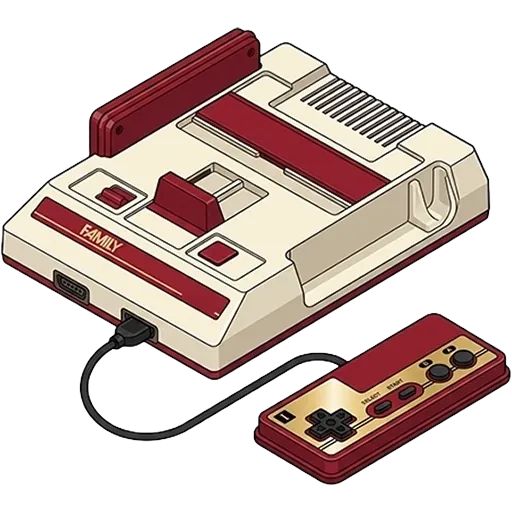
The Famicom reached Japanese stores on July 15, 1983 at 14,800 yen, model HVC-001: red over white, cartridge slot in front, RF out the back, 256 by 240 on screen. The launch lineup is recorded as three ports of Nintendo's own arcade games, Donkey Kong, Donkey Kong Jr. and Popeye.

Evan-Amos · Wikimedia Commons · Public domain

Within months, units began failing, and the fault was traced to the PPU itself. Eurogamer puts the defect rate at roughly one percent. Staff proposed swapping out only the units confirmed to be faulty. Ninety-nine machines in a hundred were fine. Yamauchi overruled them and ordered every unit pulled back.
Japanese Wikipedia describes shipments halted from the second half of 1983 until at least the end of January 1984, with customers still crowding stores waiting for restocks. Its eventual success was still unknown, and the halt cost the company months of potential sales.
Uemura's recollection gives a more personal view of that period. Uemura, living in a large apartment complex in Osaka, remembered neighborhood children knocking on his door because the Famicom would not come up on the TV, asking him to fix it himself. The failures brought customers directly to the engineer's door.
The Deal That Was Never Signed
While Japan was pulling hardware off shelves, Nintendo was working a different problem across the Pacific. Yamauchi's proposal to Atari was far bolder than the distribution arrangement usually described. Nintendo would keep Japan; Atari would sell the system everywhere else in the world under its own brand. Uemura demonstrated the hardware himself at a Kyoto meeting in early summer 1983, and the signing was scheduled for June's Consumer Electronics Show in Chicago.
The next episode dominates many accounts. At that June 1983 CES, Coleco demonstrated Donkey Kong running on its new ADAM home computer. Atari held the home-computer rights to Donkey Kong and treated the demo as a breach. In the popular telling the Nintendo deal ended on the show floor, in front of witnesses.
The primary sources say otherwise. David Sheff's Game Over records that the Coleco mess turned out to be irrelevant to the Nintendo deal, and Steven Kent's history states flatly that no deal was ever signed. There was no signed contract to break.
The chronology shows a more gradual breakdown. Right after CES, a letter from Ray Kassar's side reached Minoru Arakawa threatening, in Sheff's rendering, not only to cancel the deal Skip Paul had made, but also legal action. A month later, in July 1983, Kassar was removed as Atari's chief executive in an internal company decision. In September, Atari, Nintendo and Coleco met again in Warner executive Manny Gerard's office to settle the Donkey Kong rights. Arakawa saw a company struggling with mass layoffs and enormous quarterly losses. Sheff's reading is that the deal ended not because of Coleco but because Atari was unraveling on its own.
An account of Yamauchi from the same weeks describes his negotiating tactics. At a hotel meeting convened right after the CES incident, he walked in without a greeting and tore into Coleco president Greenberg in Japanese. Afterward he turned to Howard Lincoln and asked: Sometimes this is the way you have to handle people, Mr. Lincoln. What did you think about that performance? The rage was staged, at least by his own description. Per The Dot Eaters, Lincoln was the man who had defended Donkey Kong against Universal's King Kong claim, and he ran these talks.
The other side left testimony too. Atari's vice president of engineering, Steve Bristow, told WIRED's 2001 oral history: Regrettably, it was my decision not to license the Nintendo system. In that account the collapse was an internal judgment about keeping the 2600 business alive, not an external accident. Sheff goes further, raising the possibility that the whole negotiation was a charade orchestrated to tie Nintendo up and remove a potential competitor, a possibility he builds on a single anonymous account. Arakawa later saw an advantage in the deal's failure. Arakawa's own summary: Can you believe that we almost sold the whole thing? If we had, no one outside of Japan would know about Nintendo.
Disguised as an Appliance
With Atari out, Nintendo had to sell in America itself, to retailers reluctant to stock anything described as a video game. The first attempt was not a game console at all. At the January 1985 CES, Nintendo showed a home-computer concept called the Advanced Video System from a small booth Arakawa worked himself. After it attracted no orders, Nintendo scrapped the concept and redesigned the hardware as a pure game machine.
The redesign focused on how the machine would be perceived. Cartridges slid in from the front like a videocassette instead of dropping in from the top, and the case turned gray. Anything that recalled the Atari 2600 was engineered out. The gray shell was drawn by Lance Barr, a designer at Nintendo of America who spent months in Japan in 1984 working with Nintendo's engineers. The name served the same purpose: Entertainment System replaced video game system. Per English Wikipedia, marketing manager Gail Tilden extended the vocabulary, so cartridges became Game Paks and the console became a Control Deck. The terminology obscured its identity as a game console.

Evan-Amos · Wikimedia Commons · Public domain

The new design created a mechanical problem. The 72-pin ZIF connector required by front loading let cartridges press against the contacts over and over until the picture began to flicker. That is the technical origin of the folk remedy an entire American generation learned, pulling the cartridge and blowing into it. That familiar gesture can be traced back to a marketing decision.
Nintendo also bundled a robot with the console. R.O.B. came out of Gunpei Yokoi's R&D1 group, and it was aimed at securing retail shelf space rather than use in the living room. American toy aisles in 1985 were crowded with robot friends such as Teddy Ruxpin and Tomy's Omnibot, and Nintendo joined that trend. The robot gave buyers reluctant to stock a game console another reason to consider it. Uemura's explanation for bundling the Zapper light gun was shorter still: Americans like guns. He said it through an interpreter at a 2015 lecture at NYU.

Chapuisat from España · Wikimedia Commons · CC BY 2.0
.jpg)
Thirty People in a Hackensack Warehouse
Yamauchi also rejected the proposed launch markets. Vice president Bruce Lowry wanted to start quietly in smaller markets. With his daughter interpreting, Yamauchi threw the plan out: they would start in New York, because that is where success happens.
In the fall of 1985, Nintendo of America set up a command post in a run-down warehouse in Hackensack, New Jersey. About thirty employees called themselves the SWAT team and worked the phones. The first official sales call, to Woolworth, produced a flat refusal. At Toys R Us the assigned buyer hesitated, and senior vice president Howard Moore pushed the order through himself with a line about why he was the senior vice president.
Shelf space was one problem; getting people in front of the machine was another. The New York Mets sent Mookie Wilson and Ron Darling to in-store demos to play customers at Baseball. On October 18, 1985, the NES went on sale in exactly one city. The dealer list printed in the October 1985 issue of Computer Entertainer does include F.A.O. Schwartz, and that is as far as the record goes. The familiar image of a Fifth Avenue window given over entirely to the NES is not something the primary source supports.
Nintendo's first American television spot for the NES, from 1985.
Initial shipments are described in the tens of thousands. Mental Floss, relaying a participant's recollection, puts the wholesale price to retailers at 98 dollars. How many sold in New York by Christmas depends on whom you ask: Lowry remembered clearing the 50,000-unit goal, the Times cited 90,000, and Gail Tilden suspected the larger number was publicity. The same trade magazine expected the national rollout in early 1986, probably in February. Sales did widen to Los Angeles and other major cities that February, but the actual nationwide release did not come until the fall of 1986. The toy company Worlds of Wonder, the people behind Teddy Ruxpin and Lazer Tag, joined as a distribution partner to secure more shelf space.
What It Actually Cost
The NES launch price is difficult to reduce to a single figure. The number that circulates most is 179.99 dollars. The contemporary trade press printed something else. Nintendo On Schedule, on page 13 of Computer Entertainer's October 1985 issue, describes the New York launch set, console, two controllers, R.O.B. with Gyromite and the Zapper with Duck Hunt, and states: Suggested retail price for all these goodies is $159.95.
The deluxe set's contents changed before launch. The same article notes that the configuration announced at the June 1985 CES had been smaller, and that R.O.B. with Gyromite and the Zapper with Duck Hunt were added by October, expanding the package. The bundle everyone remembers grew in the final months before launch. The nearest documented basis for 180 dollars is a pre-launch estimate: in The Milwaukee Journal of October 5, 1985, Edward J. Semrad wrote that the entire package will sell for under $180. That upper-limit estimate later came to be repeated as a retail price.
Store advertising ran lower. A Toys R Us ad in Newsday on December 16, 1985 listed 139.97 dollars with R.O.B., the console, two controllers, the Zapper, Gyromite and Duck Hunt all named. The Wiz, in the Daily News of December 12, 1985, priced a Nintendo Video Robot System at 139 dollars. For the basic package a JCPenney ad reads 149.99 and a Macy's ad reads 160. So the real price paid on October 18, 1985 cannot be reduced to one number. What the record supports is a 159.95 suggested retail price and a scatter of advertised prices between 139 and 160 dollars, depending on store, package and week. The single remembered price obscures those variations.
Mario, and the Programmer Who Wrote Golf
A game that demonstrated software's importance to hardware sales arrived in Japan on September 13, 1985. By the figures compiled on English Wikipedia, Super Mario Bros. sold about 1.2 million copies in Japan in its first month, and the original cartridge release finished at roughly 40 million. The same entry notes that in 1988 it became the pack-in for the NES Action Set, bundled with Duck Hunt on a single multicart. The sequence matters, however: in a Polygon interview, Uemura recalled that around three million Famicoms had already sold in Japan before Mario shipped. Mario's success built on an existing base of console owners.
In Japan, Nintendo also pursued an alternative to cartridges. By the English and Japanese Wikipedia entries, the Famicom Disk System arrived on February 21, 1986 at 15,000 yen, using double-sided 112KB disk cards, and rewriting a disk with a different game at a shop kiosk cost 500 yen. The English entry puts its lifetime sales at roughly 4.4 million units, often calling it the most successful console peripheral ever made, with the disk-rewriting service running until 2003.
This period's software also includes an early credit for a future Nintendo president. The programmer of the original Famicom and NES Golf was Satoru Iwata, who would become president of Nintendo. In an official Nintendo interview, when Shimamura mentions the game, Iwata answers: I know it! I worked as the programmer on that game! (laughs) At the time he did not work for Nintendo at all. He had joined HAL Laboratory around 1982 after graduating from the Tokyo Institute of Technology, and he would not take the Nintendo presidency until 2000. In a 1999 interview he recalled devising his own compression scheme to fit the course data into the memory available, and added that back then, programmers had a lot of discretion. The software faced tight memory constraints alongside the hardware's cost constraints.
61.9 Million
The hardware also found a use in arcades. Nintendo's early VS. System arcade cabinets were essentially Famicom hardware in a coin-op enclosure, and some operators modified them without permission so cartridges could be swapped. A machine cost-engineered for the living room got re-exported to the arcade.
This brings us back to that September 1986 front page. When the Times announced the market's recovery, the recovery was a quarter the size of 1982. Fan compilations still repeat figures for that fourth quarter, fifteen or sixteen million dollars in marketing and 1.1 million consoles for the year, and those numbers trace back to fan sites rather than to anything Nintendo has put in print.
One number is not in dispute. Nintendo still publishes combined Famicom and NES hardware sales of 61.91 million units and software sales of 500.01 million copies. The figure has remained unchanged for decades.
Successful games were one part of the machine's history. It was designed to meet a price, recalled at a loss to protect a reputation still being established, turned down by the biggest name in the business, and redesigned to resemble a videocassette recorder. It nevertheless became the console that defined the category for an entire generation.
Designed backwards from a price: the pads were hard-wired because connectors cost money
The Atari deal did not die on the CES floor; it was never signed, and it cooled from June to September 1983
The NES went on sale in exactly one city on October 18, 1985, and reached the rest of the country only in the fall of 1986
Its suggested price was $159.95, not the $179.99 everyone repeats, and American stores advertised $139 to $160
61.91 million Famicom and NES units, a figure Nintendo still publishes today
A box reverse-engineered from its own price tag restarted an industry. Not by magic, but through a run of deals that quietly failed and thirty people in a New Jersey warehouse who kept working the phones anyway.
Designed to meet a price, recalled in full when its graphics chip failed, and held back by an Atari deal that was never signed, the machine returned in gray for a single-city launch. Combined sales eventually reached the 61.91 million units Nintendo still lists today.
Sources
- Game Over: How Nintendo Conquered The World (David Sheff)
- The Ultimate History of Video Games: Revisited (Steven L. Kent)
- Computer Entertainer, Vol.4 No.7 (1985년 10월호) 13쪽 「Nintendo On Schedule」
- The NES Launch Collection (토이저러스·The Wiz·JCPenney·메이시스 광고 스캔 모음)
- The Milwaukee Journal 1985-10-05 「New Nintendo system way ahead of the field」(Edward J. Semrad) 스캔
- Video Games, Once Zapped, In Comeback
- The Man Who Made The NES
- The Famicom's Creator Reflects On 30 Years Of 8-Bit Bliss
- An Insider's Memories Of Making The Nintendo Entertainment System
- 2001년 비디오게임 구술사 — 스티브 브리스토 인터뷰(표제 미확인)
- How Nintendo Conquered Manhattan in 1985
- The Nintendo Entertainment System, page 2
- 岩田さんに聞きました『Wii Sports』Vol.4 (공식 인터뷰)
- Consolidated Sales Units of Hardware and Software
- 패밀리컴퓨터
- 국내 패미클론·해적판 브랜드 정리(표제 미확인)
- 현대 컴보이·슈퍼컴보이 가격·출시 정리(표제 미확인)
- 한국 게임기 시장·패미클론·일본문화 수입금지 칼럼(표제 미확인)
- 1989년 삼성 겜보이·현대 컴보이 출시 회고(표제 미확인)
- 용산역사박물관 특별전 '접속, 용산전자상가'와 패미클론 전시(표제 미확인)
- 1993년 신해철 슈퍼컴보이 광고 관련 기사(표제 미확인)
- ファミリーコンピュータ (Family Computer)