Hello, Macintosh — The Computer That Said Hi
Fall 1979 papers already called for a bitmapped, user-friendly screen — months before Jobs walked into Xerox PARC. The Super Bowl commercial did not air only once. The Hello demo ran on a 512K prototype. Apple's $2,495 Macintosh, introduced on January 24, 1984, was a cheaper Lisa whose origins predated the Palo Alto visit.
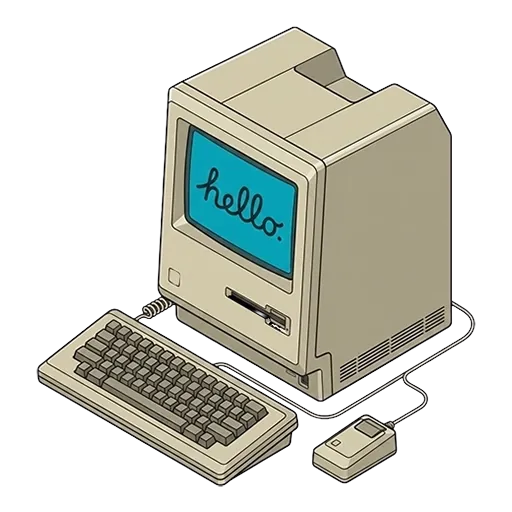
On January 22, 1984, during the third quarter of Super Bowl XVIII, a sixty-second commercial from Chiat/Day ran nationally. Ridley Scott directed it. Apple's board had tried to cancel it. Jay Chiat sold back only the thirty-second slot. Two days later, at Flint Center on the De Anza College campus in Cupertino, Apple priced a beige box at $2,495 and named it Macintosh.
Several familiar claims grew around that box: Xerox PARC invented its GUI, the ad aired only once, and a stock 128K spoke Hello on stage. Compare them with the record and almost every claim needs a small but significant correction. The gold-mine story is better remembered, but the paperwork from fall 1979 offers firmer evidence.
A desk still waiting for a command
In January 1984 a personal computer in an American office still meant a screen that waited for a typed command. Using the machine required memorizing command syntax. The Computer History Museum's timeline later called Macintosh the first successful mouse-driven GUI PC, and rounded the price to $2,500. Apple's own press release that morning was more precise: suggested retail $2,495.
BYTE's February 1984 preview, by Gregg Williams, introduced the same machine as mouse-window-desktop technology under $2,500 and called it the most important development in computers in five years. The nine-inch monochrome CRT ran 512 by 342. The clock, in that same issue, was 7.83 MHz — about 8, not 8.000. For American buyers, the consequential change was the mouse that shipped in the box.

Sailko · Wikimedia Commons · CC BY 3.0 · Sailko · CC BY 3.0
.jpg)
Annie, not a GUI
The Macintosh project did not begin with Steve Jobs. Jef Raskin opened it in 1979 under the code name Annie. He wanted a cheap, easy text appliance rather than a graphical showpiece — a $500 computer for people unfamiliar with command lines. The M0001 that reached stores kept the name but departed from that appliance concept.
Jobs, pushed off Lisa, took Macintosh around January 1981. Raskin was forced onto leave that February and left Apple in 1982. Andy Hertzfeld has called Jobs the father of the Macintosh in public. The project kept Raskin's name, while the shipped box followed Jobs's concept: a cheaper Lisa rather than the proposed $500 text appliance.
The name itself is Raskin's. He took it from the McIntosh apple and changed the spelling so it would not collide with McIntosh Laboratory, the American high-end audio maker. Apple's 1982 trademark filing was refused as phonetically identical. On November 16, 1982, Jobs wrote Gordon Gow; counsel advised Gow to refuse. A license is reported in late March 1983, a purchase of the mark in 1986.
The purchase is often said to have cost $100,000 cash. McIntosh counsel called it substantially off the mark and significantly higher. The contract terms remain confidential. The apple origin is well established; the price paid for the name remains unconfirmed.
Lisa, cut to $2,495
The Macintosh's immediate predecessor was already in American showrooms, and already too expensive. Lisa shipped on January 19, 1983, at $9,995. Hansen Hsu, writing for the Computer History Museum in 2023, described the lineage directly: without Lisa there would have been no Macintosh in the form we have it today. That account places Lisa firmly in the Macintosh's lineage.
Macintosh reused Bill Atkinson's QuickDraw — the same 68000 graphics package, Jobs told BYTE, the exact same graphic structure and package, the exact same code as Lisa. It dropped the hard disk and multitasking and cut RAM to 128 KB to hit $2,495. In that design-team interview Jobs called Mac a really cheap implementation of Lisa's technology. They chose the 68000, he said, so they could pick up QuickDraw. Reducing the cost was central to the design.
BYTE also clocked the two machines against each other: Macintosh at 7.83 MHz, Lisa at 5 MHz. The cheaper machine ran at a higher clock speed, with the savings coming from storage, simultaneous work, and memory. Apple's January 24 press release said the architecture was based on the 32-bit work done for Lisa, and that Macintosh came with Lisa Technology built in. The company explicitly acknowledged the Lisa connection on launch day.
PARC didn't draw this screen
The Xerox PARC visits of 1979 were two, not one, and Jobs went on the second. The Stanford Macintosh archive essay on the visit calls the Prometheus story — Jobs stealing fire from Palo Alto — wrong in almost every way a story can be wrong. Raskin arranged the visits so Jobs would value work already underway. The Mac project, in Raskin's chronology, was approved before anyone from Apple sat down in front of Smalltalk.
Earlier documentation challenges the PARC origin story. The Book of Macintosh, fall 1979, already specified a user-friendly interface, a bitmapped multi-font screen, graphics, and graphical input — months before the PARC visit. The visit could have accelerated that work, but the screen concept was already on paper.
Larry Tesler's oral history records Jobs saying they were sitting on a gold mine. That account is retrospective testimony. Bill Atkinson, in the same cluster of later interviews, said they already had bitmap graphics and overlapping windows; PARC contributed to that existing work. Apple did not simply copy Smalltalk. The claim that PARC invented the Macintosh GUI does not reflect that sequence.
No slots, thirty-two squares
The press release listed the machine as 128 KB of RAM, 64 KB of ROM, a 9-inch 512×342 monochrome CRT, a Motorola 68000, a mouse, a 3.5-inch 400 KB floppy, and two RS-232C/RS-422 serial ports. An external floppy port and audio were included, but expansion slots were deliberately absent. Model family M0001 had a suggested retail price of $2,495 and was designed as a sealed appliance.
The slotless philosophy traces to Raskin and was kept by Jobs. BYTE's design-team interview defends slots as costly. Jobs's exact wording was not rechecked in the OCR for this article and is therefore not quoted. The hardware itself shows the choice: two serial ports, no slots, a case nobody was invited to open. These were deliberate choices about the machine's design.

Marcin Wichary · Wikimedia Commons · CC BY 2.0 · Marcin Wichary · CC BY 2.0
.jpg)
Inside that sealed case the team left signatures in the mold — Jobs, Atkinson, Hertzfeld, Bruce Horn, Raskin among them. Hertzfeld logged it as the Signing Party. Their names remain inside a machine designed never to be opened. The account comes from Folklore rather than a service manual.
Susan Kare, recruited by Andy Hertzfeld, designed the screen's visual language. She bought graph paper, let each square stand for a pixel, and drew the original icons at 32 by 32. Chicago, the system typeface, was first named Elefont. It used only vertical, horizontal, and 45-degree strokes, with capital letters nine pixels high. She started at Apple in 1983. Hertzfeld's call is often dated 1982. The call and her arrival at Apple need not share a date.
SFMOMA holds 1982 icon sketches and later Graphic Icons sheets. That is the museum record that could be dated for this article. A story that MoMA and SFMOMA jointly acquired the ink sketches in 2015 was not independently dated for this article and remains unverified here. The documented work includes the graph-paper icons, thirty-two squares across, and the typeface first named for an elephant.

Benoît Prieur · Wikimedia Commons · CC0 · Benoît Prieur · CC0
_Macintosh_128K_(1984)_-_1.jpg)
The sixty-second slot Chiat/Day kept
The commercial titled 1984 was conceived at Chiat/Day — Hayden, Thomas, Clow — and directed by Ridley Scott. Apple's board previewed it and wanted to cancel it. Mike Markkula suggested finding a new agency. John Sculley ordered both Super Bowl slots sold back. Jay Chiat sold only the thirty-second one. The sixty-second slot remained booked for the game.
Hertzfeld's account, from the Macintosh team that watched the fallout and then the airing, is the closest insider record. The board despised the spot. Markkula wanted another agency. Sculley told Chiat/Day to dump the time. In later interviews Sculley remembered the board asking whether they were really going to run that thing; Hayden remembered Markkula putting his head in his hands. The Super Bowl's importance as a national advertising event explains why the dispute centered on airtime rather than art direction.
FAN ARCHIVE reupload of the 60-second Ridley Scott spot. Not an Apple official HD original. Apple still owns the commercial.
It ran nationally in Super Bowl XVIII, third quarter, on January 22, 1984. It had already run in a small market. KMVT in Twin Falls, Idaho, aired it for awards eligibility. The sentence that it ran only once — only ever, only on Super Bowl Sunday — is false. The Super Bowl airing was the main event, but an earlier broadcast preceded it.
Hello, from a 512K prototype
On January 24, at the shareholders' meeting in Flint Center, Jobs quoted Bob Dylan, then pulled the Macintosh from a canvas bag. The machine spoke: "Hello, I am Macintosh. It sure is great to get out of that bag." Steve Hayden wrote the speech. The voice was Macintalk, from Mark Barton's SAM. Jobs called the computer insanely great and ran the 1984 spot in the hall. The commercial on Super Bowl Sunday was followed by the product demonstration on Tuesday.

Bernard Gotfryd (edit: W.carter) · Wikimedia Commons · Public domain · Bernard Gotfryd; TIFF edit W.carter; later color pass on Commons · Public domain

The spoken text is longer than the Hello couplet everyone quotes. Hertzfeld wrote it up from his notes and from Scott Knaster's videotape of the meeting. Susan Kare drew the bag graphic for the demo. The Chariots of Fire cue was a CD, not audio the Macintosh generated. The familiar account compresses these staging details into two sentences and a talking box.
FAN ARCHIVE excerpt of the bag and Hello moment. Not Apple, not Hertzfeld, not the Computer History Museum.
The memory configuration is a crucial qualification. Hertzfeld is blunt: they cheated with one of two 512K prototypes. That admission shows that 128 KB was already too small for the demonstration Apple wanted to give. The machine that said hello had more RAM than the $2,495 model American buyers took home.
Five years, a five-by-seven image
Williams in BYTE called Macintosh the most important development in five years and framed it as mouse, windows, and desktop for under $2,500. In the same issue's design-team interview, Jobs described it as a really cheap implementation of Lisa's technology. That winter's American computer coverage paired enthusiastic praise with close attention to the hardware.
The New York Times was colder. On January 24, 1984 — launch day — Erik Sandberg-Diment slammed the 9-inch screen as a diminutive five-by-seven viewing image, and in the same review still called the launch a revolution versus IBM's PCjr. The column combined a harsh screen assessment with a headline about a revolution. That week, the relevant American retail comparison was with the PCjr rather than PARC.
BYTE published a follow-up in August 1984, but its usable-space and printer-bundle figures were not rechecked in the PDF for this article and are not used here. The English-language review coverage rests on Williams in February and Sandberg-Diment on launch day.
What the United States actually got
What shipped in the United States was the sealed $2,495 appliance, model family M0001, with a mouse in the box and no slots on the back. Apple's January 24 press release said localized versions would go to the United Kingdom, France, West Germany, Italy, and Australia within three months, and to other countries within a year. That list records Apple's first-wave plans rather than actual sales.
This article cannot establish a firm sales total. Later roundups recycle 70,000, 250,000, 500,000. Those figures were not checked here against a 1984 Apple 10-Q or a contemporaneous InfoWorld page, so this article does not treat them as established totals. The press release quoted analyst Jean Yates forecasting 350,000 worldwide that year — a forecast, not a result. U.S. tables put the 128K's discontinuation at October 1, 1985. That date is firmer than any of the round numbers.
The sentences that don't hold
The specifications are clear, even where familiar accounts need correcting. $2,495, 128 KB, Lisa's QuickDraw, a case with no slots, icons on 32-by-32 graph paper. PARC did not originate that screen. Raskin's $500 appliance did not ship. The Chiat/Day Super Bowl spot did not air only once. Hello did not come out of a stock 128K. These corrections leave the machine's significance intact.
Apple priced the Macintosh at $2,495 on January 24, 1984: 128 KB RAM, 64 KB ROM, 9-inch 512×342, Motorola 68000 at 7.83 MHz.
Raskin's 1979 project was a cheap text appliance; the shipped box is Jobs's cheaper Lisa GUI, not Annie finished.
Fall 1979 documents already specified a bitmapped, user-friendly screen; there were two PARC visits, Jobs on the second. PARC did not invent this GUI.
The Chiat/Day 1984 spot ran nationally in Super Bowl XVIII Q3 on January 22; a prior KMVT Twin Falls airing was for awards eligibility. It did not air only once.
The Hello demo ran on a 512K prototype, not a stock 128K; Steve Hayden wrote the speech, Mark Barton's SAM spoke it.
"Macintosh is a really cheap implementation of Lisa's technology." — Steve Jobs, BYTE design-team interview, February 1984
The Macintosh 128K's GUI was not simply handed to Apple by Xerox PARC. Fall 1979 documents already specified a bitmapped, user-friendly screen, and the box that shipped was Jobs's cheaper Lisa: QuickDraw kept, hard disk and multitasking dropped, RAM cut to 128 KB to hit $2,495 on January 24, 1984. The Chiat/Day Super Bowl spot did not air only once. The Hello demo ran on a 512K prototype, not a stock 128K. The price and date are documented; several familiar claims about the machine do not stand up to comparison with the record.
Sources
- Apple Introduces Macintosh Advanced Personal Computer (24 January 1984 press release)
- BYTE Magazine Vol. 09 No. 02 (February 1984) — Williams preview + Lemmons design-team interview
- 1984 — Andy Hertzfeld, folklore.org
- The Times They Are A-Changin' — Hertzfeld
- It Sure Is Great To Get Out Of That Bag! — Hertzfeld
- The Xerox PARC Visit — Stanford Mac archive
- The Lisa: Apple's Most Influential Failure — Hansen Hsu, CHM, 19 Jan 2023
- Timeline of Computer History: 1984 — Computer History Museum
- Hardware Review: Apple Weighs In With Macintosh — Erik Sandberg-Diment, NYT 24 Jan 1984