Leica M3 — See and Focus in One Window
Leica Camera AG's 2024 anniversary release calls the M3 the first M camera of 1954 and leaves Photokina out. The Contax I already used a bayonet mount in 1932. What arrived in Cologne that April was Leica's own first M — one mount, one 0.91× window, and a U.S. price that is still quoted as if it bought the body alone.
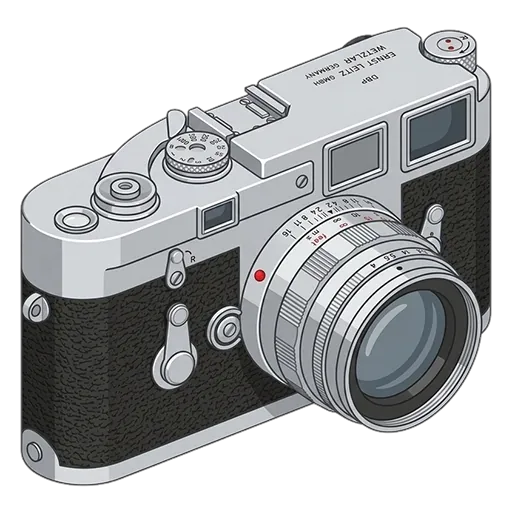
In April 1954, in Cologne, Ernst Leitz GmbH put a new camera on a Photokina table. Seventy years later the company's own anniversary release still calls that camera the first M of 1954 and still does not say Photokina. That omission fits a broader tendency in accounts of the M3: qualifications often disappear as its reputation grows.
Those qualifications matter when catalog copy credits this body with the first bayonet or the first film-advance lever, or presents a judgment of taste as a specification. The prices, serials, and Contax history provide a way to check those claims.
When screw mounts were still in use
By the early 1950s, 35mm photography had become a medium of movement. Reporters and street photographers wanted a camera that followed the body. Leica already stood for compact precision, but its screw mount (M39) required several turns to seat a lens before the photographer could return to framing. A small camera also needed quicker, simpler operations.
Competitors had already supplied parts of the answer. The Contax I used a bayonet in 1932. The Contax II combined a rangefinder with its viewfinder in 1936. Calling the M3 the first of everything makes tidy mythology and poor history. What was new in Wetzlar was Leica's first M — not photography's first bayonet, and not the world's first combined finder.

Rama · Wikimedia Commons · CC BY-SA 2.0 fr · Rama · CC BY-SA 2.0 fr

The top plate in that photograph provides a clear identification. Serial 1032196 sits in an M3 block. The rewind is still a knob. There is no red dot. Later M cameras would have a crank and a logo; this one has neither. Counting the windows helps identify the model amid those broader accounts.
A father, and the rest of the names
The name that keeps returning as the central designer is Willi Stein. Leica Society International calls him the father of the M3 and the owner of serial 700001. The CameraQuest table, built from factory figures Horst Braun supplied with Leica approval, assigns that number on 1 January 1954. That the first body sat with the chief designer is a fact. That does not establish that he invented the camera alone.
Ludwig Leitz appears on patents for the shutter and the unused-frame masks. The bayonet work is associated with Hugo Wehrenfennig. These names point to contributions across a workshop, rather than a camera invented by a single designer.
LSI's variations essay dates the start of production, kept quiet before the public announcement, to late 1953. The public debut is Photokina the following April. The production start and public debut are separate dates; they should not be collapsed into a single year of invention.
Leica's first bayonet, not the world's

Hannes Grobe · Wikimedia Commons · CC BY 3.0 · Hannes Grobe · CC BY 3.0

The M3 is the first Leica body to lock a lens on the M bayonet instead of winding it through an M39 screw. Mounting the lens also selects the finder frame. Adapters allowed continued use of old screw lenses, and the older bodies also remained available. The IIIg carried M39 in parallel from 1957 to 1960.
The earlier Contax I, from 1932, is worth recalling when the bayonet is described as the industry's first. What Leica did was move its own lens family onto a new lock, and make that lock choose a frame. The persistent claim that it was the industry's first obscures that distinction.
0.91×, and no native 35mm
The catalog and Wikipedia agree on a magnification of 0.91× for the combined rangefinder-viewfinder. Other pages read 0.90× or 0.92×; Amateur Photographer called the finder 90 percent life-size. The sources reviewed here do not establish a single official magnification. The built-in bright frames are 50, 90 and 135mm. The 50mm lines stay visible. There is no 35mm frame.
A 35mm lens needs a shoe finder, or goggles — spectacles on a 35mm Summicron, Summaron or Summilux that shrink the 50mm-oriented window to a 35mm field. The high-magnification finder favored 50mm at the expense of a native 35mm view, which required those additional optics.

Sebastian Stabinger · Wikimedia Commons · CC BY 3.0 · Sebastian Stabinger · CC BY 3.0

The photograph does not hide the compromise. Optics sit over the three windows. A Canadian 35mm Summilux, serial 2060640, is on the mount. The rewind knob and self-timer remain. The bulky attachment shows the compromise required to retain the finder optimized for 50mm.
Not 1957: serial 919251
Early M3 bodies advanced one frame with two short lever strokes. The double-stroke reduced strain on the mechanism, though it added a motion for anyone in a hurry. That difference matters when comparing how early and late M3s feel in use.
Factory serials do not date the change to 1957. They date it to 26 March 1958, serial 919251, when single-stroke advance and a rangefinder depth-of-field notch enter the line. The often-repeated 1957 date is generally incorrect. LSI's 2019 homage put the cut at 1957 and 915251; the Braun table disagrees, and the table is the one to keep.
The change did not take place all at once. Some 1957 ELC and black batches, and a Canadian ELC run of April 1958 (924401–924500), stayed double-stroke. The factory also converted DS bodies to SS. Serial 919251 marks the mainstream change; these exceptions do not establish a different year.

Rama · Wikimedia Commons · CC BY-SA 2.0 fr · Rama · CC BY-SA 2.0 fr

From this angle the top plate is shorter still. Speeds run from 1 second to 1/1000. The rewind is a knob. The flange is a bayonet. It is the same 1032196 already shown from above. The two photographs show one camera from different angles.
Photokina, and what $348 actually bought
The public debut is Photokina, Cologne, April 1954. Issue 02.1954 of Leica Fotografie, a magazine associated with Leitz, covered both the fair and the M3. It is a valuable launch-year record, though it does not represent independent consensus. In 1954, as today, a company-associated magazine introduced that company's products.
The American figure that survives in catalogs — $348 — is not a body-only price. In the code tables it matches IMARO: the M3 plus a 50mm f/3.5 Elmar. A body alone ran about $288. A collapsible Summicron outfit ran about $447. Quoting $348 as the body-only price leaves the included lens out of the account.
In Britain the camera was listed at £185 with a collapsible 50mm f/2 Summicron. A Deutsche Mark launch price did not turn up in this pass and is left blank. An unsupported figure would risk the same error as quoting $348 without identifying the outfit.
None of those kits was a cheap snapshot camera. Buyers were paying for a mount, a finder, and a lens family, in dollars or in sterling, at a fair in Cologne. Later promotion would emphasize prestige. The 1954 prices describe the more concrete choices: an Elmar outfit, a Summicron outfit, and a body price that is not the one most tables repeat.
Official Leica Camera USA. Wetzlar building the M system and its lenses. Not a 1954 M3 product film — an official film of the lineage.
The official channel shows continued production of the mount in Wetzlar rather than the original Photokina hall. Like the 2024 press release, it emphasizes the continuing lineage rather than the fair in 1954; no M3-only seventieth-anniversary film was found in this review.
A large view at 50mm, goggles at 35mm
The 0.91× window is especially large at 50mm, and mounting 90mm or 135mm lenses automatically selects their frames. Attaching the lens also establishes the framing. The speed a rangefinder can offer a practiced photographer usually comes from that connection.
The compromise appears at 35mm: without a native frame, it needs a shoe finder or goggles that shrink the view. Concentration on the standard lens gives the camera its clarity while limiting its suitability for wider views. That limitation follows from a design priority, but remains a practical drawback.
Calling it the greatest film camera ever is marketing or a judgment of taste, not a factual specification. That praise should still account for the goggles and the limitation they address.

Aconcagua · Wikimedia Commons · CC BY-SA 3.0 · Aconcagua · CC BY-SA 3.0

The 1963 body in Berlin's German Museum of Technology is a reminder that production was not a single Photokina season. The top plate carries Ernst Leitz GmbH Wetzlar, the Leica script, and serial 1079079. Reflections and modest image resolution limit the photograph, but the serial number remains useful. If the serial sits inside an M3 block, the body is an M3.
Cartier-Bresson came later
Henri Cartier-Bresson's canonical work of the 1930s through the early 1950s was shot on screw-mount Leicas — I, II, III, IIIf. Later accounts conveniently conflate his decisive-moment photography with the M3. That does not enhance the M3's achievement; it obscures the bodies that preceded it.
That is not the same as saying he never picked up an M3. He did, later: a black-paint body in 1960, a portrait by Ara Güler in 1964. Those later uses do not establish it as the camera behind his early work. Do not caption the M3 as Cartier-Bresson's camera. Identify it as a camera he used later, after making the photographs that established his reputation.
American money, British sterling, no invented mark
The available sources support the U.S. list prices: about $288 for the body, $348 for the Elmar 50/3.5 outfit that matches the catalog line, about $447 for the collapsible Summicron kit. Britain published £185 with the Summicron. Those are Photokina-era numbers in the currencies the English-speaking ads actually used.
A Deutsche Mark launch price remains unfound. As with the dollar and sterling figures, a price needs its accompanying qualifications to describe what buyers actually received.
A serial-table count, not a 2024 press figure
Leica Camera AG's 24 October 2024 seventieth-anniversary release does not publish a unit count. Add the serial tables and the range is about 220,000 to 233,000. LSI's origin story has more than 226,000 by 1966. The variations essay sums 233,209 assigned numbers, including 272 post-office bodies in 24×27mm. The catalog's conservative public figure is more than 220,000 by 1967. These figures reflect a consensus from lists, rather than a number published by Leica AG in 2024.
Dating the end of production to 1966 leaves later bodies unaccounted for. CameraQuest still lists 20 chrome bodies on 2 February 1967 (1164846–1164865) and 38 olive on 30 July 1968. Uncertainty over the end date does not undermine the six-figure total, but that total still lacks official confirmation in the 2024 release.
In 2024 Leica marked seventy years of the M system and wrote that the line is still running. The release presents the system as iconic; that promotional description should not be treated as independent judgment. The enduring feature is the short action that links locking a lens to automatic frame selection, rather than the claim to have been first.
Official Leica Camera AG. A Leica I centenary conversation that takes in the M system. No M3-only seventieth-anniversary film turned up this pass.
Photokina, Cologne, April 1954. The 2024 Leica release still omits the fair.
The M bayonet is Leica's first, not the industry's — Contax I, 1932.
Combined finder 0.91×; frames 50, 90 and 135mm only; 35mm takes goggles.
Factory serials put single-stroke at 919251 on 26 March 1958, not 1957.
$348 is the IMARO body-plus-Elmar 50/3.5 outfit; about 220,000–233,000 is a serial-table consensus, not a 2024 Leica AG figure.
First M camera is a sentence Leica still prints. First bayonet is a sentence it does not have to.
The M3's claim is not that it invented the bayonet. Contax used one in 1932, and a combined rangefinder-viewfinder was not a Leica monopoly either. Wetzlar linked lens mounting to the selection of a 50, 90 or 135mm frame inside one 0.91× window. That arrangement remained in production long enough for serial tables to account for roughly 220,000–233,000 bodies. $348 bought an Elmar outfit, rather than the body alone. Cartier-Bresson's work in the 1930s used screw-mount cameras. Calling it the greatest film camera expresses a preference rather than a specification.
Sources
- 70 years of Leica M — Leica Camera AG press release, 24 Oct 2024
- Leica Time Travel Through a Century: 1954
- Leica Serial Numbers: M and R Sorted by Number (Horst Braun / Leica)
- LFI 02.1954: Photokina and the Leica M3
- The Leica M3 Origin Story — LSI (Jason Schneider)
- Leica M3 Variations, 1954 to 1966 — LSI
- Homage to the Immortal Leica M3 — LSI
- Leica M3 — Summichronica (codes and US prices)
- Leica M3: Blast from the Past — Amateur Photographer