Game Boy vs Game Gear — Time or Color
Color LCDs already existed. Nintendo declined them in 1989; Sega chose a color screen powered by six AAs. Tetris was packed in for America, not for Japan. Battery-life estimates and the hundred-million sales figure also need their source context.
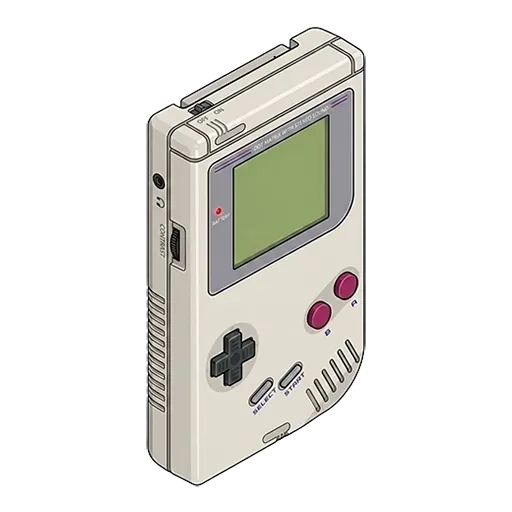
On July 31, 1989, Nintendo put a gray brick on American shelves at $89.95, Tetris in the box. Japan had shipped the same machine on April 21 without a pack-in. The unlit 160×144 STN screen displayed four shades of gray, and the handheld ran on four AA cells. Color LCDs already existed. Gunpei Yokoi had decided not to use them.
Sega's reply reached the United States in April 1991 at $149.99: a 3.2-inch backlit color display, six AAs — not C cells — and an optional tuner that turned the handheld into a pocket analog TV. The color screen had an obvious advantage in a store, while a trip made battery life more pressing.
July 31, 1989, $89.95

Evan-Amos · Wikimedia Commons · Public domain · Evan-Amos · Public domain

The National Museum of American History describes it as a 1989 handheld that combined NES-style cartridges with Game & Watch portability. Instead of one electronic toy built around one fixed game, it offered a living-room cartridge format small enough to run on four AAs. Nintendo's own hardware page gives April 21 as the Japanese launch date. Smithsonian Magazine gives July 31 as the American launch date in its account drawing on the museum's perspective. Don Coyner, who worked in Nintendo of America marketing, recalled the $89.95 price.
Coyner's brief was portability, head-to-head play, and strong games. He recalled a $20 million television campaign and the difficulty of filming the unlit screen. He also recalled that Nintendo built a million Game Boys for the United States in 1989 and sold every one. For that brief, portability mattered more than a futuristic appearance.
Color existed
Yokoi did not ship monochrome because color was impossible. In a 1997 interview with Yukihito Morikawa he said it flatly: "The technology was there to do color. But I wanted us to do black and white anyway." He put battery life first and designed hardware with the software in mind. "Hardware design isn't about making the most powerful thing you can."
In the same interview, he compared the choice to drawing a snowman on a blackboard, where white chalk is enough. His response to news of a color rival was brief: "He told me it was color, and I reassured him, 'Then we're fine.'" He regarded a color screen as an expense for the other company. The famous slogan about lateral thinking with withered technology is not a line from that interview. It is a phrase from the book Yokoi Gunpei Game House. Attributing it to 1997 conflates two documents.
Backlit color for ¥19,800

Evan-Amos · Wikimedia Commons · Public domain · Evan-Amos · Public domain

Hideki Sato took the opposite position: they could not go back to black and white. In his Hitotsubashi IIR oral history the color LCD itself ran ¥4,500 to ¥4,600; Citizen supplied the backlight and light guide. According to Sato, ¥19,800 was not a profitable price for Game Gear; the early Game Boy cost ¥12,500.
Sega's hardware encyclopedia lists a Japanese launch on October 6, 1990 at ¥19,800. It specifies a 3.2-inch backlit color LCD that displayed thirty-two of 4,096 colors in games, and a Z80A running at 3.58 MHz. Six AA alkalines provided about three to four hours of use; it did not take six C cells. The black landscape body had a blue START button. With both machines on in a showroom, the screen's appeal was clear.
The same 160×144
Both game screens are 160×144, but their lighting differs. Game Boy's unlit four-shade STN holds up in daylight and needs a lamp in a dark room. Game Gear's backlight lets it work in the dark. A resolution table alone misses this expensive difference.
Bob Strauss, writing a buying guide for Entertainment Weekly on November 22, 1991, had already put that on paper. Game Boy was "the most popular and compact of the four major portable systems" with an enormous library — "but as the software designed for it gets more complex, the inadequacies of its small black-and-white screen become glaringly apparent." Grade: B-. Game Gear combined "color; a generous screen with good resolution; a reasonable price; and comfortable handling over long stretches of play time." The drawback was a still-small library. Grade: A. His reservation concerned the catalog, rather than the hardware concept.
Four AAs, six AAs
Sources give different figures for Game Boy's run time. Nintendo UK currently says about 15 hours. Smithsonian, citing NMAH curator Drew Robarge, says four AAs at 10 to 14 hours. A later rewrite of Nintendo's Japanese DMG-01 page says about 35 hours on alkaline. The familiar 15-to-30-hour range combines these differing estimates. Nintendo UK lists a weight of about 300 grams with batteries and dimensions of 90×148×32 mm.

Evan-Amos · Wikimedia Commons · Public domain · Evan-Amos · Public domain

The board contradicts the claim that it used a Hudson chip. The large chip is DMG-CPU B, ©1989 Nintendo JAPAN. The crystal reads 4.194304 MHz. The SRAM is Sharp LH5164N-10L. A Nintendo/Sharp custom, not a Hudson part from the PC Engine. The NMAH card's "8-bit Z80 processor" describes the family, rather than a Zilog part number.

Evan-Amos · Wikimedia Commons · Public domain · Evan-Amos · Public domain

Game Gear's battery-life estimates vary less. Sega's page: six AAs, about three to four hours. Sato: about three, about two in the cold. The LCD module still sitting on the board shows the hardware behind that power demand. Needing spare cells for a trip made portability different from being able to use a handheld for days without thinking about batteries.
Tetris in the American box
A North American launch spot: Tetris pack-in, a Game Link, portable play. Not an official Nintendo channel — a fan reupload of a 1989 broadcast.
North American Game Boys packed in Tetris. Japan launched without a pack-in. Henk Rogers's pitch to Minoru Arakawa survives in a 2019 Polygon interview: "If you want little boys to buy your Game Boy, then include Mario. But if you want everyone to buy your Game Boy, then include Tetris." Super Mario Land for boys; Tetris for everybody. The NMAH statement that all original Game Boys bundled Tetris overgeneralizes from the American kit.
Game Gear arrived in the United States in April 1991 at $149.99. No manufacturer PDF in this review establishes the exact day; by November, Entertainment Weekly was already treating it as a machine you could buy. It cost sixty dollars more than the Game Boy, with a color screen that made the difference immediately visible and a requirement for six AAs. American buyers faced that pair of prices: Tetris at $89.95 against a backlit color handheld at $149.99.
A converter and a pocket TV

Evan-Amos · Wikimedia Commons · Public domain · Evan-Amos · Public domain

Game Gear was a cartridge machine too. Sato said that overseas, a converter was sold which allowed it to play Master System games — access to software Sega already had. That differed from a large, continuing supply of Game Gear-only releases. It is why Strauss, in 1991, could grade the hardware an A and still flag the library.
Television provided another use. Sega's own page says an optional TV tuner pack turned the handheld into a portable TV. The cartridge in the photograph is labeled SEGA GAME GEAR TV TUNER, with a UHF/VHF scale and a telescoping antenna. Analog NTSC/PAL. After the digital transition, the tuner could no longer receive those broadcasts. The tuner shows that the color screen served uses beyond games, though that additional use soon became obsolete.
118.69 million is a family
Write the sales story as 118 million against ten and you are no longer comparing 1989 with 1990. That comparison includes Nintendo's later years as well. Nintendo's IR unit table lists Game Boy hardware at 118.69 million lifetime — Japan 32.47, the Americas 44.06, other regions 42.16. The columns run through the Game Boy Color years. The 2006 annual report records the 100 millionth unit in 2000, and 118.7 million by March 31, 2006. That figure covers the family, including Color, rather than DMG-01 alone or just the years of the original rivalry.
Sato provides the Game Gear total closest to a primary source. In a 1998 interview he put it at about 14 million systems, counting the overseas converter and domestic sales. An interview, not an audited Sega filing. The frequently cited 10.62 million figure does not have the same level of source support. A 1994 holiday claim of 53 percent dollar share of handhelds is Sega PR, via Business Wire. The account that nobody bought it is misleading, as is using 118.69 million to compare the original 1989 and 1990 machines.
The winner lasted; the future screen was color
Official Nintendo of America channel. The 2024 Nintendo Museum at Uji Ogura, Kyoto. Not a 1989 commercial.
Nintendo followed with Game Boy Pocket on July 21, 1996, and Game Boy Color on October 21, 1998. Neither is the 1989 DMG. That is why Color years sit inside the 118.69 million, and why Pocket and Color photographs do not belong in this rivalry. In 2024 Nintendo opened a museum on the old Uji Ogura plant site in Kyoto. The official Direct is a tour of that building. It is not the 1989 Tetris spot.
Game Boy did not win because monochrome was beautiful. It won on price, batteries, Tetris in the American box, and a cartridge catalog that kept accumulating. Game Gear's weakness was not that color was a bad idea. In 1990, battery consumption and panel cost still made that idea expensive. The market winner was Game Boy. The screen later handhelds treated as default looked like Game Gear's. That account holds provided 118.69 million is not used as the sales figure for the original contest.
Game Boy DMG-01: Japan April 21, 1989; North America July 31 at $89.95; four AAs; 160×144 four-shade unlit STN; DMG-CPU B at 4.194304 MHz on the board. Tetris packed in for North America, not for Japan.
Yokoi's 1997 interview is the source for color-as-choice: the technology was there; he wanted black and white. The withered-technology slogan is from the book Yokoi Gunpei Game House, not from that interview.
Game Gear: Japan October 6, 1990 at ¥19,800; United States April 1991 at $149.99; six AAs, not C cells; 3.2-inch backlit color; Z80A; Master System adapter and analog TV Tuner; about three to four hours on Sega's page.
Sources give a range of estimates for Game Boy battery life: Nintendo UK about 15 hours, Smithsonian 10–14, later nintendo.jp about 35 on alkaline. A single 15–30 hour figure combines those differing estimates.
Nintendo's 118.69 million is the Game Boy family, including Color. Sato's estimate of about 14 million for Game Gear comes from a 1998 interview that includes the converter, rather than a Sega filing.
"He told me it was color, and I reassured him, 'Then we're fine.'" — Gunpei Yokoi, 1997 interview with Yukihito Morikawa
The contest involved more than a direct comparison of monochrome and color. Yokoi declined a color panel that already existed; Sega offered the screen Nintendo would not ship for ¥19,800, requiring six AAs. Tetris was packed in for North America, not for Japan. Nintendo's 118.69 million is the Game Boy family, including Color, not DMG-01 alone. Hideki Sato's "about 14 million" comes from an interview that includes a converter in its account, rather than a Sega filing. Battery-life estimates also vary by source.
Sources
- ゲームボーイ(DMG-01)ハードウェア紹介
- Game Boy | Hardware | Nintendo UK
- 連結販売実績数量の推移 (Historical dedicated hardware units)
- Nintendo Annual Report 2006
- ゲームギア|セガ SEGA ハード大百科
- Hideki Sato oral history (Hitotsubashi IIR)
- Gunpei Yokoi × Yukihito Morikawa – 1997 Interview
- Thirty Years Ago, Game Boy Changed the Way America Played Video Games
- Game Boy | National Museum of American History
- How Nintendo introduced the Game Boy, Tetris, and Pokémon to the West
- Video game consoles — A guide to the video game systems currently available
- Requiem for a Game Gear
- 게임기 할인 판매 (매일경제 1991-08-10)
- A History of Korean Gaming — Licensed consoles appendix
- 애증의 휴대게임기! 세가 게임기어(핸디겜보이)를 추억해보자
- Nintendo Museum | Nintendo (Uji Ogura, Kyoto)