The Brick Phone — Motorola DynaTAC 8000X
790 grams, thirty minutes of talk time, $3,995. Four decades on, the DynaTAC 8000X's spec sheet still holds up. Accounts differ on the details around it — the wording of the first call, the phone that actually opened Chicago's network, the date it went on sale, even where the nickname came from. The brick was real, but its legends need a second look.
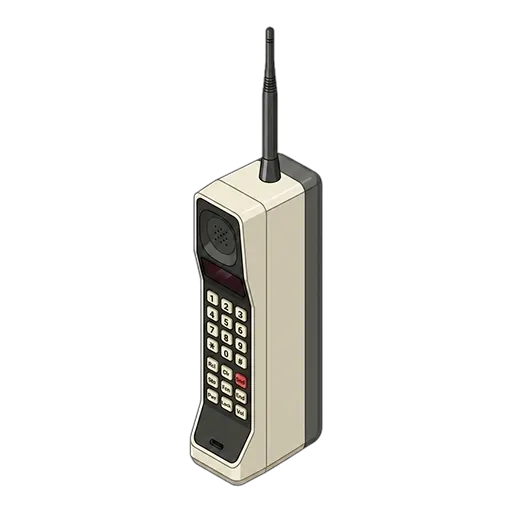
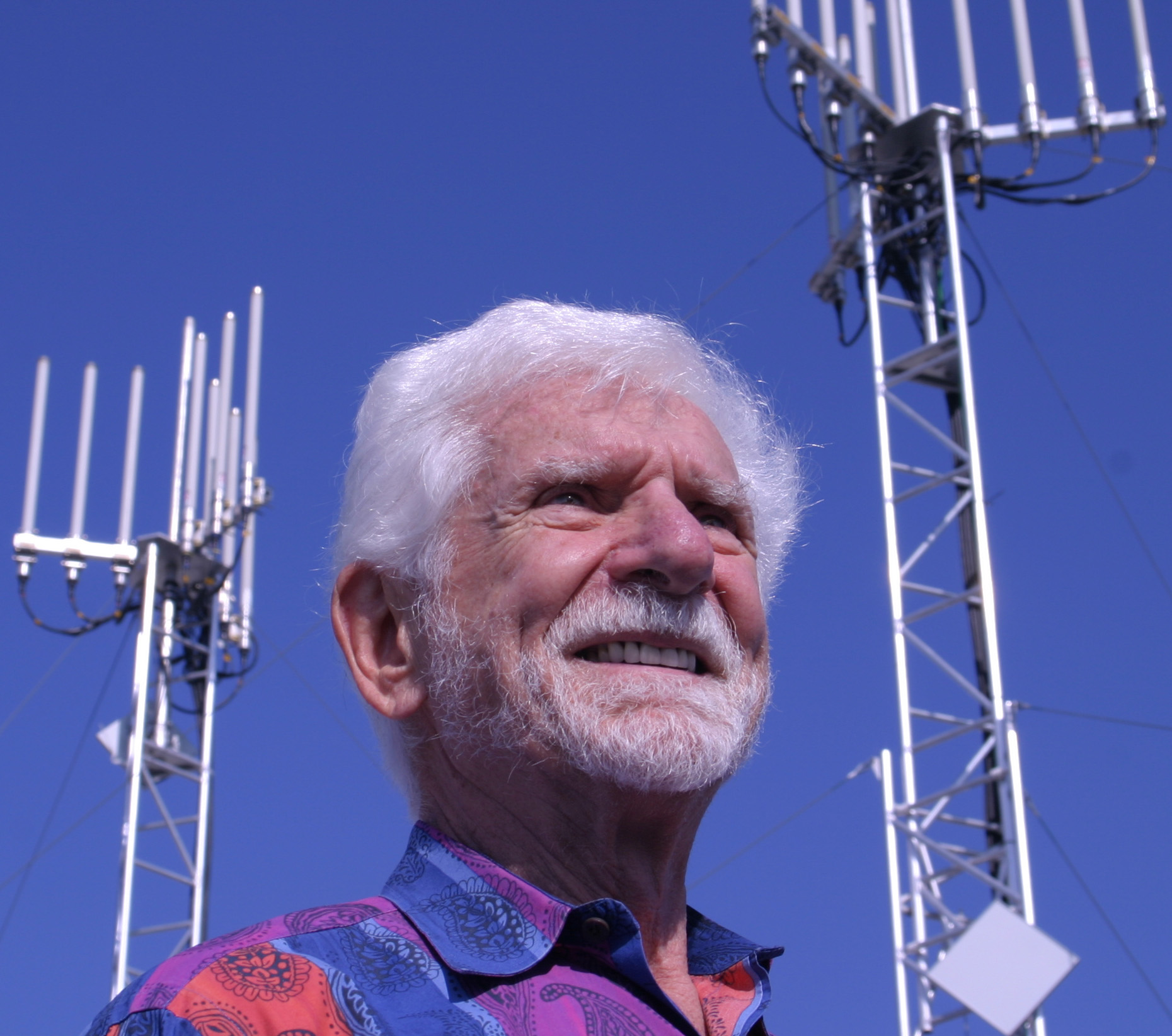
On April 3, 1973, a man stood on a New York sidewalk with a white slab the size of a brick pressed against his ear. He was Martin Cooper of Motorola. The man on the other end was Joel Engel, from the rival camp. The content of the call was essentially the object itself: what I am holding is not a telephone bolted into a car but a genuine handheld cellular phone. Cooper placed several more calls that day, and he is said to have described one of them — crossing a New York street while talking to a radio reporter — as probably one of the most dangerous things he has ever done.
His exact words remain disputed. The BBC ran it in 2003 as “Joel, I'm calling you from a real cellular telephone. A portable handheld telephone.” Twenty years later Cooper told NPR the line was “I'm calling you from a cellphone but a real cellphone — the personal, handheld, portable cellphone,” and added, “You notice I was not averse to rubbing his nose in our achievement.” Wikipedia carries a third wording. Each account conveys the same meaning in different words.
That is the pattern around the DynaTAC 8000X. Four decades on, the hardware record is more consistent than the eyewitness accounts. Which phone opened Chicago's network, when the thing first reached a store shelf, how many years and dollars went into it, what Gordon Gekko was holding on that beach, where the nickname came from — check them one at a time and every one has drifted somewhere. This piece re-checks those accounts against the hardware record.
When a Phone Number Belonged to a Place
Into the early 1970s, a mobile phone was effectively a car accessory. The radio gear lived in the trunk, the antenna went on the roof, and the power came off the vehicle battery. A number belonged to a place — a house, an office, at best an automobile. Anyone walking, standing, or waiting for an elevator was simply unreachable. Cooper's 1973 call also needed infrastructure: by one account, the signal went through a base station on the roof of the Burlington House and then out onto AT&T's landline network.
The industry consensus did not stray far from the car, either. The same account holds that Bell Labs carried AMPS standards work from 1968 to 1983 while handset design and manufacturing fell to Motorola and others — a clean division of labor. It also describes Chicago trials of roughly 100 units in 1977 and 1978, followed by a paid service test with about 2,000 users. Cooperation at the standards level and rivalry at the personal level ran side by side; some accounts note that AMPS came out of Bell Labs first and was then revised jointly with Motorola.
Cooper was working from a different premise. In a 2003 BBC interview he said, “We believed people didn't want to talk to cars and that people wanted to talk to other people,” describing a number attached not to a place, not to a desk, not to a home, but to a person. Motorola's own heritage page quotes him more practically: “When you park your car and leave, you can't use your mobile but you can take your portable with you.” That distinction eventually justified a decade of spending.

Rico Shen · Wikimedia Commons · CC BY-SA 3.0

Six Weeks — or Maybe Thirteen
Motorola's heritage page describes the initial deadline this way: “A three-dimensional model needed to be built within days in order to have a working prototype for the FCC meeting in six weeks.” In that sentence, six weeks refers to the time until a meeting, rather than the duration of development. The deadline came first; development had to follow. Later accounts turned that sequence into the legend that Motorola built the first cellphone in six weeks, treating the deadline as the time the work took.
Industrial designer Rudy Krolopp told CNN in March 2003, “Because initially, we were given only six weeks,” and later in the same transcript the line “And in six weeks, we had a working unit” appears as well. He described the internal unveiling as the moment “I ripped the cloth off the top of the model and everybody's jaw dropped down.” He also recalled Cooper telling the room that anyone who did not believe the deadline could leave — and nobody moved.
Other records of the same weeks disagree. Reuters and Wired put the build at six to eight weeks. When the Daily Herald gathered the original development team decades later, the headline itself said about thirteen. Later retellings shortened the timeline. The more accurate account is that a six-week deadline existed and the actual work almost certainly ran past it.
The improvised nature of the team is on the record too. An Invention & Technology interview notes that the electronics research department had no mechanical engineers at all, so Krolopp brought in people from elsewhere to help assemble the thing — the world's first handheld cellular phone depended on help from other departments.
Squeezed in a Vise
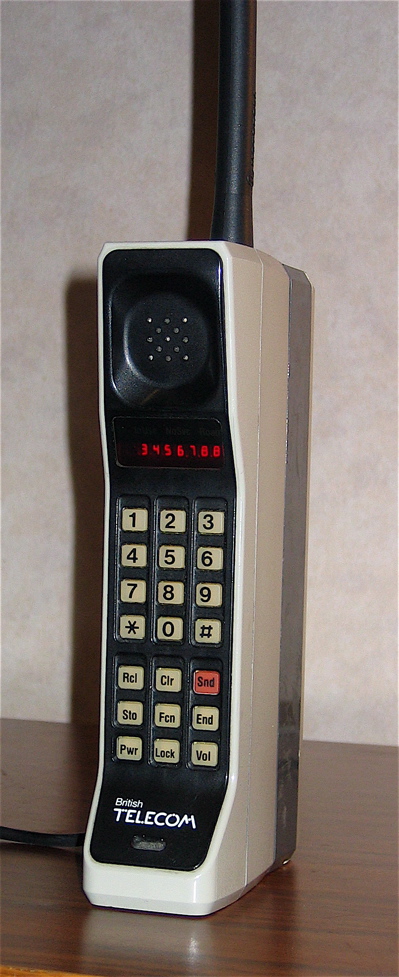
The first constraint Krolopp locked down was the human hand. Width would stay under two inches; if the parts would not fit, the box grew in depth rather than sideways. That is why the DynaTAC ended up long and thick instead of broad. Cooper described the 1973 prototype to NPR in 2023: “It ended up weighing 2 1/2 pounds. It was about 10 inches high, inch and a half wide, 3 inches deep. It was like a brick.” That design constraint helps explain the nickname.
Fitting the electronics into that box was harder. By Bill Dumke's account, Jim Durante assembled the local oscillator circuitry in three dimensions and then compressed it in a vise to make it fit; when something shorted, he pried the wires apart with a probe and tweezers and squeezed it again, repeating the routine in all three directions. Antennas were no better. Don Linder said of the ones Al Davidson built, “He made three or four. They were all supposed to work the same, but they didn't. I picked the one that worked best.”
Even the test equipment was handmade. Needing an antenna for a signal generator that could impersonate a base station transmitter, Dumke — a ham radio operator — recalled, “I thought immediately of the ‘Coat Hanger Ground Plane Antenna’ and made one for him out of some tinned buss wire and a coax connector.” Ron Chislak, who handled two integrated circuits out in Phoenix, remembered it more dryly: “Most of the time, I did not make it home for a break... I would work until the sun came up, go home and sleep a couple of hours then go back to work, starting all over again.” His postscript: “if I had been a little more insightful, I would have bought stock, lots and lots of Motorola stock.”
The argument over color is one scene worth correcting. John Mitchell wanted Motorola's usual beige; Krolopp pushed for white. “The last thing we wanted to do was make this look heavy, so we needed a light color” — a line often credited to Mitchell — belongs to Krolopp, the man arguing for the lighter shade. Cooper later summarized the dynamic: “John had opinions about everything and was almost always right, but there were times when guys had to stand their ground.”

Avicente05 · Wikimedia Commons · CC BY-SA 4.0

Ten Years, $100 Million, No Revenue
By Motorola's own records, the FCC granted type acceptance to the DynaTAC 8000X on September 21, 1983 — the origin of the phrase “world's first commercial portable cellular phone.” The company's 1983 annual report is more clerical about it: “the first cellular portable telephone to receive FCC type-acceptance. Shipments will begin in 1984.” Approval came in one year and shipments in the next. That distinction settles which phone was used at the Chicago launch discussed below.
Next to that approval entry sits the phrase “After 10 years and more than a US$100 million investment.” In context it covers the stretch that carried the portable cellular system and its handset to type acceptance. Other sources give a different time span. The Mobile Phone Museum describes the same achievement as fifteen years of work by the engineers under Cooper, Krolopp, and Mitchell. The institutions thus count ten or fifteen years.
Cooper's own accounts also differ. In a 2011 PCMag interview he said Motorola “spent $100 million between 1983 and 1993 developing a product they had no revenues from.” In a 2023 Data Center Dynamics interview he put it at “Between 1969 and 1983, Motorola spent more than $100 million.” The figure is always $100 million; the years it covers slide from a single decade to 1983–1993 to 1969–1983. The repeated number has no agreed time span.
A related claim needs closer scrutiny. The claim that Motorola spent $100 million over twenty years before the business finally turned a profit has circulated for years, but the PCMag interview it cites starts in 1983, not 1973, and says there were no revenues — not that the business became profitable. The trade press greeted approval enthusiastically. Popular Science, in October 1983, called the unit demonstrated in Motorola's offices “an amazing portable telephone small enough to fit into a briefcase or a woman's handbag.”
GS200 · Wikimedia Commons · CC BY-SA 3.0

October 13, 1983: The Race at Soldier Field
Commercial service started in Chicago. Ameritech applied to the FCC in June 1983 to convert its system to commercial operation, covering 2,500 square miles that ran from Lake Forest out to Geneva and Beecher. The FCC signed off on October 6; the network opened exactly one week later, on October 13. The next morning The Washington Post reported that “the nation's first commercial cellular mobile telephone service was launched in Chicago yesterday by Ameritech Mobile Communications Inc.”
The launch ceremony included a footrace. Participants parked in the Soldier Field lot and stood beside their cars while the installers lined up as if for a fifty-yard dash. On the signal, each technician sprinted across the lot, plugged the activation component into the transceiver in the trunk, and only then could the owner place a call. Accounts split on how many cars took part — fourteen in the Chicago Tribune and Forbes, fifteen in the installer's own recollection. A witness remembered a “cold and bitter day with sunshine”; the same story describes a marching band and balloons.
David Meilahn won. His technician, Jeff Benuzzi, told him to wait until every indicator light on the phone had stopped blinking before dialing — press too early and the system could reset. Cubs broadcaster Jack Brickhouse called the race. As it happened, October 13 was also Meilahn's birthday. What he took home afterward was an oversized check for $2,809 covering equipment and installation; he has said, “I think I paid around $3,600 — they were very expensive at the time... they were giving me a free phone for having won the race.” Asked forty years later what he actually said on the historic call, he answered, “I was excited because we won. I can't quite remember what was said.”
Accounts often misidentify the phone used that day. The first commercial call that day is frequently said to have been placed on a DynaTAC. But Meilahn's own fortieth-anniversary interview with WBBM identifies his historic handset as an Oki Model CS-1, and a technician who was on the field remembers a car-mounted Oki unit. It also squares with the annual report line quoted earlier: the 8000X had type acceptance as of September 21 and nothing more. Shipments began the following year. There was no 8000X at Soldier Field to plug in.
Sources also disagree about another call that afternoon. Ameritech president Bob Barnett placed a ceremonial call to a descendant of Alexander Graham Bell in Germany, and the sources cannot agree who that was — WBBM and Forbes say a granddaughter, the Tribune says a grandkid without specifying, and other accounts say a great-grandson. Barnett's own forecasting held up better: on camera in 1983 he declined to predict that cellular would replace the ordinary residential phone service people already had.
What It Actually Cost
The most widely repeated spec sheet reads: 790 grams, about thirty minutes of talk on a charge, roughly ten hours to refill the battery, $3,995 at launch. The Mobile Phone Museum converts that price to about $11,500 in 2023 terms, or £9,300. The handset was not the whole bill, either. Per the Smithsonian's exhibit text, early cellular service ran about $50 a month plus 40 cents per peak minute and 24 cents off-peak. Both the handset and those thirty minutes of calls were expensive.
Contemporary press reports give conflicting specifications and prices. Popular Mechanics, in its August 1984 issue, called the device “the smallest mobile phone in the world” at 28 ounces on page 92, then reported on page 115 that “the company has set its price at $3,145.” That same month, Fortune wrote that “the only walk around cellular phone now available, made by Motorola, costs more than $4,000.” A $3,145 sticker and a figure north of $4,000 ran in the same summer's magazines.
Cooper himself recalled the launch price as $3,500 in 2003, but multiple independent records keep landing in the $3,995–$4,000 band; even a principal's memory drifts after twenty years. Weight is messier still. There is 790 grams and 28 ounces; the Smithsonian's collection record says 2.5 pounds, Britannica says 1.1 kg, and Cooper's 2003 recollection says 16 ounces. That same Smithsonian record notes a rechargeable nickel-cadmium pack that clipped onto the back of the phone — which is to say a large share of the weight you were carrying was the battery.
The frequently cited first-sale date of March 13, 1984 has no primary support either. Mashable, which printed the date, admits in the same article that “we don't know who that first cellphone buyer was,” and a German museum collection page carrying the same date describes a unit made in early July 1984 as production from about two months after sales began — contradicting itself. The one thing firmly established is that retail sales started in 1984. The world's first cellphone has no verified first-sale date.
Redrum0486 · Wikimedia Commons · CC BY-SA 3.0

How a Brick Became a Prop
Start with the nickname. Inside the development team the thing was called the shoe phone — not, as the story usually goes, because it looked like a boot. Bill Dumke, who was there, put it plainly: “A lot of us called the DynaTAC the Shoe Phone after the shoe phone used by Maxwell Smart in the TV comedy, ‘Get Smart.’ What else could we call it? Nobody had ever done this before.” The joke supplied a name for a device that had no established category.
The public settled on brick, but the most symbolic use of the brick happened outside the United States. The Mobile Phone Museum is specific about how the 8000X became a badge of the British yuppie: “individuals with newfound wealth through working in well paid jobs in London.” Some surviving units still wear an early British Telecom badge, offered as physical evidence of rebranded sales through the UK distribution chain.
One movie scene remains unresolved. The phone Gordon Gekko uses on the beach in Wall Street (1987) is popularly identified as a DynaTAC 8000X, but only Mental Floss states the model outright; Retrowow hedges to “8000X or 8000S,” and no production or prop documentation confirms either. The scene did more for this device's image than any advertisement ever did. What is actually in Michael Douglas's hand is still an open question.
Meanwhile, demand for service grew. Roughly 4,000 to 5,000 people applied for service in the first week after launch — applications, not completed activations. Ameritech had 5,000 customers by the end of 1983 and added 3,800 more in the first half of 1984. TIME reported on May 7, 1984 that “Ameritech has been operating its network only since October and has 6,500 customers” — a count that does not sit easily beside Ameritech's own running tally of 5,000 by New Year's and 3,800 more across that first half. Even the subscriber numbers disagree with each other. The same TIME piece carried an Arthur Andersen estimate that seven million cellular telephones could be operating by 1990.
They were not far off. Per CTIA's own timeline, U.S. cellular subscribers went from 340,213 in 1985 to five million in 1990 and past ten million in 1992. One account of the AMPS standard has it that the FCC widened the system from 666 channels to 832 by 1989, as subscriber counts climbed into the millions. The brick, initially affordable to almost nobody, preceded a rise in demand that no one had budgeted for.
After the Brick
The DynaTAC's declared successor, the MicroTAC, is generally dated to April 25, 1989, at an initial price of $2,495 to $3,495 — the smallest and lightest phone of its moment and the product that popularized the flip. Former Motorola CEO George Fisher recalled that “when we did MicroTac, Rudy Krolopp (director of industrial design) held up a very small phone as a model,” and the MicroTAC entry in Icons of Design: The 20th Century credits R. Krolopp, A. Nagele, and L. Soren together. Krolopp thus helped design both the brick and its folding successor.
The program is usually credited to John F. Mitchell, Motorola's lead engineer for mobile communications from 1960. Of the Chicago launch, Bell Labs' Richard H. Frenkiel is quoted as calling it “a real triumph; a great breakthrough” — a notable sentence coming from the camp that had spent a decade on the other side of the argument.
The standard itself outlasted almost everyone's expectations. According to the Mobile Phone Museum, the last commercial DynaTAC call was placed in June 2007, just before Rogers Wireless in Canada shut down its analog network, by a customer recorded as Kosta Tsiriotakis. A phone sold in 1984 was still a working telephone in 2007. That service life invites comparison with the software support window of a current phone.
Car phones were already mobile; the 8000X made the phone number portable with the person. Everything after it, including the slab that replaced it, is a refinement of that one decision. The machine was heavy, expensive, and nearly unusable for a full conversation. Despite those limitations, its central idea proved right.

Umut Çolak · Wikimedia Commons · Public domain

Cooper's April 3, 1973 call has no fixed wording — three accounts, three different sentences
Motorola's own heritage page puts 10 years and more than $100 million behind the September 21, 1983 type acceptance
790 grams, about 30 minutes of talk, roughly 10 hours to charge, $3,995 at launch
The first commercial call at Soldier Field in October 1983 was not made on a DynaTAC
Ameritech counted 5,000 customers by the end of 1983; U.S. cellular passed ten million subscribers in 1992
“I like to say that technology will go from the phone in the car to a phone in the briefcase to finally a phone in your pocket.” — Bob Barnett, president of Ameritech Mobile Communications, CBS Evening News, November 8, 1983
The DynaTAC 8000X was never a good phone, yet it was the first device to prove that a phone number could belong to a person instead of a place. After forty years of retelling, the hardware record is far more reliable than many accounts of its history.
Sources
- Cell Phone Development — Explore Motorola Heritage
- Motorola — DynaTAC 8000X
- 50 years ago, Martin Cooper made the first cell phone call
- They changed the world — in about 13 weeks: From the brick to the RAZR
- First cellular call, 40 years later(Chicago Tribune 원문, Courier-News 재게재)
- Chicagoan has distinction of making first cell phone call
- Phones on the Go, Popular Mechanics 1984년 8월호 115쪽(Google Books 스캔)
- SK텔레콤 40년사
- 이동전화 30년 특집 — 1988년 휴대전화 도입